Type G vs Type L Plugs: Differences & Compatibility
Type G vs Type L plugs are not compatible: an adapter is needed in both directions. Type G is a 3-pin, grounded plug rated 13A at 220-240V, while Type L is a 3-pin, grounded plug rated 10A/16A at 220-240V. The two differ mainly in amperage and pin design, which is what decides compatibility — whether a Type G plug fits a Type L socket, and vice versa. Compare this with can i use a type D adapter with a type E socket.
Swipe to compare
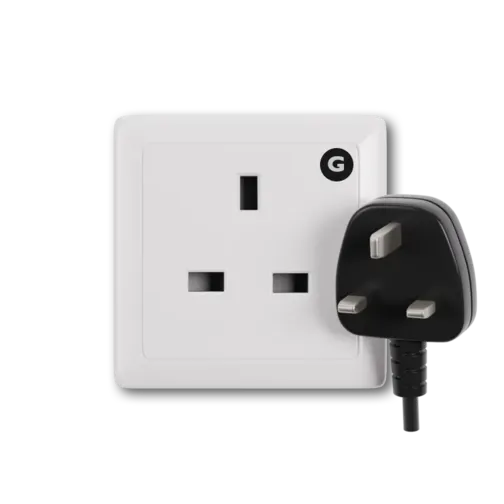
Type G
|
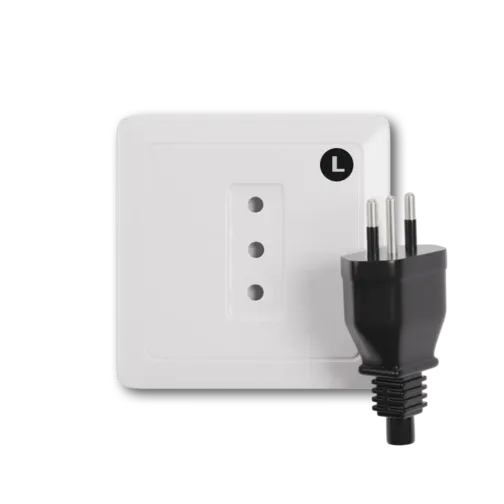
Type L
|
|
|---|---|---|
| Standard | BS 1363 | CEI 23-50 |
| Pin Configuration | Three rectangular pins in triangular pattern (live/neutral 6.35x3.18mm, earth 3.18x7.92mm) | Three round pins in a row (10A: 4mm pins 5.5mm apart / 16A: 5mm pins 8mm apart) |
| Grounding | Grounded | Grounded |
| Pin Count | 3 | 3 |
| Amperage | 13A | 10A/16A |
| Voltage Range | 220-240V | 220-240V |
Flying between London and Milan, or buying a lamp that has to work in both homes? The type G vs type L plug difference is bigger than it looks: the British plug carries three flat blades and its own fuse, while the Italian one lines up three round pins in a row, so neither fits the other's domestic electrical outlet without a plug adapter.
Both sets of power plugs and power sockets share the same voltage and frequency, so you need a shape changer rather than a voltage converter.
Type G vs Type L Plug: The Quick Comparison
Both systems belong to the lettered plug types the IEC lists on its world plugs pages and in IEC 60083. The letters name an outlet style and define no dimension; the drawings come from BS 1363 in Britain and CEI 23-50 in Italy.
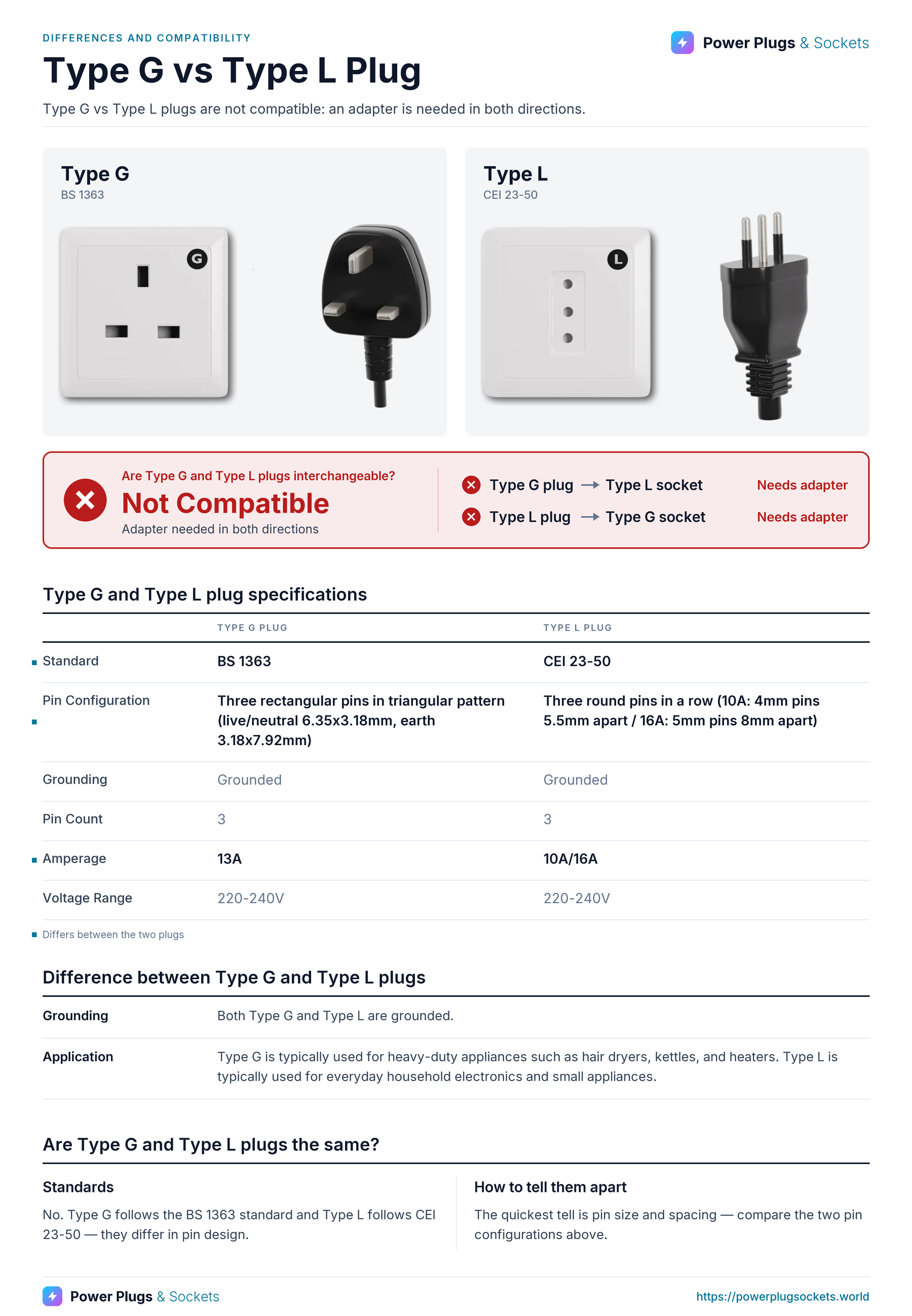
G is a grounded, fused and polarized plug rated 13 A at 250 V, while L is grounded but unfused, with no fixed polarity, in two sizes rated 10 A and 16 A. Mains electricity is 220 – 240 V in nearly all these countries, so the gap is mechanical. These electrical standards are written into national wiring rules, and the Italian design replaced the older CEI 23-16 drawings without changing the layout.
Within Europe, L is something of an outlier next to Schuko and the Europlug.
| Feature | G (BS 1363) | L (Italian standard) |
|---|---|---|
| Outlet style | Three blades in a triangle | Three pins in one straight line |
| Pin shape | Rectangular pins, earth on top | Round pins, earth in the middle |
| Current rating | 13 A | 10 A or 16 A (two sizes) |
| Voltage rating | 250 V | 250 V |
| Grounding | Yes, longer earth blade | Yes, centre earth contact |
| Fused | Yes, cartridge fuse inside the plug | No |
| Polarized | Yes | No, fits either way round |
| Insulated pins | Yes, sleeved live and neutral | Yes |
| Recessed socket | No | No |
| Socket takes a Europlug | No | Yes, the smaller socket |
| Main users | United Kingdom, Ireland, Gulf states, Southeast Asia | Italy, Chile, Uruguay |
How BS 1363 and CEI 23-50 Are Built
The British plug has three flat prongs, rectangular blades in an isosceles triangle (the live and neutral blades are 4 × 6.35 mm and 22.2 mm apart). The longer earth pin on top, 4 × 8 mm, is the circuit protective conductor and opens the internal shutters, so the holes stay blocked without it. You might also want what is the difference between type A and type D electrical sockets.
The built-in fuse is unique: a BS 1362 cartridge fuse, 3-amp for lamps or 13-amp for kettles, protects the flexible cord, not the appliance, from an overload or short circuit, and BS 7671 sets the UK wiring rules behind it. The Italian plug has three prongs set in a row: three round pins in a straight line with live and neutral outside and earth in the middle.
It is symmetrical and unpolarised, so it fits either way up, with no fuse; the breaker in the consumer unit protects it.
The two Italian sizes differ in contact diameter and spacing: the 10 A version has 4 mm pins 19 mm apart for lamps and chargers, matching the Europlug, and the 16 A version has 5 mm pins 26 mm apart for washing machines and heaters. The pin diameter of the larger one will not enter a 10 A outlet, so check which size the wall takes before buying plug type L fittings.
British live and neutral blades are sleeved, and Italian plugs are too, so half-inserted pins cannot cause electric shock. Neither socket is deeply recessed; many Italian sockets add a safety lid that opens only when two pins press together.
The British plug is polarized, with live on the right, so a switch always breaks the live side; the Italian can swap live and neutral, so the earth pin is the only fixed contact.
Which Plug and Socket Combinations Fit Each Other
Nothing crosses between the two systems directly. A British socket takes British plugs only; a 10 A Italian socket is socket compatible with 10 A plugs and the Europlug; a 16 A socket takes only 16 A plugs.
Class II devices with double insulation usually ship with a two-pin Europlug and need no earth.
Most modern Italian walls carry a presa bipasso (CEI 23-50 P17/11) with a round centre hole and two figure 8 outer holes. The larger P40 hybrid socket adds a Schuko recess, so it also accepts CEE 7/4, CEE 7/7 and CEE 7/17 plugs.
A type G outlet takes British plugs and nothing else, since its shutters open only for a full earth blade; a two-pin Euro or Italian plug has no blade to open them. British bathroom shaver sockets are a separate low-power design, so do not count on one for a hair dryer.
Any modern power plug sold for Italy, such as a CEE 7/7 hybrid, goes straight into a P40 but needs an adapter for an older P17/11 socket, and type L plugs are the native fit for both.
A universal socket that claims to take every plug meets no standard, often exposes live pins and cannot guarantee earth, so a proper adapter beats any multi-standard outlet.
Countries Using the British Plug and the Italian Standard
British sockets are found in Europe (the United Kingdom, Ireland, Malta, Cyprus), on the Arabian Peninsula (Saudi Arabia, the United Arab Emirates, Qatar), in Asia (Malaysia, Singapore, Hong Kong) and in Africa (Kenya, Nigeria), mostly at 230 V or 240 V and 50 Hz. The plug type G spread through former British colonies and trading hubs, whereas the Italian plug stayed close to home.
Where Italian Sockets Are Found
The Italian plug is native to Italy, San Marino and Vatican City, and is used in Chile, parts of Uruguay, Libya and Ethiopia, all at 220 – 240 V. In Italy expect a mix of bipasso, Schuko-combination and older single-size sockets.
Picking a Travel Adapter for British and Italian Outlets
When traveling, choose one adapter plug for each direction, matched to your destination. From the UK to Italy, use a British-to-Italian adapter with three pins in a row, or a Europlug-style adapter for a Class II device; all three pins keep a Class I appliance grounded. For a related pairing, see what is the difference between type E and type M electrical sockets.
From Italy to the UK, choose type G adapters with a fuse, 13-amp for heaters or 5-amp for chargers, with a real top earth pin. For safety, never rely on a loose universal fit.
Check that the adapter rating matches your appliance: cheap ones are 10 A at 250 V, fine for a charger but not a 2,000 W hair dryer. For multiple devices, plug a power strip into one adapter, but its rating then covers the whole strip, and Italian rules discourage stacking multisocket adaptors; use extension cords sparingly.
Do You Need a Voltage Converter Too?
Usually not. Laptops, phones and cameras use AC adapters rated 100–240 V at 50 or 60 Hz, so electronics with a dual voltage label only need the shape changed.
Older single-voltage appliances from North America need a step-down transformer.