Type E vs Type M Plugs: Differences & Compatibility
Type E vs Type M plugs are not compatible: an adapter is needed in both directions. Type E is a 2-pin, grounded plug rated 16A at 220-240V, while Type M is a 3-pin, grounded plug rated 15A at 220-240V. The two differ mainly in amperage and pin design, which is what decides compatibility — whether a Type E plug fits a Type M socket, and vice versa. Compare this with do you need a type A to type D plug adapter.
Swipe to compare
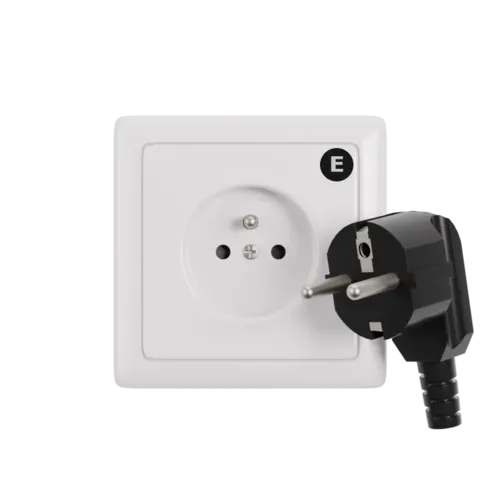
Type E
|
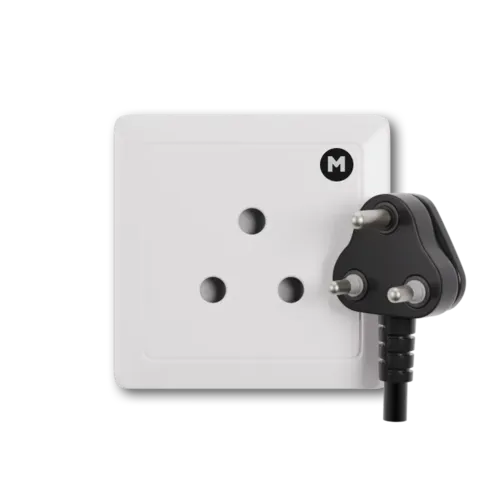
Type M
|
|
|---|---|---|
| Standard | CEE 7/5 | BS 546 (15A) |
| Pin Configuration | Two round pins (4.8mm diameter) plus hole for socket grounding pin | Three large round pins in triangular pattern (earth 8.7mm diameter, live/neutral 7.1mm diameter) |
| Grounding | Grounded | Grounded |
| Pin Count | 2 | 3 |
| Amperage | 16A | 15A |
| Voltage Range | 220-240V | 220-240V |
Packing for Paris and Cape Town? The type E vs type M plug question comes down to one fact: the two systems share nothing physically, so no plug from one fits the sockets of the other.
Type E belongs to Belgium, France, Poland, the Czech Republic and Slovakia, while Type M powers homes across southern Africa. Both run on the same mains electricity (230 V at 50 Hz frequency), so you need only the right plug adapter for each set of power plugs and sockets.
Type E vs Type M Plug at a Glance
The IEC World Plugs letters group designs by rough mechanical fit. Type E is defined by the CEE 7/5 socket and its plug; Type M comes from the British BS 546 standard (1934) and its southern African twin.
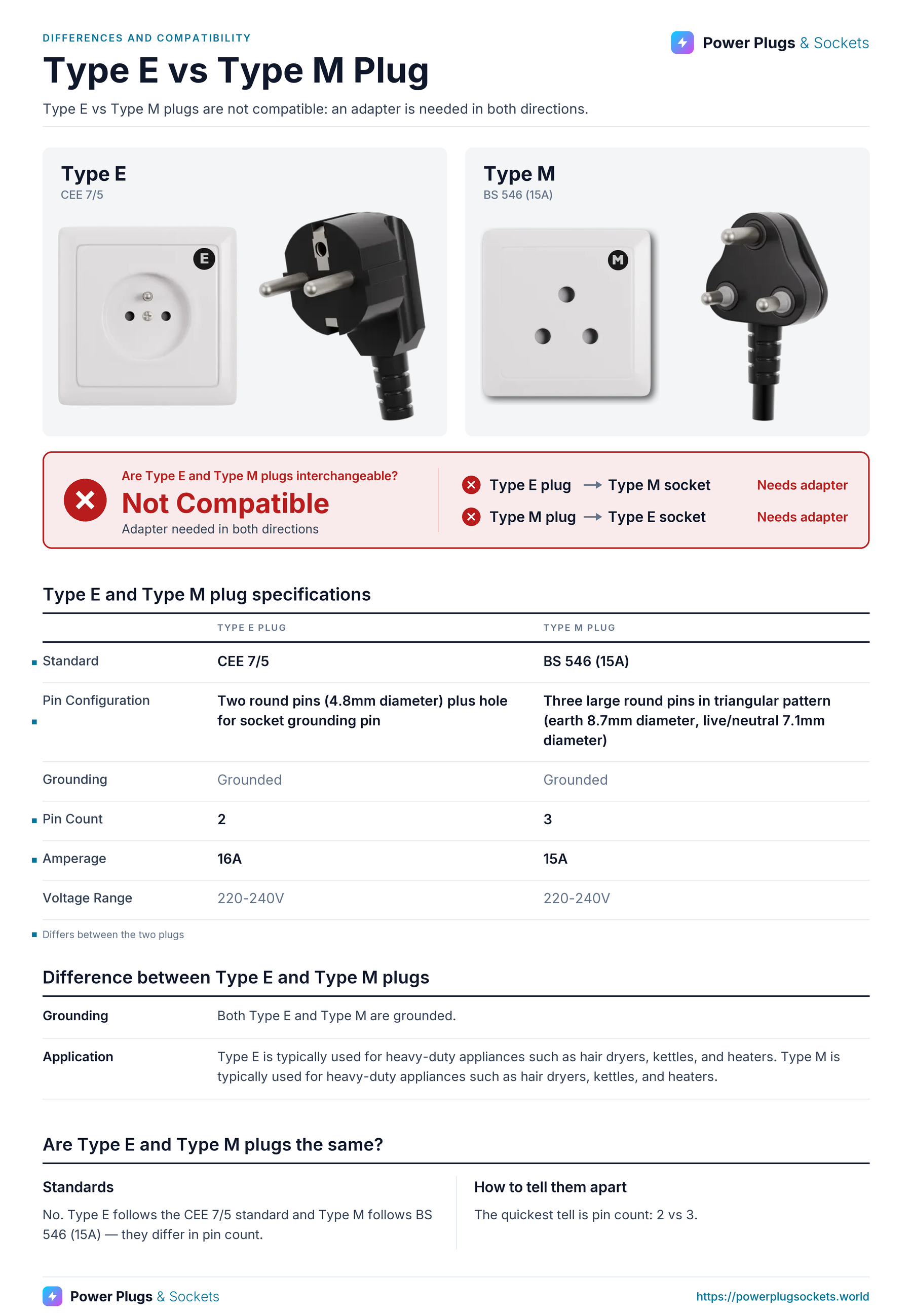
Every pin on both plugs is round, but the sizes are far apart: a type E plug has two round prongs with a pin diameter of 4.8 mm and centres spaced 19 mm apart, while Type M uses larger pins, three prongs with live and neutral pins about 7.05 mm across and an earth pin about 8.7 mm.
| Feature | Type E | Type M |
|---|---|---|
| Defining standard | CEE 7/5 socket, CEE 7/6 plug | SANS 164-1 (15 A British origin) |
| Pins on the plug | 2 round power pins, earth hole | 3 round pins, earth pin on top |
| Earth contact | Pin fixed in the socket | Largest pin on the plug |
| Rated current | 16 A | 15 A (16 A in the South African version) |
| Rated voltage | 250 V | 250 V |
| Typical supply | 220 – 240 V, 50 Hz | 220 – 240 V, 50 Hz |
| Earthed | Yes | Yes |
| Recessed socket | Yes, about 15 mm deep | No, flush face |
| Insulated pins | Not required | Optional |
| Accepts the Europlug | Yes | No |
16 Amps Against 15 A for the Same Wall Socket
Type E is rated at 16 amps and Type M at 15 A, both at 250 V, which is 3,680 W against 3,450 W at 230 V. The gap rarely matters, except for heavy appliances on extension leads, where a multi-way adaptor's own rating, often 10 A, becomes the real ceiling. A 15 A plug is the Type M kind.
How the Type E Socket Works
Each socket is a round recess with two holes and a short metal pin standing up from the face. The CEE 7/6 plug has a female contact between its prongs that slides over that earth pin, which is about 14 mm long and sits 10 mm off the line of the power holes, so grounding engages first. You might also want how does the amperage rating of a type G plug compare to a type L plug.
The design traces back to the Belgian maker Vynckier in the 1920s or 1930s, never patented, unlike the rival German plug from Siemens, so a type E plug spread across Belgium and France, Warsaw, Prague, Bratislava, Tunisia and Morocco. A plug without an earth hole, like the old Schuko, cannot enter.
Type F, Schuko and the CEE 7/7 Hybrid Plug
The type F or Schuko national standard earths through two springy earthing clips instead of a pin. The CEE 7/7 hybrid plug carries both side clips and an earth hole, so one lead is compatible with both, and Type E and Type F are now treated as one family.
The 15 A Type M Plugs Used in South Africa
Type M plugs are the 15 A member of a British round-pin family. In South Africa the plug is defined as SANS 164-1, rated 16 A, and it is the most common domestic outlet.
Pins differ between ratings, so a 5 A plug won't seat in a 15 A socket outlet, a deliberate electrical safety feature.
A Triangle of Pins Borrowed From Type D
Type M is a scaled-up type D: the triangular pattern is identical in shape but not in size, so neither plug is compatible with the other's sockets. In Namibia you see both on the same wall.
South Africa, India and Lesotho Outlets
About 15 countries use Type M, including Lesotho, Eswatini (formerly Swaziland), Botswana, Mozambique and Namibia. In India, Sri Lanka and Nepal it is reserved for larger appliances such as air conditioners and geysers.
SANS 164-2 and the Move to Type N
South Africa is moving to SANS 164-2, a compact design classed as Type N that became preferred in 2013. Type M will remain the standard to plan for, since older sockets stay in service for decades.
Type E Plugs and a Type E Outlet: What Else Fits
The Type E socket accepts its own plug, the hybrid E/F plug, the unearthed CEE 7/17 plug and the flat Europlug; the Type M socket takes only Type M. Nothing from Type M is compatible with Type E, so you need a plug and socket adapter in each direction.
Why the Europlug and Type C Fit Only One Side
The Europlug, known as type C, is a slim two-pin plug rated 2.5 A and 250 V with 4 mm pins, so it slides into Type E sockets. A Type M socket has holes for much thicker pins; only newer SANS 164-2 sockets accept it.
A partially inserted plug can overheat and, in an unrecessed Type M socket, leave live metal exposed, a shock hazard, so if a plug doesn't go in fully, stop and use an adaptor; risking electrocution is never worth it. The Type E grounding pin sticks out of the socket, so plugs without an earth hole sit half-in.
Travel Adapter Choices for Power Outlet Type E and Power Outlet Type M
For power outlet type E, almost any European adaptor works; for power outlet type M, you need a dedicated adaptor with three thick pins. Travellers to both regions carry two, since no single adaptor fits both. Compare this with comparing type B and type F plugs for international travel.
A good travel adapter checklist: check your plugs, buy a Type E/F (CEE 7/7 style) adaptor for Europe and a Type M adaptor for Johannesburg, and check every voltage label.
Why Worldwide Travel Adapters Skip Type M
Most worldwide travel adapters leave out Type M because its pins are too large to fold into a compact body. Look for "Type M" on the packaging, or buy a single-purpose adaptor on arrival.
Plug Adapter or Voltage Converter
An adaptor only changes the plug shape. Since both regions supply 230 V at 50 Hz, a dual voltage device marked 100-240 V needs only an adaptor; a 120 V hair dryer needs a voltage converter.
CEE 7/5 vs BS 546: Which Socket Protects You Better
Type E relies on a recessed socket and an earth pin that connects first; Type M on a large earth pin, switched sockets and, in newer ones, a shutter. Type E scores better for electrical safety on touch protection.
Type M is polarised, fitting one way, while Type E is only partly polarized and a Europlug is unpolarized.
Shutters, Recessed Sockets and Insulated Sleeves
Child-safety shutters are common in new Type E sockets in Belgium and in newer Type M sockets. The recess keeps fingers from the pins, and some southern African plugs add insulated sleeves.
Choose an adaptor with shutters, firm grip and a 250 V, 16 A rating.