Type I vs Type O Plugs: Differences & Compatibility
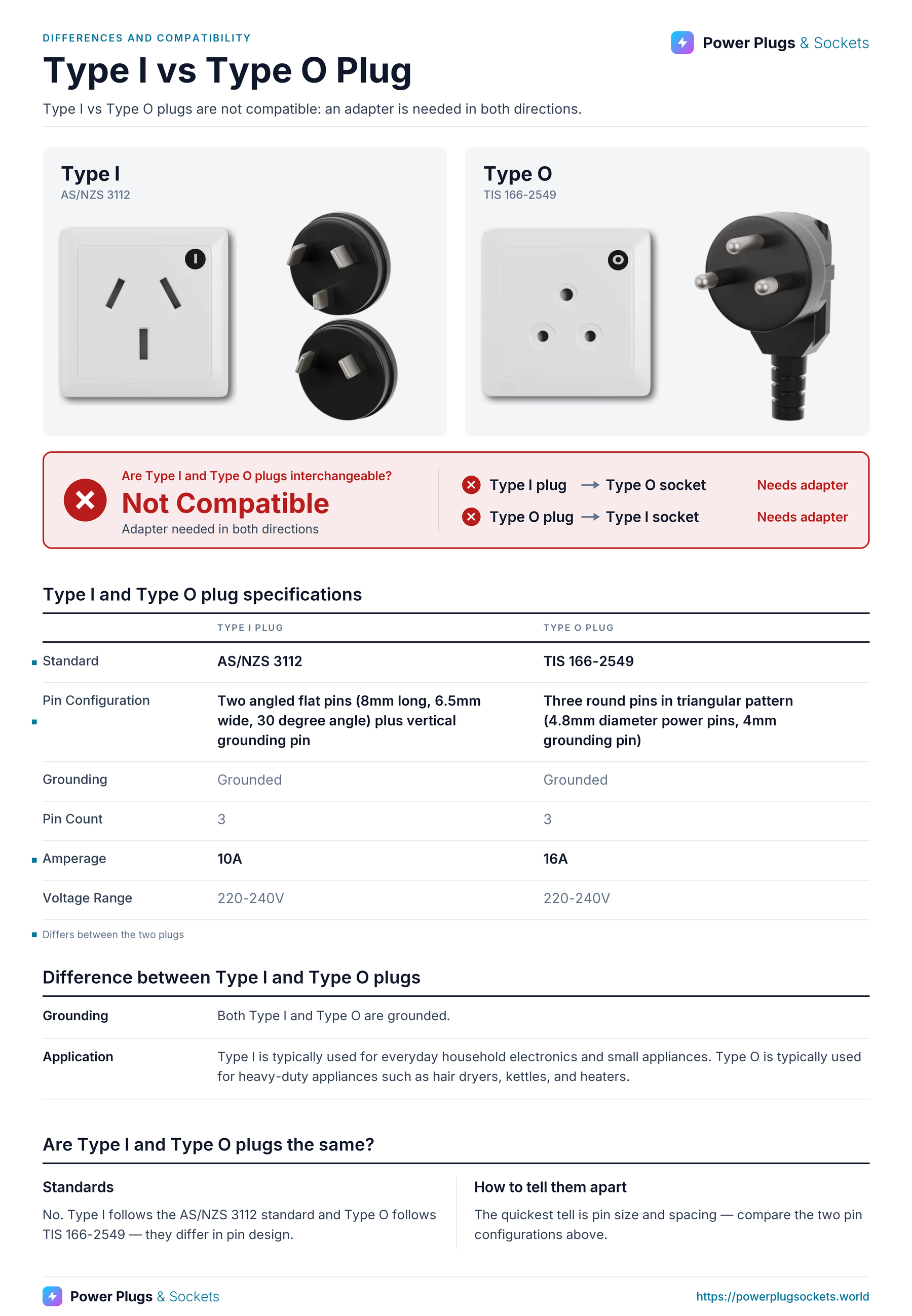
Type I vs Type O plugs are not compatible: an adapter is needed in both directions. Type I is a 3-pin, grounded plug rated 10A at 220-240V, while Type O is a 3-pin, grounded plug rated 16A at 220-240V. The two differ mainly in amperage and pin design, which is what decides compatibility — whether a Type I plug fits a Type O socket, and vice versa. Next, check how do i tell a type A plug apart from a type E plug.
Swipe to compare
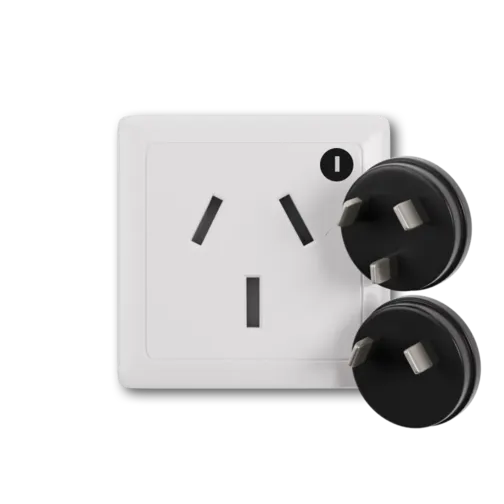
Type I
|
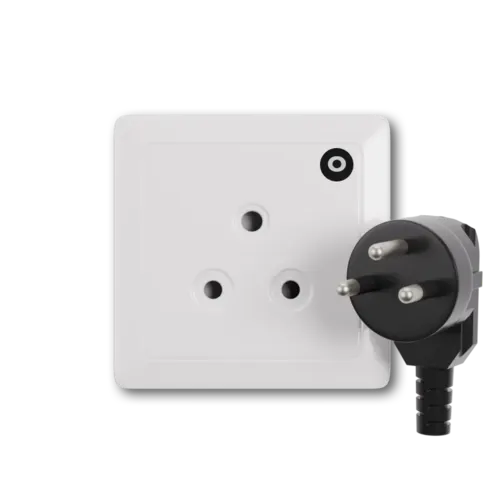
Type O
|
|
|---|---|---|
| Standard | AS/NZS 3112 | TIS 166-2549 |
| Pin Configuration | Two angled flat pins (8mm long, 6.5mm wide, 30 degree angle) plus vertical grounding pin | Three round pins in triangular pattern (4.8mm diameter power pins, 4mm grounding pin) |
| Grounding | Grounded | Grounded |
| Pin Count | 3 | 3 |
| Amperage | 10A | 16A |
| Voltage Range | 220-240V | 220-240V |
Packing a charger for a trip between Sydney and Bangkok? The type I vs type O plug question comes down to one fact: neither plug fits the other's socket, even though both countries run on almost the same mains supply.
The Thai standard uses three cylindrical pins, the Australasian standard uses angled flat blades, so your device needs an adapter rather than a voltage converter.
Type I vs Type O Plug: Side-by-Side Specifications
Both designs are three-pin, earthed plugs and sockets built for 220–240 volt networks, listed in the IEC World Plugs guide, which reuses the letter codes first published by the US Department of Commerce. The real definitions sit in each country's own electrical standards.
| Feature | AS/NZS 3112 plug | Thai TIS 166-2549 plug |
|---|---|---|
| IEC letter | I | O |
| Pin shape | Two flat blades at an angle plus a flat earth blade | Two round power pins plus a round earth pin |
| Earthed version | Yes, grounded | Yes, grounded |
| Two-pin version | Yes, for double-insulated appliances | Yes, a slim plug close to the Europlug |
| Standard household rating | 10 A (15 A, 20 A, 25 A and 32 A variants) | 16 A |
| Supply voltage | 220 – 240 V | 220 – 240 V |
| Frequency | 50 Hz on both | |
| Polarized socket | Yes | Yes |
| Insulated pins | Required in Australia; optional in China and Argentina | Yes, first 10 mm of each power pin |
| Socket accepts the Europlug | No | Yes (hybrid outlet) |
| Main countries | Australia, New Zealand, China, Argentina, Pacific islands | Thai homes, hotels and offices |
In the IEC TR 60083 listing, the voltage and frequency rows are why a phone charger moves between the two systems without trouble; only the pin geometry differs. The amp rating matters for heaters and kettles, where a standard Australian outlet's 10 A sits below the 16 A a Thai outlet is built for.
How the AS/NZS 3112 Plug Is Built
The joint Australian/New Zealand standard defines the Type I plug, the one most people picture as the "Australian plug". It is used across the South Pacific and Oceania in Fiji, Tonga, the Solomon Islands and Papua New Guinea.
Most household appliances ship with the 10 A plug, and a wall outlet usually carries its own on/off switch.
Flat Pins in a V-Shape
The live and neutral contacts are two flat pins set at 30° to the vertical, forming an inverted V-shape, with a flat vertical grounding pin below, slightly longer so it makes contact first. The earth contact is ungrounded in the two-pin form, and no round-pin plug from Europe or Bangkok can be pushed in.
The unearthed two-pin version is the same angled pins without the earth blade.
Amp Rating and the 15 A, 20 A and 32 A Variants
The standard 10 A socket outlet is the everyday version of Type I plugs. Higher ratings use a wider earth pin, so a socket accepts plugs of equal or lesser rating but never a larger one: a 10 A plug fits a 15 A socket, but a 15 A plug will not enter a 10 A socket.
China (GB 1002) and Argentina (IRAM 2073) use the same shape, with a 20 A size in Argentina that also appears in Brazil, but Argentina swaps polarity: with the earth receptacle at the bottom, the live pin is on the right there and the neutral pin on the left, the reverse of Sydney. Insulated pins are optional there, and the outlet type is shared by Class I appliances; no adapter can fix reversed polarity.
Thai Plug Design Under TIS 166-2549
Thailand replaced its older rules, based on NEMA 1-15 and NEMA 5-15, with Thai Industrial Standard 166-2547 and its 2006 revision, written for a 230 V residential power supply of mains electricity. The Type O plug & socket uses cylindrical pins, is rated 16 A in both earthed and two-pin forms, and has polarized sockets.
It resembles the Israeli SI32 plug used in Israel, but the layout differs and they cannot be swapped.
Round Pins, Pin Length and Pin Spacing
Pin dimensions: round power pins are 4.8 mm in diameter and 19 mm long, with the first 10 mm sleeved and a 19 mm centre-to-centre gap. The earth pin is also 4.8 mm and 21.4 mm long, offset 11.89 mm from the line joining the power pins.
The 19 mm gap matches European round-pin spacing, and the two-pin version carries 16 A against the Europlug's 2.5 A because its pins are thicker.
Hybrid Socket Outlets and NEMA Plugs
Most Thai homes and hotels still have a hybrid dual socket that takes the round three-pin plug plus NEMA 1-15 and NEMA 5-15 plugs from North America, on a 16 A circuit. Many of those appliances are rated for 120 V, so plugging one into a 230 V outlet can destroy it.
Thai rules plan to phase the hybrid outlet out, and no face of it accepts the angled Australasian blades.
Do the Plug Types Fit Each Other's Sockets?
No. The angled flat blades of Australasian plugs and sockets and the cylindrical Thai pins have no overlap, so neither outlet accepts the other's plug. Going to Sydney, you need an adapter that takes cylindrical pins and presents angled blades, and the reverse for Bangkok.
Universal adapters with sliding blades do both, though most are rated 10 A.
What Is Compatible with Plug C, E and F
A Thai socket is compatible with plug type C (the Europlug), and gives partial and unsafe compatibility with Type E (French) and Type F (Schuko) plugs, which go in but make no earth connection. An Australasian socket accepts plug C, E or F not at all.
A Schuko plug pushed into a Thai outlet may leave live pins exposed if it is not fully home, so, being not grounded, treat that fit as acceptable only for double-insulated gear, never a metal-bodied kettle.
Earthing and Safety Differences Between Each Power Plug
On voltage the two systems match, both in the 220-240 V band at 50 Hz. Both use polarized sockets and a recessed socket is optional, so an appliance switch interrupts the live conductor. For a related pairing, see which countries use type G plugs versus type M plugs.
On both plugs the earthing pin is longer than the power pins, 21.4 mm against 19 mm on the Thai design, so it connects first and breaks last. Swapping in a two-pin cord removes that protection, so grounded appliances should stay on grounded plugs.
Australian plugs have carried insulating sleeves on the power blades since the mid-2000s, and the Thai standard sleeves the first 10 mm of each power pin, so a half-inserted plug exposes no bare live metal. Shaver sockets in some bathrooms accept two-pin plugs but are limited to razors.
Neither fuses the plug itself; protection sits in the circuit breaker.
Travel Adapter or Voltage Converter for an Electrical Plug?
Because both networks run at 220–240 volts, a plain travel adapter is enough for almost every device; a converter is only needed for a 110-120 V appliance from the Americas or Japan. An adapter changes the electrical plug shape and nothing else, and "100–240 V" on a charger means it accepts any of these supplies. You might also want do you need a type I to type L plug adapter.
An adapter feeding a 10 A Australian-style plug becomes the weak point under a kettle load. Many laptops use a detachable power cord with an IEC inlet, so for a long stay the simplest fix is a local cord with the destination's own plug.
Avoid a multisocket adaptor, which can make a plug and socket pairing unsafe; stacked on an adapter, which pushes several plugs into one electrical outlet through a single 10 A plug.