Type J vs Type O Plugs: Differences & Compatibility
Type J vs Type O plugs are not compatible: an adapter is needed in both directions. Type J is a 3-pin, grounded plug rated 10A at 220-240V, while Type O is a 3-pin, grounded plug rated 16A at 220-240V. The two differ mainly in amperage and pin design, which is what decides compatibility — whether a Type J plug fits a Type O socket, and vice versa. Compare this with which countries use type D plugs versus type K plugs.
Swipe to compare
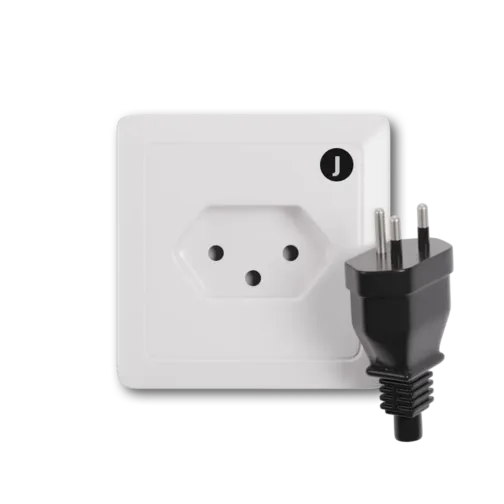
Type J
|
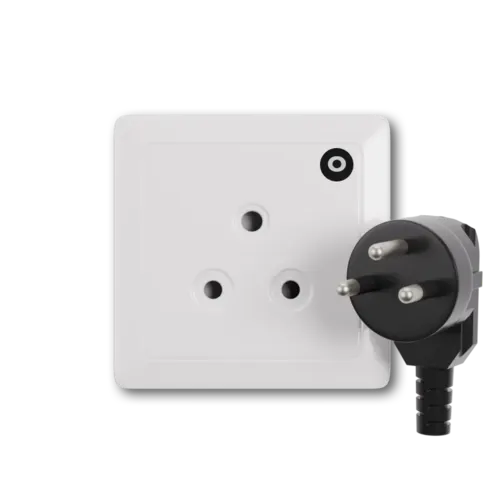
Type O
|
|
|---|---|---|
| Standard | SEV 1011 | TIS 166-2549 |
| Pin Configuration | Two round pins (4mm diameter) plus offset grounding pin (center pin 10mm from others) | Three round pins in triangular pattern (4.8mm diameter power pins, 4mm grounding pin) |
| Grounding | Grounded | Grounded |
| Pin Count | 3 | 3 |
| Amperage | 10A | 16A |
| Voltage Range | 220-240V | 220-240V |
A Swiss lamp and a Thai rice cooker have plugs that look like cousins: three round pins, 19 mm between live and neutral, an earth pin below. The type J vs type O plug question comes down to a pin thickness and an earth pin position, which decide whether your plug fits, whether it is earthed, and whether you need a plug adapter.
This guide covers both and the electricity in each country.
Type J vs Type O Plug Specifications Side by Side
Both are earthed three-pin plugs and sockets for 230 V networks, listed in the IEC World Plugs guide. The Swiss design is used in Switzerland and Liechtenstein; the Thai design only in Thailand, in homes, hotels and offices, so neither is used by other countries.
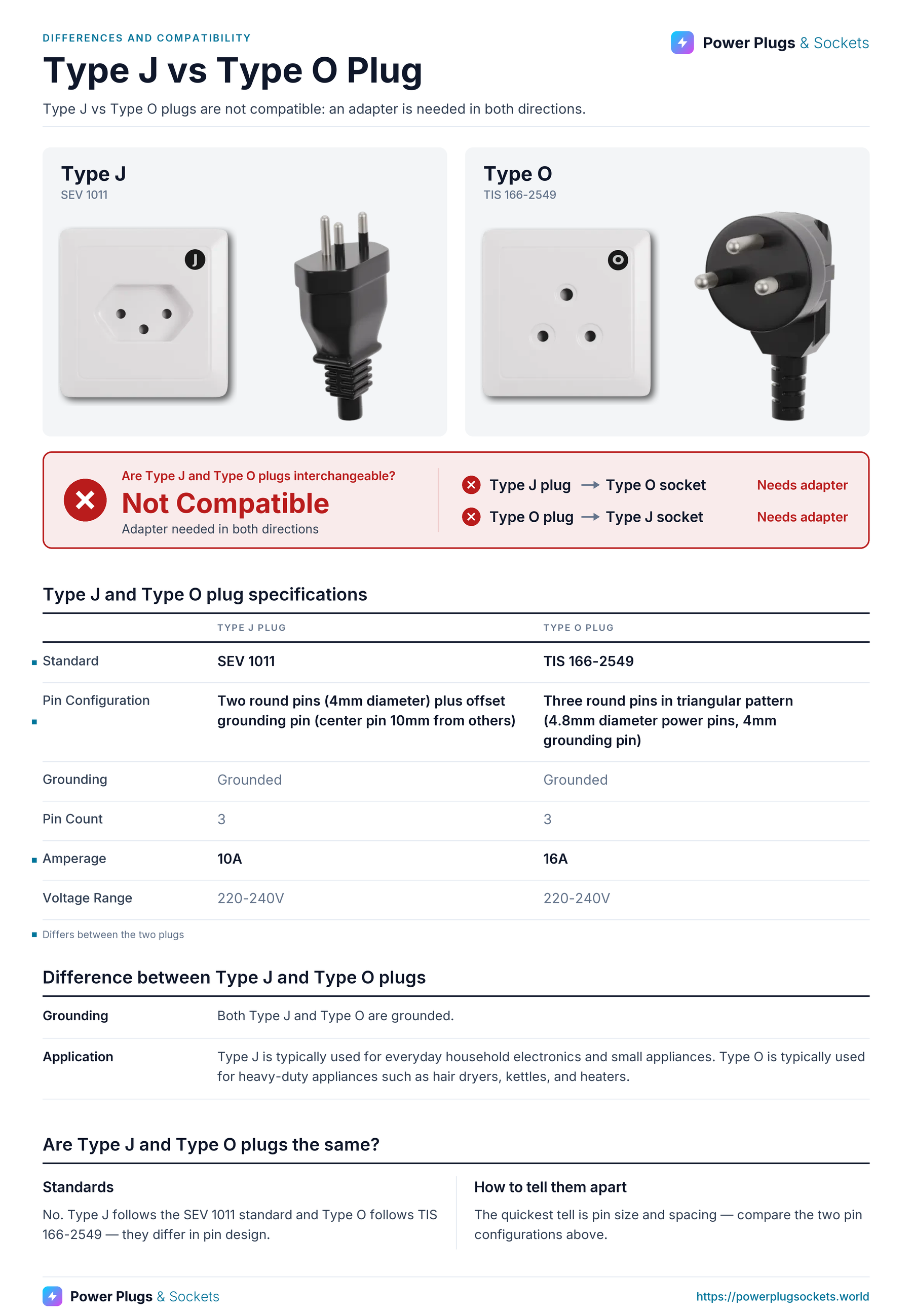
These plugs and outlets, and type O plugs especially, are built for domestic use, with safety in mind.
| Feature | Swiss (J) | Thai (O) |
|---|---|---|
| Standard | SEV 1011 (renamed in 2019) | TIS 166-2549 |
| Rating | 10 A (16 A in the type 2x family) | 16 A |
| Power pin diameter | 4 mm | 4.8 mm |
| Pin spacing (centre to centre) | 19 mm | 19 mm |
| Earth pin position | 5 mm below the line of the power pins | 11.89 mm below the line of the power pins |
| Earth pin length | Same as the power pins | 21.4 mm (longer than the power pins) |
| Recessed socket | Yes, on the current type 13 socket | Flush face; hybrid sockets also common |
| Polarized socket | Fixed line and neutral positions | Yes, polarized like NEMA 5-15 |
| Accepts the Europlug | Yes (2.5 A) | Yes |
Round Pins: Diameter, Length and Spacing
The Swiss line and neutral pins are 4 mm thick, 19 mm long and 19 mm apart; the Thai power pins match except they are 4.8 mm thick. A thicker pin will not enter a Swiss socket, while a thinner pin wobbles in a Thai one.
The earth pin is the other difference. On the Swiss design the earth pin is offset by just 5 mm from the line of the power pins; the Thai grounding pin sits 11.89 mm below that line, is 21.4 mm long, and reaches earth first.
Because the positions differ by almost 7 mm, neither earthed plug can reach the other's earth hole. The ratings differ too: a 10 A circuit supports roughly 2,300 W and a 16 A circuit roughly 3,680 W, so check any adapter before using it with high-power appliances.
Inside the Swiss Standard: SN 441011 and SEV 1011
The standard was published as SEV 1011 and renamed SN 441011 in 2019. It describes plugs and sockets with two, three or five pins in 10 A and 16 A versions, and a socket accepts any plug with the same or fewer pins and the same or lower rating. Compare this with how the DS 60884-2-D1 standard for type K compares to IEC 60906-1 for type N.
The IEC type J family includes type 11, an unearthed two-pin plug; type 12, the earthed plug with the central earth pin 5 mm off the line, which with the type 13 socket is what most people mean by type J plugs; and type 15, with two extra flat pins for three-phase equipment, whose socket accepts single-phase plugs. Only the unearthed two-pin version is likely to enter a Thai socket.
The current type 13 socket is recessed in a hexagonal well, and the power pins carry 10 mm insulated sleeves, because older plugs with unsleeved pins left live metal exposed when partially inserted, a shock hazard. A recessed type J socket accepts type 11 and 12 plugs and the Europlug, not round Schuko or French plugs, and a triple socket packs three outlets in one plate.
For loads above 10 A the 16 A family uses 4 mm × 5 mm rectangular pins at the same spacing: the recessed type 23 socket accepts its own plug, 10 A plugs and the Europlug, while Thailand reaches 16 A with one round-pin shape.
The Thai Plug Under TIS 166-2549
The Thai Industrial Standard 166-2547, updated as TIS 166-2549, replaced earlier rules that borrowed American NEMA shapes although the country runs on 230 V. It defines the plug and its socket-outlets, and the IEC files it under the letter O.
Grounded and Ungrounded Thai Plugs
The grounded version has two 4.8 mm power pins and the long earth pin; the ungrounded version keeps the same power pins in a body like a Europlug, only taller. Both are rated 16 A, against 2.5 A for a real Europlug, and both fit the same Thai socket.
The Hybrid Socket and NEMA Plugs
Most Thai walls still carry the hybrid socket, accepting NEMA 1-15, NEMA 5-15, the Europlug and Thai three-pin plugs, which is why the Thai earth pin sits where the NEMA 5-15 earth pin sits. NEMA support is being phased out for a plain three-round-pin socket.
Thai sockets are polarized, with fixed line and neutral positions, so a switched appliance breaks the live side; fitting the socket does not make a 110-120 V NEMA device safe at 230 V.
Compatible Plugs and Sockets for Swiss and Thai Outlets
A Swiss earthed plug does not fit a Thai socket, and a Thai earthed plug does not fit a Swiss socket: the pins are the wrong diameter in one direction and the earth pin is in the wrong place in both. Each outlet takes a different set of plugs: the Swiss type 13 socket is compatible with type 11 and 12 plugs and the Europlug; the Thai socket takes Thai plugs, the Europlug and, on hybrid sockets, NEMA plugs. Next, check what adapter converts a type C plug to a type E socket.
The Europlug and Type C
The Europlug, CEE 7/16 or type C, has 4 mm pins about 19 mm apart, so it enters Swiss and Thai sockets alike. It is unearthed and rated 2.5 A, suiting phone chargers and shavers.
Schuko Type F and French Type E
The German Schuko plug (CEE 7/4, type F) and French type E plug use 4.8 mm pins, like the Thai power pins. Most appliances ship with the hybrid CEE 7/7.
None fit a Swiss socket, because the pins are too thick for the recess. In a Thai socket the pins can go in but the earth contact is not made, a dangerous partial compatibility that needs an earthed adapter.
Why Type N Is Incompatible
Brazil's type N plug resembles the Swiss plug, with three round pins and 4 mm pins on the 10 A version, but its earth pin sits about 3 mm off the line instead of 5 mm, so the two are incompatible.
Israeli SI32 and Other Lookalikes
The Israeli SI32 plug also resembles the Thai grounded plug but is incompatible. Compare numbers rather than shapes: a 1 mm difference can stop a fit or leave the earth disconnected.
Travel Adapter Choices for a Swiss or Thai Power Plug
Travelling between the countries, every earthed appliance needs an adapter that carries the earth through, as cheap universal adapters and multi-way blocks drop it. Check the rating: a 10 A Swiss adapter on a 16 A Thai kettle circuit is the weak link.
Europlug devices need no adapter, though they stay unearthed by design.
Voltage and Frequency
Both countries supply mains electricity at 230 V and 50 Hz, so no voltage converter is needed, only a plug adapter. Devices bought for 110-120 V countries are damaged unless the label says 100-240 V. The Swiss standard does not require child protective shutters, so do not assume sockets have shutters; earthing and sleeved pins are what protect household appliances, and a Swiss three-pin plug belongs only in Swiss sockets.