Type L vs Type N Plugs: Differences & Compatibility
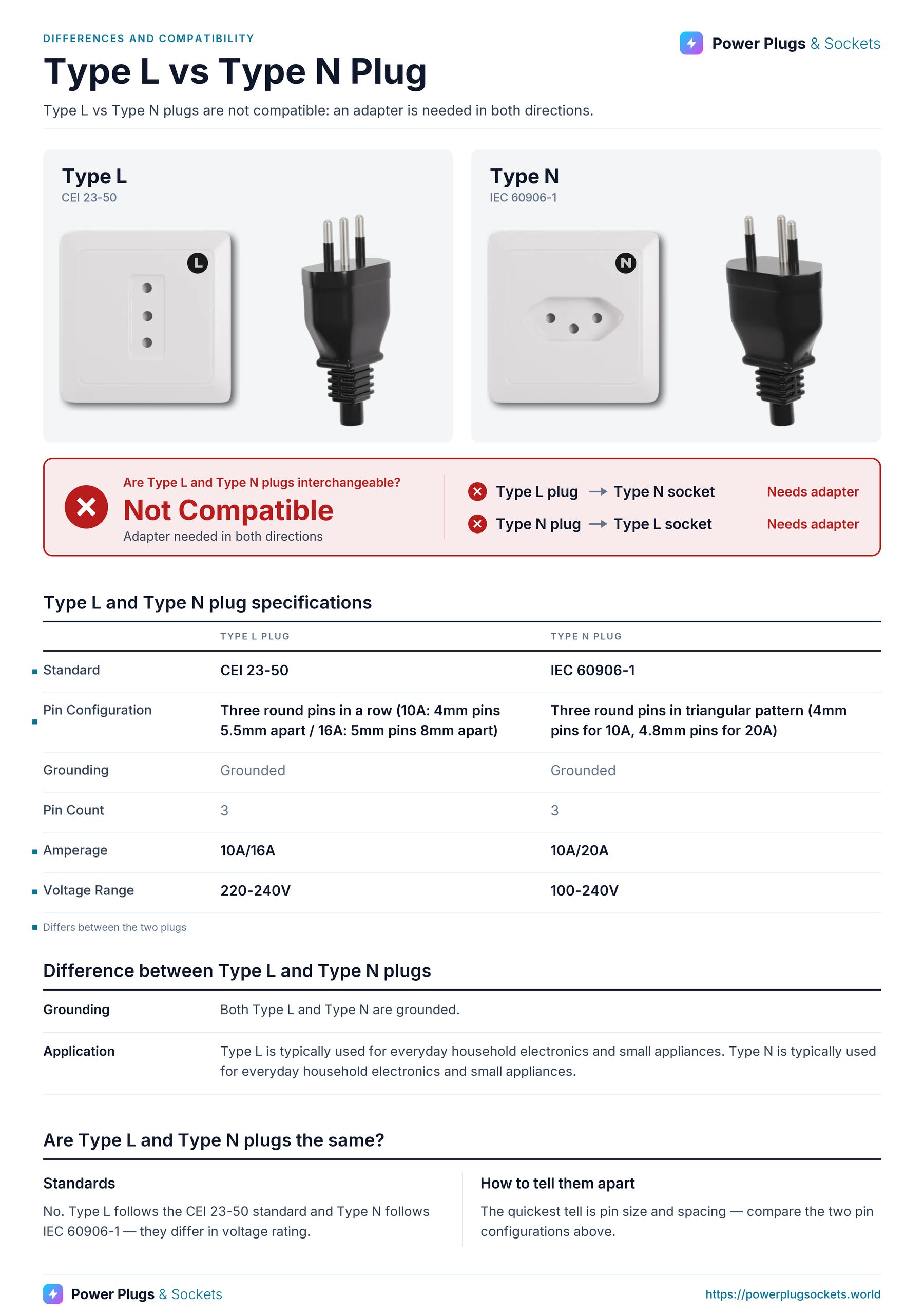
Type L vs Type N plugs are not compatible: an adapter is needed in both directions. Type L is a 3-pin, grounded plug rated 10A/16A at 220-240V, while Type N is a 3-pin, grounded plug rated 10A/20A at 100-240V. The two differ mainly in voltage, amperage and pin design, which is what decides compatibility — whether a Type L plug fits a Type N socket, and vice versa. You might also want type I plugs run on 220-240V while type J plugs run on 220-240V.
Swipe to compare
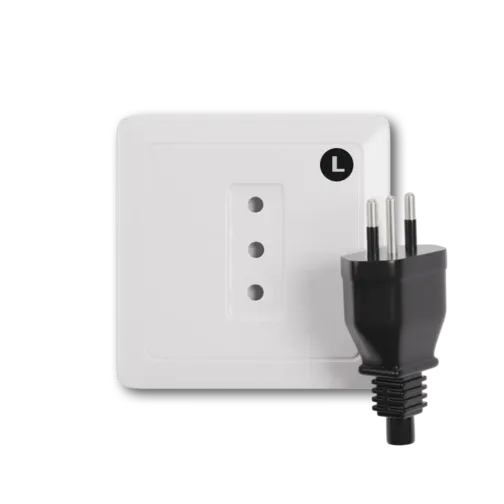
Type L
|
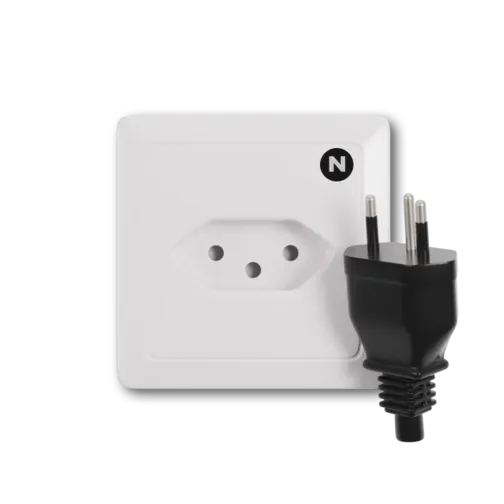
Type N
|
|
|---|---|---|
| Standard | CEI 23-50 | IEC 60906-1 |
| Pin Configuration | Three round pins in a row (10A: 4mm pins 5.5mm apart / 16A: 5mm pins 8mm apart) | Three round pins in triangular pattern (4mm pins for 10A, 4.8mm pins for 20A) |
| Grounding | Grounded | Grounded |
| Pin Count | 3 | 3 |
| Amperage | 10A/16A | 10A/20A |
| Voltage Range | 220-240V | 100-240V |
Heading to Italy and then Brazil with the same charger bag? The type L vs type N plug answer: both are earthed, three-pin systems with round pins, but neither power plug fits the other's socket, and only the slim two-pin Europlug works in both.
Here is how the Italian and Brazilian/South African power sockets differ in pin size, current rating and earth position, so you know what to pack for the electricity ahead. Each plug type was designed around a different problem.
Type L vs Type N Plug at a Glance
The Italian design kept two pin spacings from when homes had separate lighting and power supplies; the newer design was drawn up in the 1980s as one compact plug for 230 V countries. Both are grounded, use three pins and are rated 250 V; the frequency and voltage behind the wall depend on the country, not the plug. You might also want type C versus type I plug shape and socket design compared.
Current ratings and mains voltage differ. Italy, Chile and Uruguay supply 220-230 V mains at 50 Hz and South Africa 230 V, while Brazil runs at 60 Hz and an identical socket may deliver 127 V or 220 V. A 127 V appliance on 220 V can burn out, so check the nominal voltage on each household appliance and the building wiring.
The Italian earth pin sits in the middle of a straight line, so the symmetrical plug goes in either way up, with no polarity. On the triangular design the earth pin is offset 3 mm, which fixes where the live pin and neutral land.
Looking at the socket with the earth hole above, live sits on the right. That grounding pin has no hole in an in-line Italian socket.
| Feature | Italian system | Brazilian / South African system |
|---|---|---|
| Governing standard | Italian CEI standard | IEC 60906-1 family |
| Current versions | 10 A and 16 A | 10 A and 20 A (Brazilian), 16 A (South African) |
| Pin layout | Three round pins in a straight line | Two power pins plus an offset earth pin in a triangle |
| Pin diameter | 4 mm (10 A), 5 mm (16 A) | 4 mm (10 A), 4.5 mm (16 A), 4.8 mm (20 A) |
| Live-to-neutral spacing | 19 mm (10 A), 26 mm (16 A) | 19 mm on every version |
| Earth pin position | Centre, in line with the other two | Offset 3 mm from the line of the power pins |
| Rated voltage | 250 V | 250 V |
| Accepts a Europlug | Yes | Yes |
| Main countries | Italy, Chile, Uruguay | Brazil, South Africa |
Pin Diameter and Spacing Side by Side
A small Italian plug has 4 mm pins on 19 mm centres, the large one 5 mm pins on 26 mm centres. A small Italian plug and a Brazilian 10 A plug share pin size and spacing, yet the earth pin position still stops one entering the other's socket, and the large Italian plug has a contact diameter too wide for a triangular type N socket.
Italian Plugs and the CEI 23-50 Standard
Italian plugs follow the CEI 23-50 standard, also used in Chile and Uruguay. All Type L plugs are grounded with the earth in the middle, and the family reaches parts of North Africa and sits across Europe's borders, next to Switzerland. Next, check how the pin configuration of a type A plug differs from a type C plug.
The compact bipasso outlet (P17/11, the presa bipasso) takes both 10 A and 16 A Italian plugs and a Europlug through figure-of-eight holes. An older single-size socket outlet may offer only 10 A. The larger P40 hybrid socket adds a Schuko outlet for CEE 7/4, CEE 7/7 and CEE 7/17 plugs.
Type L System: Two Sizes in One Line
The type L system comes in 10 A and 16 A sizes at 250 V. The 16 A version has thicker pins and a wider span for washing machines, ovens and heaters. The two sizes date back to homes with separate lighting and power connections, so the plugs were kept physically apart.
Where Italian Sockets Are Found
Italian outlets are found on the Italian mainland, San Marino, the Vatican, Chile and Uruguay. A Brazilian or South African three-pin plug fits none of them, so bring a grounded adapter or a two-pin charger.
IEC 60906-1 and the Brazilian Standard NBR 14136
The triangular plug is based on IEC 60906-1, published in 1986 as a common household plug for 230 V, rated 16 A at 250 V. Brazil adopted a variant as NBR 14136, while European roll-out stalled in the mid-1990s. Brazil's two ratings and pin sizes for type N plugs are 10 A with 4 mm pins and 20 A with 4.8 mm pins.
A 10 A plug fits a 20 A socket, but a 20 A plug will not enter a 10 A socket.
Before the change, older Brazilian appliances had a flying earth lead to screw to a ground point, and the standard moved the earth into the plug. A hexagonal recess shapes the socket, but few older homes have proper earthing, so the third hole may not be connected.
South Africa adopted the South African standard SANS 164-2 in 1992 and made it the preferred standard in 2013. It uses the 16 A, 4.5 mm version and a two-pin unearthed plug, and its sockets take the Europlug too.
For electrical safety, power pins carry 10 mm insulated sleeves, so a partially inserted plug exposes no live metal. The international version requires shutters, giving protection against accidental contact, but NBR made shutters optional, so check the outlet.
Origins of the Type N Standard
The International Electrotechnical Commission wrote the type N standard as a clean-sheet design aimed at standardization, with one 19 mm footprint for every rating, injection moulding and insulated pins. Paraguay has adopted it as a voluntary standard.
Plug Types L and N: Compatibility and Adapters
Comparing plug type L and N sockets, the three-pin plugs are incompatible with each other's outlets in both directions; the link is the two-pin plug both families accept.
Can an Italian Plug Fit a Brazilian Socket?
No. A 10 A Italian plug has the right pin size and spacing for the live and neutral pins, but its in-line earth pin meets solid plastic. Never snap off an earth pin; use a plug adapter that keeps the earthing connected.
Why Type C Is the Shared Plug
The type C Europlug is a plug with two pins and works in both countries, so phone chargers and laptop bricks need no adapter. A type N socket was shaped to accept it.
A German CEE 7/4 Schuko plug fits neither without one.
Choosing a Travel Adapter or Voltage Converter
For a grounded three-pin plug, pack a travel adapter for each country. Most chargers are rated 100-240 V, but a single-voltage device needs a voltage converter in the 127 V Brazilian states.
Type J Confusion: Similar Look, Different Earth
The triangular plug resembles the Swiss type J, but the Swiss earth sits 5 mm off the centre line instead of 3 mm, so they are not compatible.