Type I vs Type J Plugs: Differences & Compatibility
Type I vs Type J plugs are not compatible: an adapter is needed in both directions. Type I is a 3-pin, grounded plug rated 10A at 220-240V, while Type J is a 3-pin, grounded plug rated 10A at 220-240V. The two differ mainly in pin design, which is what decides compatibility — whether a Type I plug fits a Type J socket, and vice versa. You might also want how the pin configuration of a type A plug differs from a type C plug.
Swipe to compare
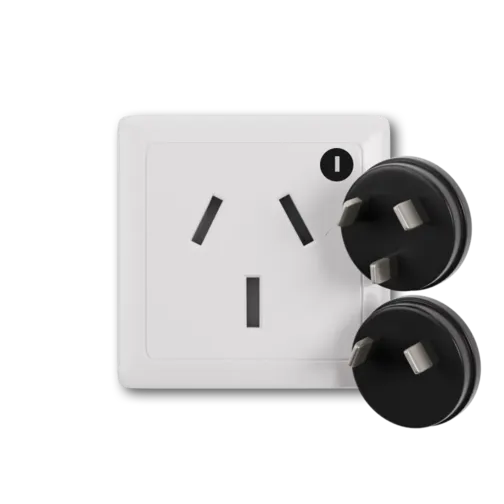
Type I
|
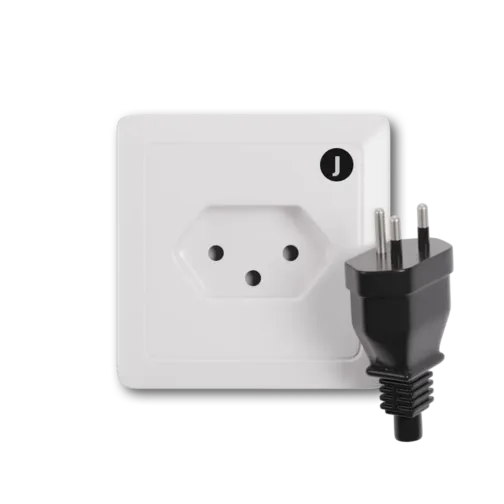
Type J
|
|
|---|---|---|
| Standard | AS/NZS 3112 | SEV 1011 |
| Pin Configuration | Two angled flat pins (8mm long, 6.5mm wide, 30 degree angle) plus vertical grounding pin | Two round pins (4mm diameter) plus offset grounding pin (center pin 10mm from others) |
| Grounding | Grounded | Grounded |
| Pin Count | 3 | 3 |
| Amperage | 10A | 10A |
| Voltage Range | 220-240V | 220-240V |
Packing a charger from Sydney for a trip to Zurich, or a Swiss laptop for a stay in Auckland? The type I vs type J plug question comes down to one fact: the two pin layouts never fit each other, but the electricity behind them is nearly identical, so a simple plug adapter (or travel adaptor) is usually all you need to run an electrical appliance safely abroad.
Below: how each power plug is built, where it's used, and when voltage or frequency matters for travel.
Type I vs Type J Plug: Side-by-Side Comparison
Both plug types serve 230 V, 50 Hz grids and are rated for about 10 amps, yet their plug shape is completely different, so they are incompatible in both directions. The table puts the key differences in one place. Compare this with type L plugs run on 220-240V while type N plugs run on 100-240V.
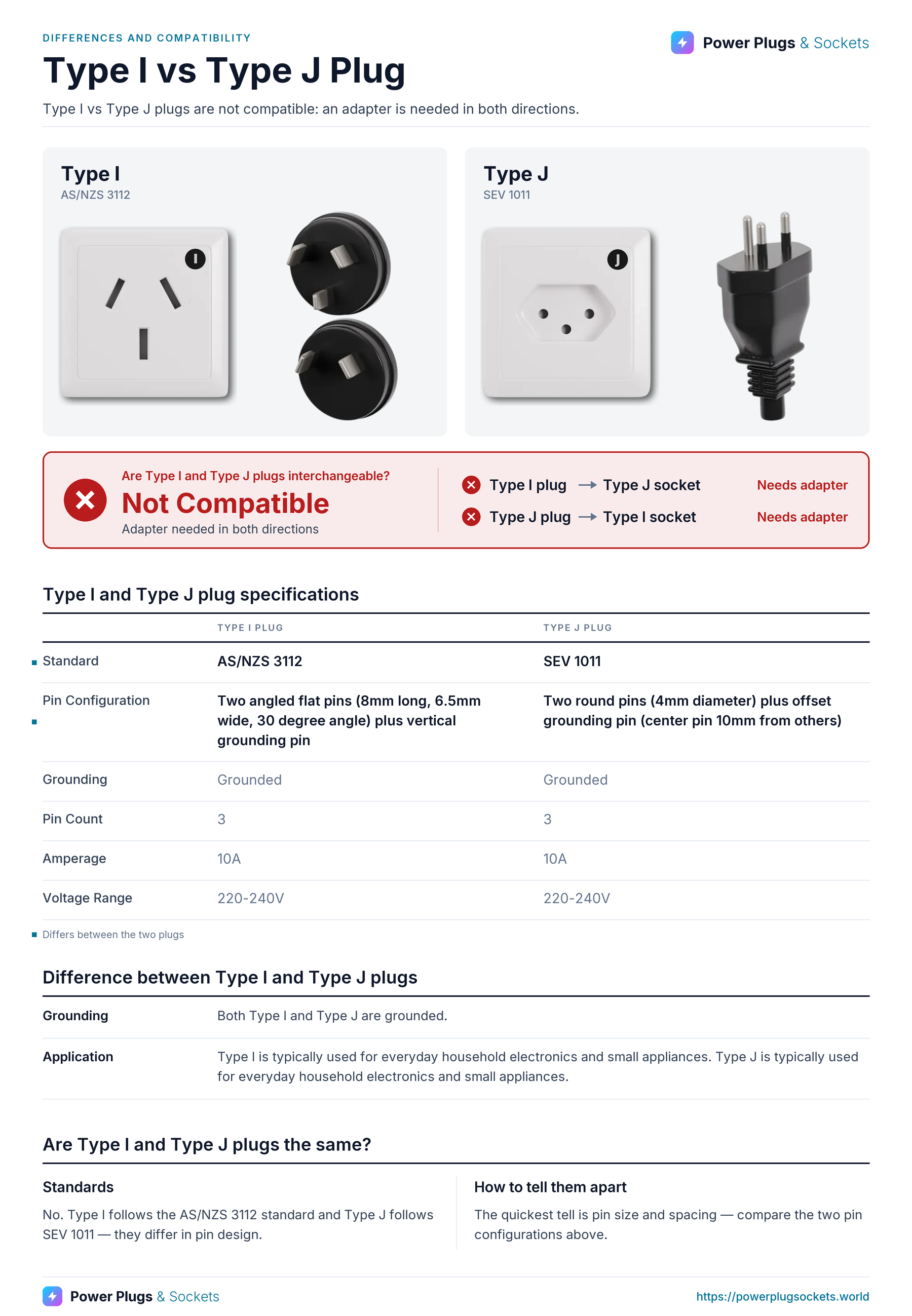
| Feature | Type I | Type J |
|---|---|---|
| Pin shape | Two flat blades plus a flat earth blade | Three round pins |
| Layout | Inverted V with vertical earth | Triangle with offset earth |
| Grounded | Yes (2-pin version also exists) | Yes |
| Standard | AS/NZS 3112 | SEV 1011 |
| Rating | 10 A, 230 V | 10 A, 230 V |
| Accepts a Europlug | No | Yes |
| Main countries | Australia, New Zealand, China, Argentina | Switzerland, Liechtenstein, Rwanda |
Adapters that bridge the two sockets are usually labelled up to 250V and 10A or 13A; a compatible adapter reshapes pins, never voltage.
Type I Plug: Two Flat Prongs in a V Shape
The type I plug uses two flat prongs angled toward each other like an upside-down V, with a third flat blade pointing straight down for earth. An ungrounded version with just the two angled blades is common on phone chargers and other 2-prong double-insulated gear.
A power outlet type I is standard across Australia, and sockets in mainland China take the same shape with minor differences, which is why Chinese hotel sockets often accept an Australian charger.
Type J Plug: Round Pins and an Offset Earth Pin
A type J plug carries three round pins about 4 mm thick. The line and neutral pins sit side by side, and the earth pin sits below them, offset 5 mm from the centre line that joins the other two.
That offset lets type J plugs reject look-alikes. Swiss sockets are recessed and hexagonal, so a 3-prong plug from Switzerland sits flush and can't be pulled half out while live.
Why a Type J Socket Rejects Type I Blades
A type J socket has round holes; a type I plug has flat blades, so nothing lines up. The reverse fails too: round Swiss pins can't enter the slanted slots of an Australian outlet.
Never force either plug into the other's outlet; damaged pin insulation risks electrocution.
Grounding Pin Position and Insulated Sleeves
On type I the grounding pin is a vertical blade, longer than the others so earth connects first. On type J, grounding comes from the offset round pin.
Both standards now require insulated sleeves on the live and neutral pins, so if a plug is partly withdrawn your fingers can't touch a live surface. Older Swiss plugs with unsleeved pins still turn up in rental flats and still fit a modern type J outlet.
Where the Type C Plug and Europlug Fit
The two-pin type C plug, better known as the Europlug, has two round pins and fits perfectly into a Swiss socket, so most chargers bought in Europe work in Switzerland without an adapter. A thicker Schuko plug with earth clips usually won't fit.
Australia is different: type I sockets don't accept round pins at all.
Type N: The Brazilian Look-Alike
Type N, used in Brazil, also has three round pins and looks almost identical to type J. The giveaway is the earth position: type N's earth pin sits closer to the centre, so a Swiss plug and a Brazilian socket won't mate even though they look like twins.
Where Each Power Outlet Is Used
Knowing which power outlet you'll meet tells you which adapter to pack. A power outlet type J is limited to a small group of countries, while type I covers a wide stretch of the Pacific. Next, check is it safe to use a type E device on a type I socket.
Type I Countries: Australia, New Zealand and Beyond
Beyond Australia, you'll find type I in New Zealand, Papua New Guinea, Fiji and much of the South Pacific, plus China and Argentina. Argentina's version swaps the live and neutral positions, which doesn't affect how a plug fits but is worth knowing if you wire anything yourself.
The Switzerland Plug Standard: SEV 1011
The Switzerland plug is defined in SEV 1011 and is used in Switzerland and Liechtenstein; Rwanda also uses it alongside type C. The 10 A limit is firm: heavier loads must be wired in permanently with proper branch circuit protection or connected through an industrial connector, and a 16 A Swiss variant exists for high-power equipment.
Travel Adapter or Voltage Converter Between Type I and Type J
For travel between the two systems, you need a travel adapter but almost never a voltage converter or transformer, because Switzerland, Australia and New Zealand all run on the same voltage. Travelling from North America is a different story.
- Type I to type J: plug adapter only, same voltage and 50 Hz frequency.
- Type J to type I: plug adapter only, same voltage.
- Europlug (type C) into a Swiss socket: no adapter needed.
- US 120 V gear into either: adapter plus a check of the device's voltage rating.
Supply Voltage and Dual Voltage Devices
Both countries share a 230 V supply voltage (China and Argentina use 220 V, inside the same tolerance). Most laptop, tablet and camera chargers are dual voltage with a voltage range of 100-240V, printed on the label.
A single-voltage 120 V appliance such as a hairdryer from the US needs a converter whose power rating in watts exceeds the device's, and timers built for 60Hz may run slow on 50 Hz. Check the amps too: high-draw appliances can trip a 10 A outlet.
Choosing a Worldwide Adapter
If your trip covers more than these two countries, a worldwide adapter with type I and type J pin sets saves carrying several single adapters. A universal model with USB ports lets you charge a cell phone and laptop chargers at once, but look for an earthed pass-through and a fuse; built-in surge protection is a bonus, not a substitute for a grounded connection for your devices.