Type M vs Type N Plugs: Differences & Compatibility
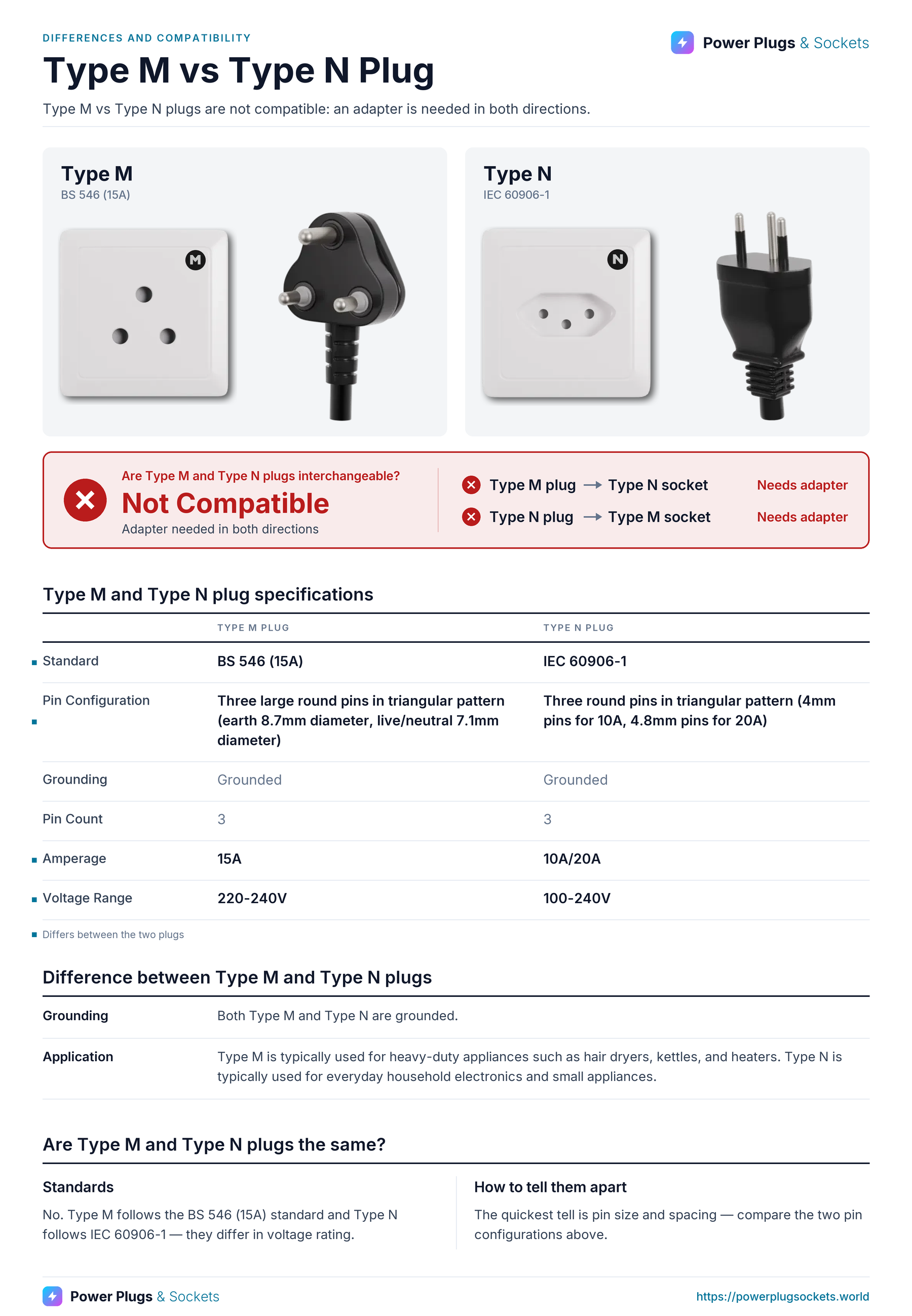
Type M vs Type N plugs are not compatible: an adapter is needed in both directions. Type M is a 3-pin, grounded plug rated 15A at 220-240V, while Type N is a 3-pin, grounded plug rated 10A/20A at 100-240V. The two differ mainly in voltage, amperage and pin design, which is what decides compatibility — whether a Type M plug fits a Type N socket, and vice versa. Compare this with is a type G plug compatible with a type J socket.
Swipe to compare
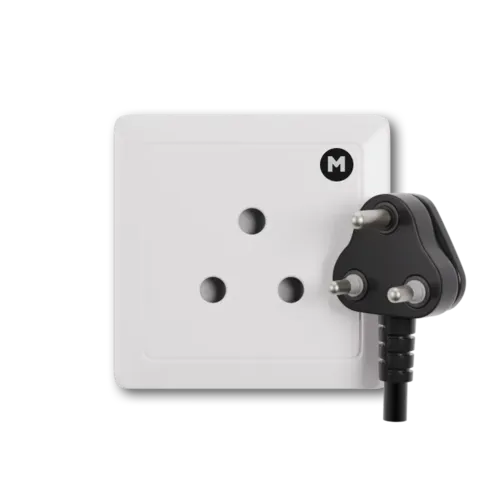
Type M
|
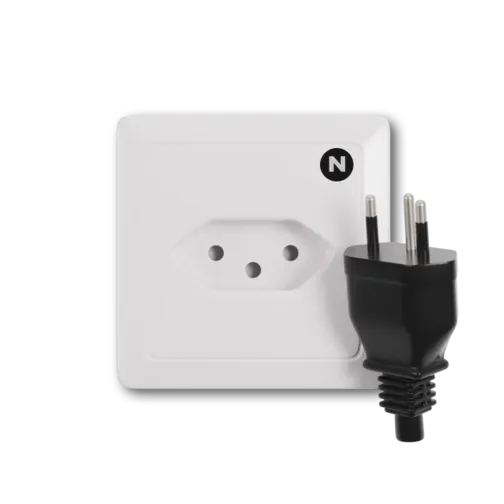
Type N
|
|
|---|---|---|
| Standard | BS 546 (15A) | IEC 60906-1 |
| Pin Configuration | Three large round pins in triangular pattern (earth 8.7mm diameter, live/neutral 7.1mm diameter) | Three round pins in triangular pattern (4mm pins for 10A, 4.8mm pins for 20A) |
| Grounding | Grounded | Grounded |
| Pin Count | 3 | 3 |
| Amperage | 15A | 10A/20A |
| Voltage Range | 220-240V | 100-240V |
Packing for South Africa or Brazil? The type M vs type N plug question decides whether your charger slides into the wall.
Both are three-pin earthed plug types, yet the type N plug & socket is slim and modern while type M is a bulky 15 A design with far thicker pins. This guide shows which domestic electrical outlet takes which plug and when travel abroad calls for more than an adapter.
Type M vs Type N Plug: Side-by-Side Comparison
Each plug has 3 pins, is grounded, and is polarized, and southern Africa runs both on 220 – 240 V mains. Type M grew from the British BS 546 family; type N was drafted by the IEC as a compact plug for the 230 V world.
| Feature | Type M | Type N |
|---|---|---|
| Standard | BS 546 (15 A), SANS 164-1 | IEC 60906-1, SANS 164-2, NBR 14136 |
| Pins | 3 pins, round, in a wide triangle | 3 pins, round, in a shallow triangle |
| Live/neutral pin diameter | About 7.05 mm | 4.5 mm (IEC); 4 mm or 4.8 mm (Brazil) |
| Earth connection | Earthed, thicker top pin | Earthed, pin offset 3 mm |
| Current rating | 15 A (16 A under SANS 164-1) | 16 A (IEC); 10 A and 20 A (Brazil) |
| Voltage | 220 – 240 V | 127 V or 220 – 240 V |
| Recessed socket | No | Yes |
| Socket also accepts | Nothing else | Europlug (type C) |
A type M socket accepts only type M, while a type N socket also takes the two-pin Europlug. Neither plug fits the other's socket, so the plug types in this pair differ by shape: type M has three prongs and larger pins far apart, type N squeezes its pins into a narrow, almost flat row.
Type M is the larger plug for heavy loads, with a 15 A or 16 A current rating suiting kettles, geysers and other large appliances, while Brazil splits type N into 10 A and 20 A variants, and the amp rating of the IEC design is 16 A. South African mains runs at 230 V and 50 Hz; Brazil uses 127 V or 220 V at 60 Hz, so socket type N never tells you the voltage or frequency.
Check the electricity supply before plugging in anything not rated 100 – 240 V.
BS 546 Roots: What Defines the 15 A Plug
Type M is the high-current domestic member of BS 546, which defined round-pin plugs at 2 A, 5 A, 15 A and 30 A from 1934. The 15 A plug is South Africa's standard socket, sold under SANS 164-1 at 16 A. Plug type M is unfused, so safety depends on the circuit breaker.
The live pin and neutral are each about 7.05 mm across with a pin length of roughly 18.6 mm, 25.4 mm apart.
The earth pin is about 8.7 mm across and 28.6 mm long, entering first so the appliance is grounded before the live contact, and often opening the socket shutters. The three round pins are unsleeved, and a plain two pins plug with no earth is ungrounded.
Why It Resembles Plug Type D
Plug type D is the 5 A sibling from the same BS 546 family with the same layout, but the sizes are not compatible: a type D plug rattles loose in a type M socket.
IEC 60906-1: The Compact Three-Pin Design
In 1986 the International Electrotechnical Commission published IEC 60906-1, a single plug to replace Europe's patchwork of national plugs. Standardization stalled, but South Africa and Brazil adopted it.
It is compact, robust and one of the safest designs, though the earth pin sits closer to the line than on the Swiss type J plug, so it will not fit a Swiss socket.
Pin Diameter, Pin Centers and the Offset Earth
- Live and neutral pin diameter is 4.5 mm; pins are about 19 mm long.
- Pin centers are 19 mm apart, like the Europlug's.
- The earth pin is offset 3 mm from the line through the others.
- Brazil uses 4 mm pins for 10 A and 4.8 mm pins for 20 A.
SANS 164-2 in South Africa
South Africa adopted the IEC design in 1992 as SANS 164-2, covering a two-pin unearthed plug and a three-pin earthed one, each rated 16 A. In 2013 it became the preferred standard and the country is transitioning, expected to run until between 2025 and 2035. New buildings get a dual socket or quadruple socket plate mixing one type M opening with type N openings.
NBR 14136 in Brazil
Brazil made a modified IEC 60906-1 its national standard in 1998 as NBR 14136. It is used at 127 V and 220 V and splits the plug into 10 A and 20 A versions; a 20 A socket accepts both.
Some regions use split-phase wiring, so never assume a terminal is neutral.
Electrical safety differs by design. Every type N socket-outlet has shutters and a recessed face, giving child protection and keeping fingers from live pins.
Type M sockets often have shutters, but the original BS 546 design does not, and a half-inserted type M plug leaves its pins exposed, as it has no insulated pins.
Where the South African Standard and Brazilian Plugs Are Used
South Africa is the only country using both side by side. These plug & socket types and outlet types reach each country's power sockets. For a related pairing, see what is the difference between type L and type M electrical sockets.
The Brazilian standard and the South African standard each define their own plug and socket.
Countries Using Type M Plugs & Outlets
Type M is common in South Africa, Lesotho, Swaziland (Eswatini), Namibia, Botswana, India, Sri Lanka and Nepal.
Countries Using Type N Plugs & Outlets
Type N is mandatory in Brazil for new devices and buildings, and found in new South African homes and hotels, usually next to a larger type M opening.
Plug M and Plug N Compatibility: What Fits Where
Neither plug fits the other: plug N's pins are too thin for a type M socket and plug M is too large for type N. Mixing them needs an adapter, or the hybrid plates in South Africa that put a large M hole next to two small N holes, each built to its own standard.
Grounded Plugs That Are Not Compatible
- Schuko (type F) is too wide for a type N socket and nowhere near a type M one.
- Type E, the French version, is just as incompatible.
- BS 1363 plugs from the United Kingdom fit neither.
- An American plug needs an adapter in both countries.
Which Sockets Are Compatible With Plug Types C and N
The type N socket is compatible with plug types C and N, because type C's 19 mm spacing matches its holes; a type M socket accepts only type M plugs.
Type C and Europlug Fit
The two-pin Europlug used on phone chargers slides into a type N socket in Brazil and South Africa but cannot enter a type M socket.
Travel Adapter Choices for SANS 164-1 and SANS 164-2 Outlets
Power plugs and sockets abroad need care. A travel adapter is essential in South Africa; buy one covering both outlet systems, as many hotels have only type M sockets. Compare this with how the pin configuration of a type D plug differs from a type G plug.
For Brazil a type N adapter or Europlug cable is enough. Travel adaptors change only the plug shape, never the supply.
Check the label of each charger or power cord: if it says 100 – 240 V, an adapter is all you need; if it says 110–120 V only, you need a voltage converter in South Africa and Brazil's 220 V regions. For a plug adapter, choose a grounded one with both faces, rated 10 A for chargers or 16 A for kettles, and avoid stacking multisocket adaptors or extension cords.