Type N vs Type O Plugs: Differences & Compatibility
Type N vs Type O plugs are not compatible: an adapter is needed in both directions. Type N is a 3-pin, grounded plug rated 10A/20A at 100-240V, while Type O is a 3-pin, grounded plug rated 16A at 220-240V. The two differ mainly in voltage, amperage and pin design, which is what decides compatibility — whether a Type N plug fits a Type O socket, and vice versa. Compare this with what are the differences between a type A and a type D plug.
Swipe to compare
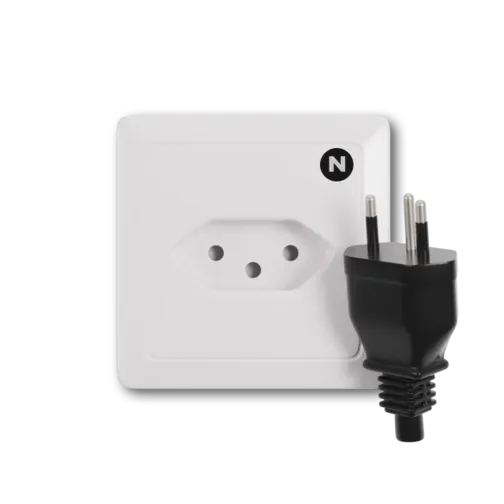
Type N
|
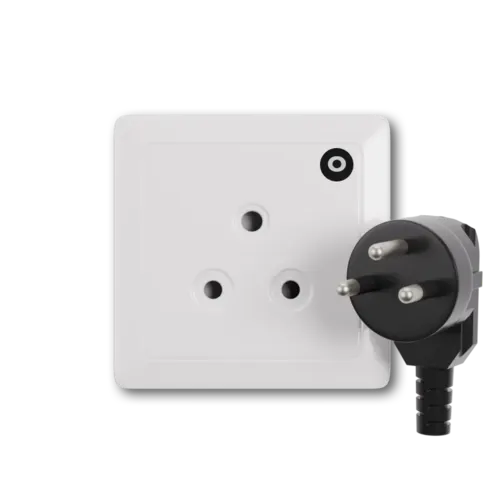
Type O
|
|
|---|---|---|
| Standard | IEC 60906-1 | TIS 166-2549 |
| Pin Configuration | Three round pins in triangular pattern (4mm pins for 10A, 4.8mm pins for 20A) | Three round pins in triangular pattern (4.8mm diameter power pins, 4mm grounding pin) |
| Grounding | Grounded | Grounded |
| Pin Count | 3 | 3 |
| Amperage | 10A/20A | 16A |
| Voltage Range | 100-240V | 220-240V |
Hold the two side by side and you would swear they were cousins: the Type N vs Type O plug question comes up because both carry three round pins and both serve a domestic electrical outlet on 220 – 240 V mains, yet neither three-pin plug seats in the other's socket. Below are the pin layout, ratings and socket compatibility for the Brazilian and South African plug family and the Thai one.
Type N vs Type O Plug at a Glance
The letters come from the IEC World Plugs pages. The letter N covers the IEC 60906-1 design and its national standard versions (NBR 14136 in Brazil, SANS 164-2 in South Africa); the letter O covers TIS 166-2549, the Thai Industrial Standard.
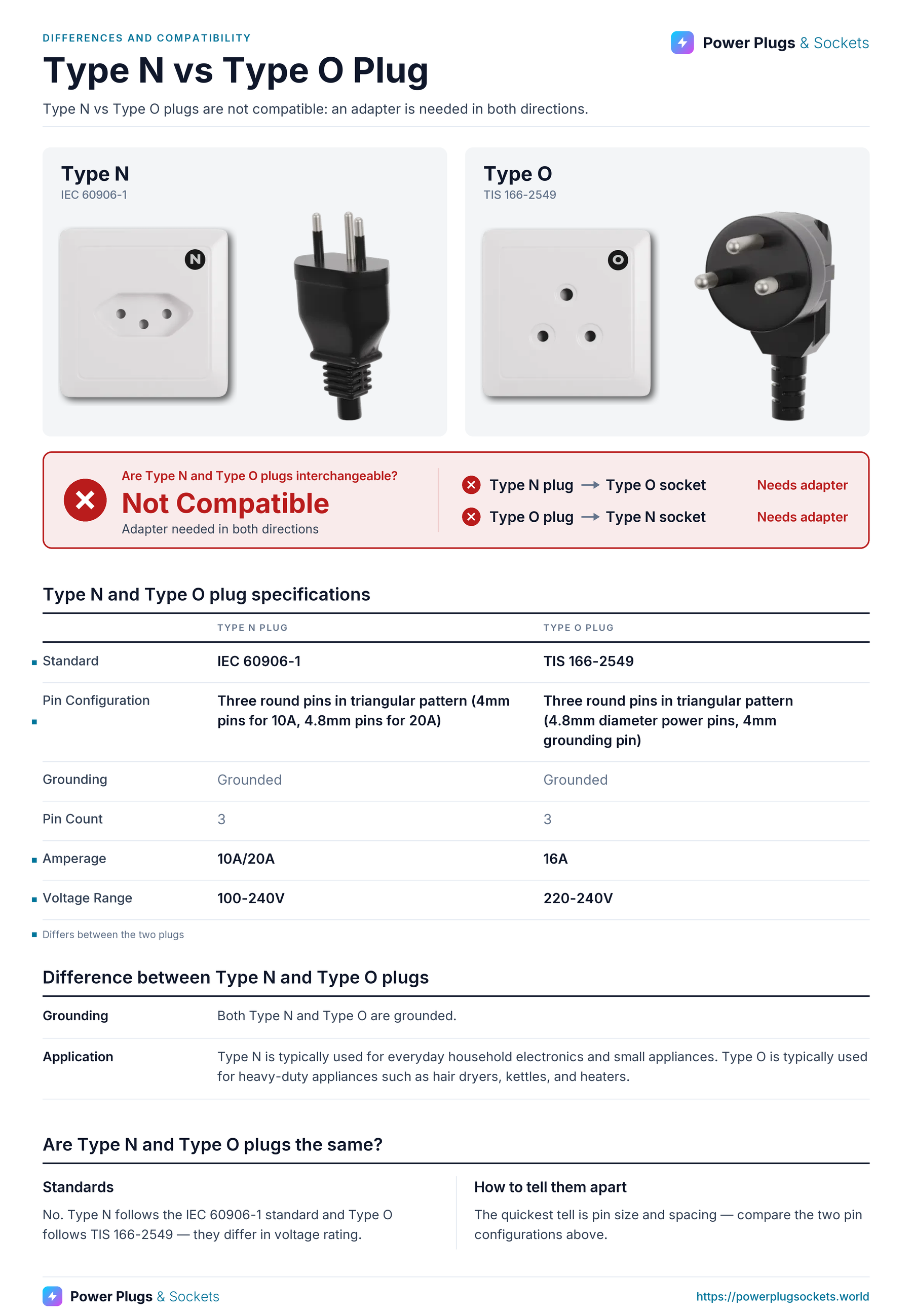
The table sets the key figures against each other.
| Feature | IEC 60906-1 family (N) | TIS 166-2549 (O) |
|---|---|---|
| Main countries | Brazil, South Africa | Thailand only |
| Pins | Three-pin earthed, plus a two-pin unearthed version | Three-pin earthed, plus a two-pin unearthed version |
| Current rating | 10 A or 20 A (Brazil), 16 A (IEC and South Africa) | 16 A |
| Voltage rating | 250 V; 127 V and 220 V circuits in Brazil | 250 V; 230 V mains |
| Power pin diameter | 4.0 mm (10 A), 4.8 mm (20 A), 4.5 mm (16 A) | 4.8 mm |
| Live and neutral spacing | 19 mm centres | 19 mm centres |
| Earth pin offset from the power pin line | 3.0 mm | 11.89 mm |
| Polarized | Yes (three-pin) | Yes (three-pin) |
| Insulated pins | Yes | Yes, insulated for 10 mm |
| Recessed socket | Yes | No |
| Socket accepts Europlug | Yes | Yes |
| Safety mark | INMETRO (Brazil), SABS (South Africa) | TIS |
One row matters most: the earth pin offset. The pin spacing is identical and both form a triangle of round pins, yet Type N plugs & outlets and Type O plugs & outlets are separate outlet types.
Each plug and socket outlet is 3 pins grounded and takes the Europlug (CEE 7/16, Type C). Mains frequency differs too: Brazil runs at 60 Hz, South Africa and Thailand at 50 Hz.
The IEC 60906-1 Family: Brazilian and South African Plugs
In 1986 the International Electrotechnical Commission published IEC 60906-1, rated 16 A at 250 V with 4.5 mm pins and mandatory shutters. It is called the most compact, robust and safest system, but European standardization stalled in the mid-1990s. For a related pairing, see comparing type B and type F plugs for international travel.
The Brazilian standard, NBR 14136, compulsory since 2010, comes in 10 A (4.0 mm pins) and 20 A (4.8 mm pins) sizes, permitted on 127 V circuits; the system is one-way compatible, as the 10 A plug fits a 20 A socket, not the reverse. South Africa adopted SANS 164-2 in 1992 at 16 A and named it the preferred standard in 2013, a long transition from the old round-pin socket.
Paraguay has adopted it voluntarily. Older Brazilian wiring may have no earthed supply behind a three-pin socket, and appliances once shipped with a flying earth tail.
The Thai Plug Under TIS 166-2549
TIS 166-2549 replaced earlier rules based on NEMA 1-15 and NEMA 5-15. The plug has two round power pins 4.8 mm in diameter and 19 mm long, insulated for 10 mm, and an earthing pin 21.4 mm long set 11.89 mm from the line, matching NEMA 5 earth spacing. Also see packing an adapter for a trip that has both type B and type I sockets.
It resembles the Israeli SI32 plug but is not interchangeable. The standard defines a grounded plug and an ungrounded plug with two pins, shaped like a Europlug but rated 16 A, not 2.5 A. The hybrid socket, often with a dual socket layout, that most household installations still have also accepts Type A, Type B and Europlug plugs, and the plan is to phase out NEMA-shaped support.
A US plug that fits is not safe for a 120 V device on 230 V.
How the Two Plug Types Differ in Pin Layout
Both use round pins on the same live and neutral spacing, which is why people expect them to swap, but the earth pin keeps them apart. On the N family it sits 3.0 mm off the line; on the Thai plug it sits 11.89 mm away, so the earth pin meets solid plastic and the plug never seats; grounding must connect first and stay connected.
The IEC design adds shutters and a recessed socket so a partly inserted plug exposes no metal, cutting electric shock risk and improving plug retention; the Thai socket face is flat and relies on insulated pins. Both sockets are polarized.
Pin Diameter Across Each Standard
Brazilian 10 A pins are 4.0 mm, the 16 A IEC and South African version 4.5 mm, and the Brazilian 20 A and Thai plugs 4.8 mm. The earth contact is what stops them mating.
Compatibility Between the Brazilian Plug and the Thai Socket
A three-pin Type N plug does not go into a Thai socket, nor a Thai plug into a Brazilian or South African one. Each socket accepts its own plug and the Europlug.
A Schuko plug is the usual surprise: its pins enter a Thai hybrid socket but its earth clips touch nothing. A so-called universal socket meets no official standard and may expose live pins, give no earth, or offer weak protection against overload or a short circuit.
Safety standards specify matched pairs, so use the matching socket for electrical safety.
Which Plugs Each Socket Is Compatible With
A Brazilian 10 A socket takes 10 A plugs and Europlugs; the 20 A socket takes both Brazilian sizes. The South African socket takes its 16 A plug, Brazilian 10 A plugs and Europlugs.
The Thai socket takes Thai plugs and Europlugs, with partial and unsafe compatibility for Type F and Type E plugs, and the hybrid also takes Type A plugs, which have 2 pins not grounded, and Type B.
The Europlug as the Shared Two-Pin Option
The Europlug is the one plug both systems accept. Its thin 4.0 mm pins slide into a Brazilian, South African or Thai outlet; it is unearthed and rated 2.5 A, for chargers and small appliances.
Voltage Rating and Current Rating by Plug Type
Each plug carries a current rating and a voltage rating, but the grid sets the wall voltage: South Africa 220 – 240 V, Thai residential power 230 V, and Brazilian electricity two voltages.
Brazil's Split Between 127 V and 220 V
Brazilian homes are supplied at 127 V or 220 V depending on state and city, with identical outlets. That voltage mismatch means a 127 V hair dryer can burn out on 220 V, so check the label of any appliance that is not dual-voltage.
A Higher Voltage Rating Does Not Make a Plug Safe for Every Appliance
Both plugs carry a 250 V rating, which describes only the plug. A device can be fine in Bangkok yet electrically incompatible in one Brazilian city.
Look for the INMETRO or TIS safety marks and an input range of "100 – 240 V", which runs anywhere these plugs are used.
Travel Adapter Advice for NBR 14136 and Thai Sockets
A trip taking in São Paulo and Bangkok needs two solutions unless every device uses a Europlug, since no three-pin plug is shared.
Travel Adaptors and Plug Adapter Choices
Choose an adaptor certified for the destination that carries the earth through. For Brazil's 20 A sockets look for 4.8 mm pins; for Thailand, a plug adapter with Thai pins and an earth pin at the 11.89 mm position gives a proper earth.
Avoid running several kettles or irons through one adaptor.
Power Cords Built for Brazilian, South African and Thai Plugs and Sockets
Each market needs its own power cord: Brazilian with a 10 A or 20 A plug, South African with the 16 A plug, Thai with the TIS plug. Many laptops use a detachable IEC cable, so swapping the cord is often easier than adding an adaptor.