Type B vs Type F Plugs: Differences & Compatibility
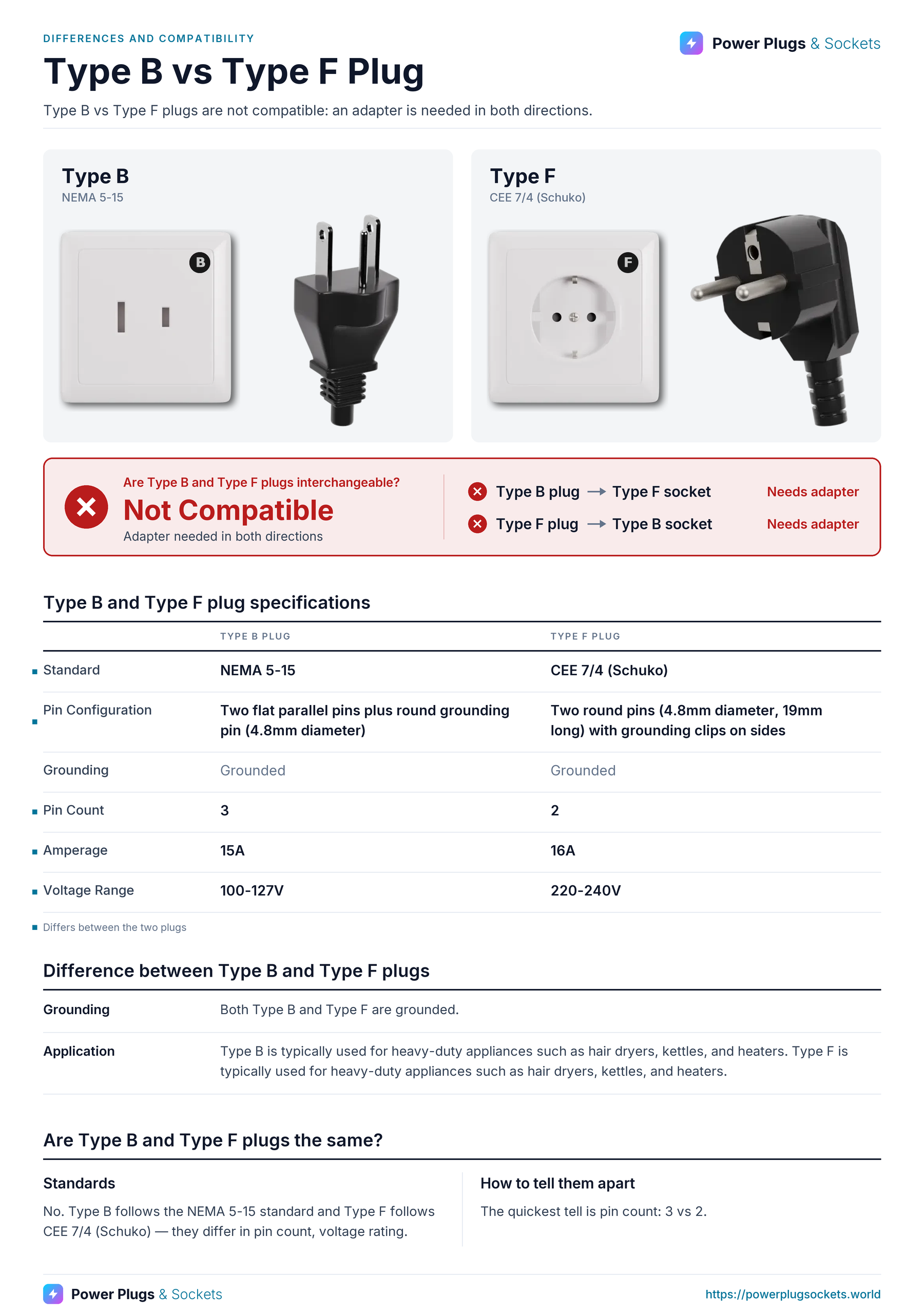
Type B vs Type F plugs are not compatible: an adapter is needed in both directions. Type B is a 3-pin, grounded plug rated 15A at 100-127V, while Type F is a 2-pin, grounded plug rated 16A at 220-240V. The two differ mainly in voltage, amperage and pin design, which is what decides compatibility — whether a Type B plug fits a Type F socket, and vice versa. You might also want how the pin configuration of a type A plug differs from a type D plug.
Swipe to compare
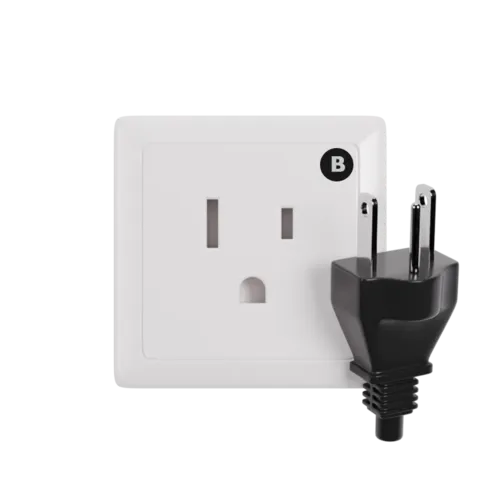
Type B
|
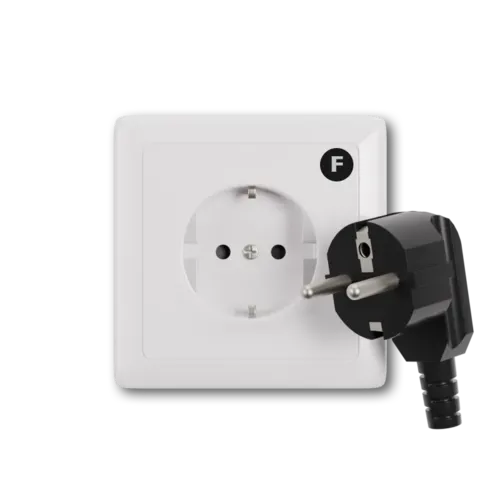
Type F
|
|
|---|---|---|
| Standard | NEMA 5-15 | CEE 7/4 (Schuko) |
| Pin Configuration | Two flat parallel pins plus round grounding pin (4.8mm diameter) | Two round pins (4.8mm diameter, 19mm long) with grounding clips on sides |
| Grounding | Grounded | Grounded |
| Pin Count | 3 | 2 |
| Amperage | 15A | 16A |
| Voltage Range | 100-127V | 220-240V |
Pack a German hair straightener for Chicago, or an American laptop brick for Berlin, and the type B vs type F plug question stops being trivia. Neither fits the other's wall socket and the electricity differs too, which matters to travellers in North America and Europe, so you need a plug adapter, and sometimes a voltage converter, to travel without frying a device.
Type B vs Type F Plug: Side-by-Side Comparison
Both letters come from a naming guide first published by the US Department of Commerce and now maintained by the International Electrotechnical Commission (IEC). Type B is defined by the NEMA 5-15 standard; the Schuko design behind Type F is defined by CEE 7/4 (plug) and CEE 7/3 (socket). Compare this with how the CEE 7/5 standard for type E compares to BS 546 (15A) for type M.
| Feature | Type B (NEMA 5-15) | Schuko (CEE 7/4 plug, CEE 7/3 socket) |
|---|---|---|
| Standard | NEMA 5-15 standard (JIS C 8303 Class I in Japan) | CEE 7 standard, sheets 7/3 and 7/4 |
| Pins | Two flat blades plus a round or D-shaped earth pin | Two round pins, 4.8 mm thick and 19 mm long |
| Earthing | Grounded through a third pin that is longer than the blades | Grounded through two spring clips at the top and bottom of the plug |
| Polarized | Yes, the ground pin forces one orientation | No, the plug can be inserted either way |
| Power socket rating | 15 A at 125 V | 16 A at 250 V |
| Typical mains supply | 100 - 127 V, mostly 60 Hz | 220 - 240 V, mostly 50 Hz |
| Recessed power socket | No, the receptacle face is flat | Yes, a deep, recessed round well |
| Insulated pins | No | No |
| Power socket also accepts | Type A plugs | Type C (Europlug) and Type E plugs that have a hybrid earth hole |
| Main regions | USA, Canada, Mexico, Japan, Central America | Most of Europe, Russia, South Korea, Indonesia |
There is no direct physical overlap between these plug types and socket types: different pin shapes, different earthing methods and roughly double the voltage. Check voltage and frequency on the label.
The NEMA 5-15 Plug and Its Socket
The NEMA 5-15 is what most people call the American plug. A type B plug is the grounded three-pin version of the older two-pin Type A, and every outlet built for it also takes a Type A plug.
Flat Parallel Pins and a Longer Grounding Pin
The two flat parallel pins, or blades, are about 6.3 mm wide and 12.7 mm apart, with a round earth pin, the grounding pin or third prong, below them. It is longer so the appliance reaches earth ground before power arrives, which protects metal-cased appliances.
Where the Type B Socket Is Found
The Type B outlet is standard in the USA, Canada, Mexico and Central America at 120 V and 60 Hz, in the Caribbean (Jamaica), in Colombia and in Taiwan; Japan uses a 100 V version. Peru and the Philippines pair it with 220 V, so the shape guarantees nothing. New US outlets are tamper-resistant, with shutters. The receptacle has a taller slot for the neutral blade, so live and neutral always line up on a polarized outlet.
The Schuko Plug (CEE 7/4) and CEE 7/3 Socket
Schuko is short for Schutzkontakt, German for "protective contact". The schuko plug is the CEE 7/4 and the wall socket is the CEE 7/3, rated 16 A and 250 V.
Two Round Pins and Earthing Clips
The CEE 7/4 has two round pins 4.8 mm thick and 19 mm long, and earths through earthing clips on the socket rim that press the strips on the plug body. The recess in the socket keeps fingers away from live metal.
Why the CEE 7/4 Plug Is Unpolarized
The plug is symmetrical, so it goes in either way and the system is unpolarized. Devices needing no earth are Class II equipment with double insulation, which is why they ship with a flat Europlug.
Where the Type F Socket Is Found
Socket type F is used across Europe outside the UK, Ireland, Italy, Switzerland and Denmark at 230 V and 50 Hz, and in Russia, South Korea and Indonesia. Some countries, such as Thailand, Jordan and Laos, install both plug type F and plug type B outlets, but the voltage is 220-230 V there, so check the current rating and standards before trusting the shape.
CEE 7/7 Hybrid Plugs and Type E Sockets
France, Belgium, Poland and Czechia use Type E, which has its own projecting earth pin. The CEE 7/7 hybrid plug fits either power socket at 16 A, and the 2.5 A Europlug (Type C) fits both too, so one European adapter covers Germany and France for a traveller.
Will a Schuko Device Work in an American Outlet?
Not without help. An adapter fixes the plug shape, but the mains electricity behind the wall is the electrical problem. A North American outlet supplies about 120 V at 60 Hz and a Schuko socket about 230 V at 50 Hz; a mains-synchronised clock built for 50 Hz runs about 20% fast on 60 Hz.
Worked Example: A Kettle and a Coffee Maker on the Wrong Mains
Power depends on the square of the voltage. A 1,250 W European kettle on 120 V produces only about 27% of its rated power. A 1,100 W American coffee maker on 230 V would try to dissipate almost four times its design power, about 4,040 W at 17.6 A, burning out and overloading the 16 A circuit. A 230 V appliance on 120 V underperforms; a 120 V appliance on 230 V is destroyed.
Choosing a Plug Adapter or Voltage Converter
A plug adapter changes the shape of the connection; a voltage converter (or transformer) changes the voltage. Laptop and phone chargers and other AC adapters labelled 100-240 V, 50/60 Hz are dual voltage and need only an adapter, while a single 120 V or 230 V label means a converter.
Adapters for European Devices in US Outlets
Choose a type F adapter with a Schuko socket on the front and a three-pin Type B plug behind, so the earth survives. A type F plug adapter or wall plug adapters of this kind are usually rated 250 volts / 15 amps on the American side, and a good travel adapter is a plug adapter only and does not convert voltage; a lifetime warranty on the housing does not help if the device is wrong for 120 V. Skip two-pin versions, which leave an appliance unearthed. Going the other way, a type B plug adapter for Europe should accept the round ground pin and pass it to the CEE 7/3 earthing contacts, at 16 A and 250 V. A travel adaptor that takes only two flat blades suits a double-insulated charger, never a metal-cased appliance. Avoid a universal socket strip or multisocket adaptors that hang many plugs on one socket.
Safety Rules for Mixing These Power Plugs and Sockets
Both systems protect you from electric shock and electrical injury only on a properly earthed circuit, and adapters between them are covered by neither standard. Keep these rules in mind:
- Read the device label first: dual voltage (100-240 V) needs only an adapter, a single voltage needs a converter.
- Keep the earth connection with grounded adapters for any three-pin or Schuko plug.
- An adapter chain is only as strong as its weakest part, typically 15 A at 125 V on the American side and 16 A at 250 V on the European side.
- Never force round pins into flat slots, and avoid 125 V extension cords and a plug strip in a 230 V socket, since the fire risk rises with overload.
- Unplug adapters that feel warm; heat means a loose contact or an overload.
For a related pairing, see does a type N plug fit into a type O socket.