Type E Power Plug & Socket
Type E plugs have two round pins with a hole for the socket's grounding pin. The grounding pin is part of the socket, not the plug. Next, look at Iceland runs on 230V at 50Hz.
Standard: CEE 7/5
Pin Configuration: Two round pins (4.8mm diameter) plus hole for socket grounding pin
Usage Notes: Type E sockets accept Type C plugs (Europlug). Type E and F are often combined in hybrid E/F plugs.
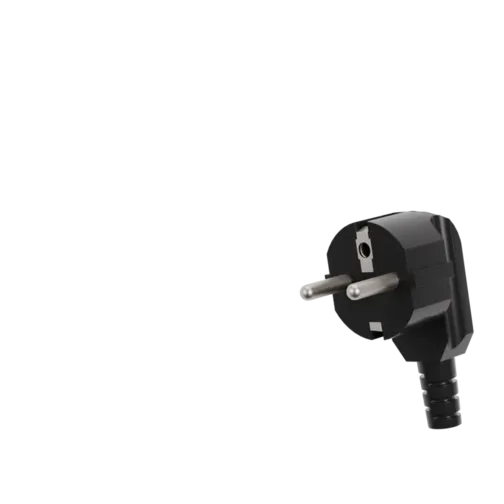
Plug
Type E
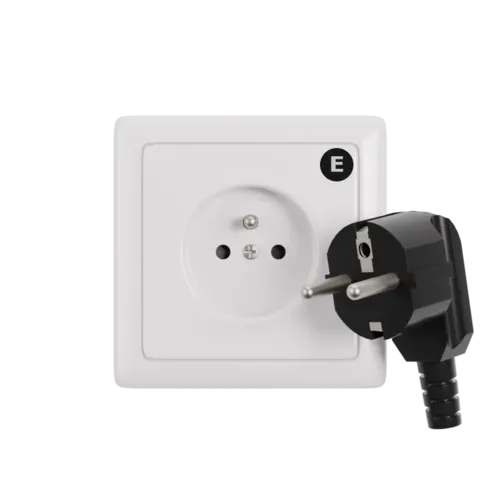
Plug & Socket
Type E
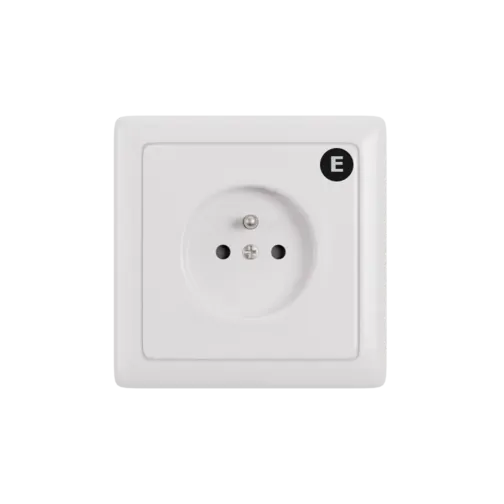
Socket
Type E
Heading to France, Belgium or Poland and wondering what the wall outlets look like? Plug type E is the round, two-pin system where the earth connection sits in the wall: every Type E socket has a male earth pin, and every Type E plug carries two round pins plus a hole for the earth pin.
Once you know that detail, you can tell which plugs fit, which need an adapter, and why the hybrid E/F plug ended up on almost every European appliance.
Plug Type E at a Glance: Round Pins, Earth Pin and 16 A Rating
The Type E connector belongs to the CEE 7 family of European plugs and sockets. It shares its pin size with its German neighbour but moves the earth pin from the plug to the socket.
Its connectors are rated at 16 A, which covers kettles and most household appliances. The socket has a round recess with a projecting grounding pin about 14 mm long, and the earth pin makes contact before the power pins do.
The matching CEE 7/6 plug has two 4.8 mm power pins set 19 mm apart and a female contact that receives the wall's pin. Like the socket, it is rated for 16 amps at 250V. Nearly every country using it supplies mains power at 230 V or 220 V and a frequency of 50Hz, and anything above 16 A is hard-wired or uses a heavier connector like IEC 60309.
| Connector | Common name | Earth connection | Rating | Fits the French wall socket? |
|---|---|---|---|---|
| CEE 7/5 socket | Type E (Belgian/French) | Projecting earth pin | 16 A | It is the socket |
| CEE 7/6 plug | Type E | Hole for the socket's pin | 16 A | Yes, earthed |
| CEE 7/7 plug | Type E/F hybrid | Hole plus side clips | 16 A | Yes, earthed |
| CEE 7/4 plug | Type F (Schuko) | Side clips only | 16 A | No |
| CEE 7/17 plug | Contour plug | None (unearthed) | 10 or 16 A | Yes |
| CEE 7/16 plug | Europlug | None (unearthed) | 2.5 A | Yes |
Type E/F Compatibility: Schuko and the CEE 7/7 Hybrid Plug
Germany and much of continental Europe use Type F, better known as Schuko, which puts the earth on clips at the sides of the socket. For decades the two were incompatible, because a CEE 7/3 socket's side notches and grounding clips were designed for a different plug body.
A classic CEE 7/4 plug is solid where the French socket expects a hole, so it does not fit. The CEE 7/7 plug, usually called the E/F plug, has metal earthing clips to touch the earth clips of a CEE 7/3 socket and a pinhole, so it is compatible with both and works from Lisbon to Warsaw.
In a French outlet it is effectively polarised, since the fixed pin lets it go in only one way.
Type C Europlug and CEE 7/17 Contour Plug
The Europlug (CEE 7/16, Type C) is a flat, unearthed plug with thinner 4 mm pins, rated at only 2.5 A. The CEE 7/17 plug has full-size pins and fits all three CEE 7 sockets, and it may be rated at 10 A or 16 A.
Which Plugs Fit the Belgian/French Socket
Because this power socket uses the standard European pin spacing, the earth pin decides the fit: a plug needs either a matching hole or no earth contact at all. A so-called universal socket in a hotel may take more types, but it meets no official standard. Compare this with plug sockets used in Saint Lucia.
Plugs That Fit Without an Adapter
- Type C (Europlug) and the CEE 7/17 plug, both unearthed.
- The CEE 7/7 hybrid, the plug on most new European equipment.
Type A and Type B plugs with flat blades, Type G plugs from the UK and Ireland, and Type J plugs from Switzerland all need an adapter. Going the other way, a Danish Type K socket in Denmark or Greenland accepts Type E plugs with no earth connection, while a Thai Type O socket accepts them fully.
An Italian Type L outlet takes the Europlug but not the round Type E body, and a Brazilian Type N socket accepts only the Europlug.
Safety Built Into the Type E Socket
The deep recessed socket face and the order in which contacts meet protect you, so a partly inserted plug presents no electric shock hazard. Many sockets add child-resistant shutters, required by national standards in some places, and there is no fuse in the plug, as overcurrent protection comes from the breaker. Travelling on? Check Type C plug.
How Earthing Protects You
The projecting earthing pin mates first and breaks last, so a metal-cased appliance stays grounded while live contacts are touching. Fault current then flows to earth and trips the breaker instead of reaching you.
An unearthed plug or an adapter with no earth path removes this protection without any visible sign. Type E sockets are polarised by the earth pin, but European equipment is designed to be safe with live and neutral swapped.
Countries Using the CEE 7/5 Socket
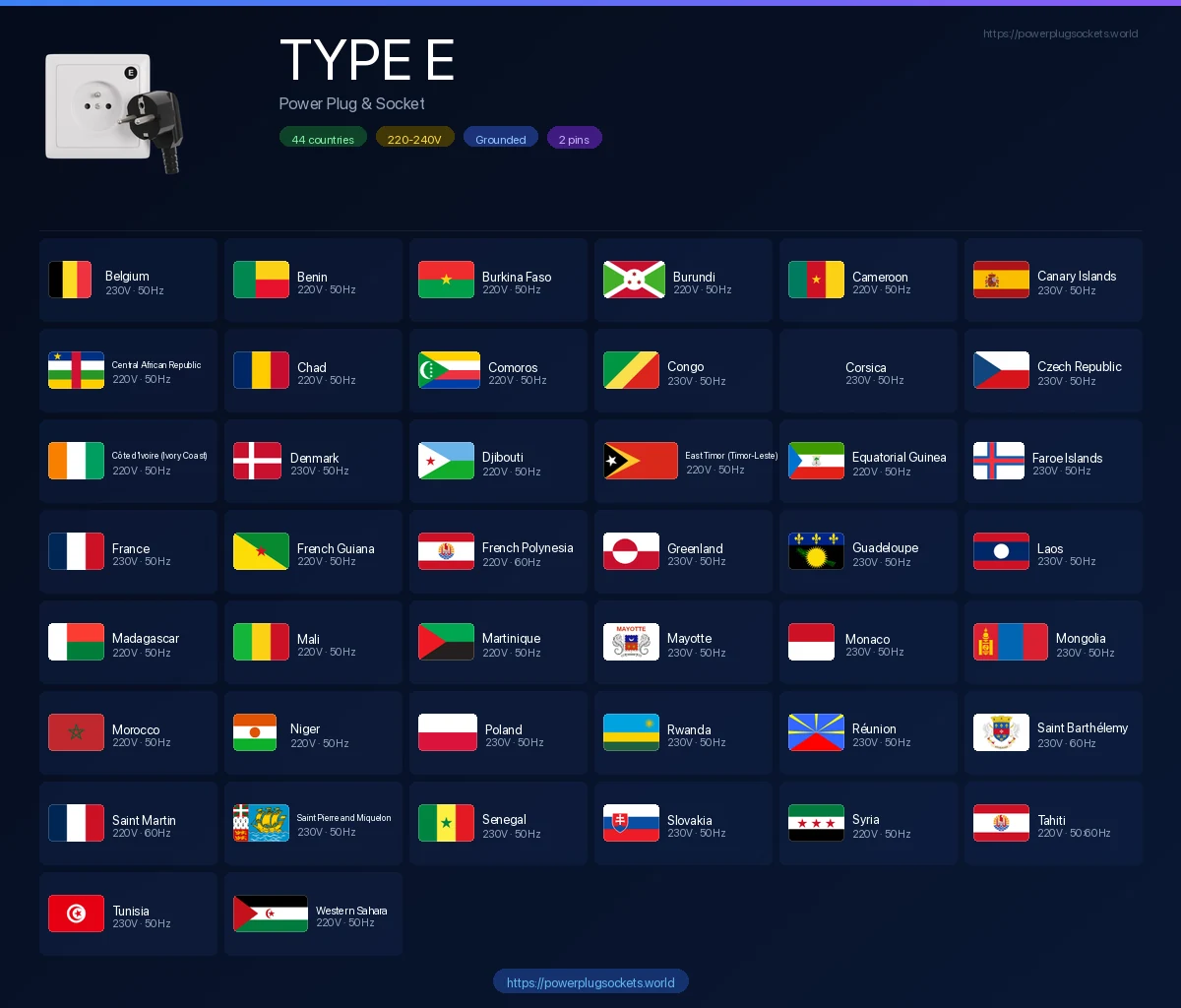
Type E sockets are the main standard in a handful of European countries and in much of French-speaking Africa, usually alongside the Europlug. This electrical socket appears in Belgium, France, Poland, the Czech Republic and Slovakia at 230 V and 50 Hz.
Type E in Europe
The French version is defined by NF C 61-314, and Denmark now permits it alongside its own Type K socket. Elsewhere, mainly Germany, Spain, the Netherlands and Scandinavia, you will find Schuko, but your E/F appliance plug fits there as well.
Africa, the Caribbean and Beyond
Former French and Belgian territories carried the system to Morocco, Tunisia, Senegal, Mali, Réunion, Mongolia and Martinique. Supply there can be 220 V rather than 230 V, which makes no difference to modern electronics.
Using a Type E Outlet Abroad
A travel adapter simply changes the plug shape and does not alter the electricity, so a 120 V-only appliance will be damaged. A voltage converter, or transformer, steps 230V down. See also Dubai plug type.
If the input voltage on the label reads 100-240 V, a plug adapter is all you need, and for a grounded plug choose travel adapters with an earthed hybrid output that keeps the earth connection.
Dual Voltage Chargers, USB Ports and Smart Power Sockets
Phone and laptop chargers are almost always dual voltage. Hair dryers and older kitchen appliances are often built for one supply and need a converter as well.
Adapters with USB ports are rated for a few watts per port, while the outlet still carries the 16 A limit of the wall socket. For extra outlets, use a proper power strip or extension cords made for this system.
A cheap adapter may claim surge protection, but that does not replace the earth path. Every strip or set of multisocket adaptors is rated for one total load, usually 16 A, so a hair dryer and kettle together exceed it.
Where the CEE 7/6 Plug Came From
The Type E design most likely originated in the Belgian market in the late 1920s or early 1930s, introduced by Vynckier Frères, and was never patented, so any manufacturer could copy it. The rival Schuko design was patented by Siemens in 1929, and royalties explain why the French, Czechoslovak and Polish markets chose the Belgian system.
In 1951 the standards body later known as IECEE gathered both into the CEE 7 specification, a set of standard sheets from 7/1 to 7/17.