Type M Power Plug & Socket
Type M plugs have three large round pins in a triangular pattern, larger than Type D. Used for high-power appliances and as the standard in South Africa. You may also need what plug does Portugal use.
Standard: BS 546 (15A)
Pin Configuration: Three large round pins in triangular pattern (earth 8.7mm diameter, live/neutral 7.1mm diameter)
Usage Notes: Type M is essentially a larger version of Type D. In South Africa, it's the standard for all outlets, not just high-power.
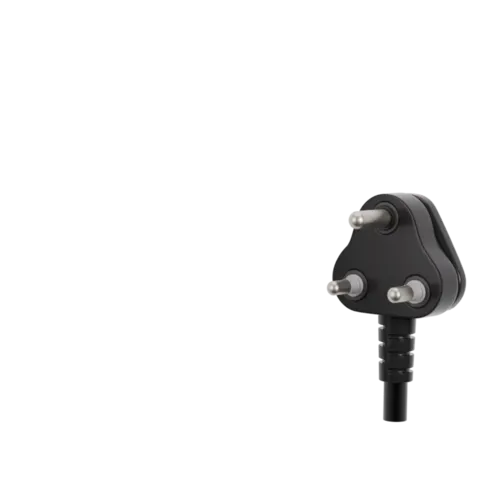
Plug
Type M
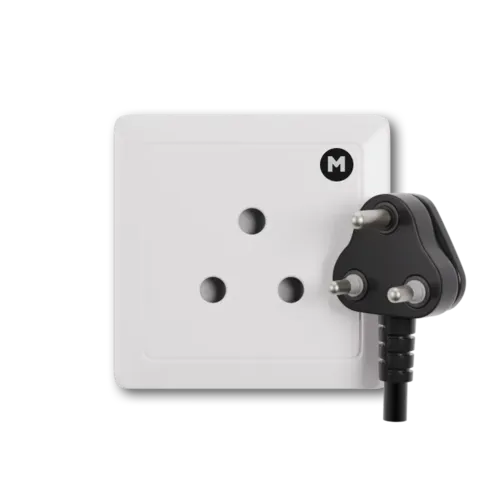
Plug & Socket
Type M
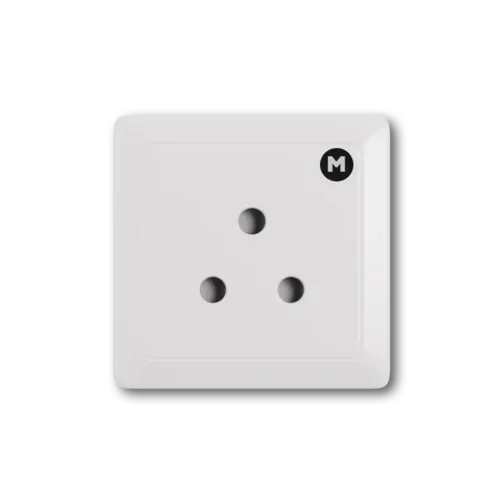
Socket
Type M
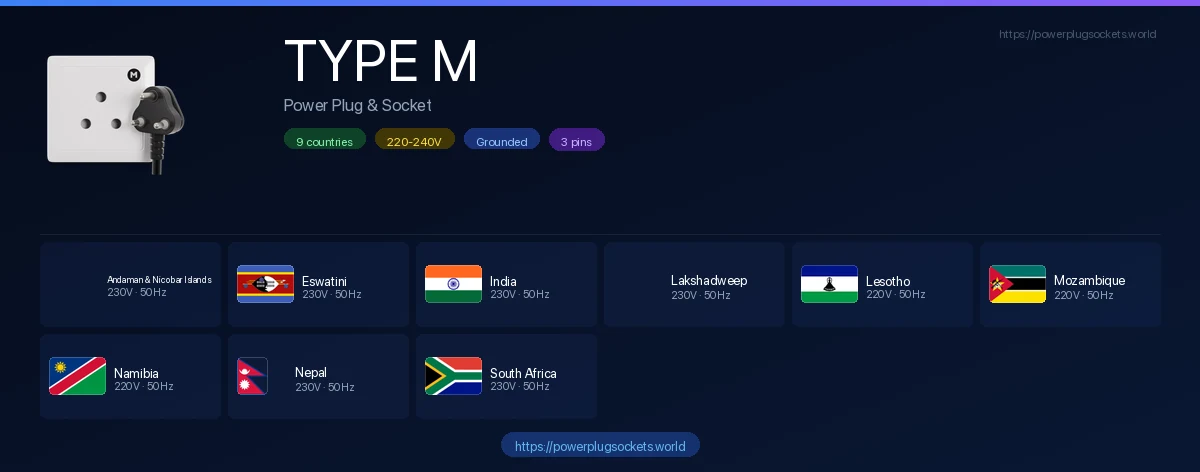
Packing for Johannesburg? The Type M plug is the chunky connector with three round prongs you will meet there.
Also listed as plug type M, it is a grounded design built for a far higher amp rating than most domestic plugs, so few foreign plugs fit its socket without an adapter. This page covers its pin sizes, where it is used, the mains supply and what to check before plugging in.
Plug Type M Pin Dimensions and Layout
Every Type M plug uses three round pins in a triangle, two power pins along the bottom and a thicker earth pin on top. The pin dimensions come from the published specification, so plugs from different factories still mate. Compare this with Australia power socket.
| Measurement | Millimetres | Inches |
|---|---|---|
| Earth pin, diameter | 8.7 mm | 0.34 in |
| Earth pin, overall length | 28.6 mm | 1.13 in |
| Line or neutral pin, diameter | 7.1 mm | 0.28 in |
| Line or neutral pin, overall length | 18.6 mm | 0.73 in |
| Distance between power pin centres | 25.4 mm | 1.00 in |
The pin centers sit exactly one inch apart. If the spacing is closer to 19 mm, you are holding a smaller relative, not a Type M.
Type M Earth Pin Size and Offset
The top pin is the grounding pin, deliberately the largest at 8.7 mm, and its earth pin length of 28.6 mm means it enters first and leaves last. In British terms it is the circuit protective conductor, and it also opens the shutters in many sockets.
Line and Neutral Pins With Insulated Sleeves
The line and neutral pins are 7.1 mm wide with a pin length of 18.6 mm. South African plugs usually have insulated pins with a plastic collar, which cuts the risk of electric shock when you pull a plug halfway out.
BS 546 Roots and Its Four Current Ratings
The design comes from BS 546, a British specification from 1934 that scales one round-pin shape to four current ratings: 2 A, 5 A (IEC Type D), 15 A (Type M) and 30 A. All are polarized, earthed through the top pin and unfused, so protection comes from the breaker in the distribution board. The sizes are non-interchangeable by design.
Amp Rating Compared With Type D
The closest relative is the 5 A plug of the same family, with the same shape but thinner pins and a smaller earth pin. Neither fits the other's socket, which is why the large version is sometimes called an Indian Type D scaled up.
The small pins suit lamps and electronics; the large ones carry a kettle, heater or air conditioner. Thick contacts run cooler under load, so the large plug suits equipment that draws serious power.
South African plugs of the modern specification are marked 16 A and 250V. A 2,850 W heater at 230 V draws about 12.39 A, which suits both the socket and the power cord.
Where the 15 A Plug Is Used Today
According to the IEC, about 15 countries use the 15 A plug. Type M outlets are the household norm in South Africa, Lesotho and Eswatini (formerly Swaziland) and appear in Namibia, Botswana and Mozambique. Travelling on? Check plug types used across Middle East, including Oman.
They also serve high-load circuits in India, Sri Lanka, Nepal, Pakistan and Bangladesh. Southern African mains electricity runs at 230 V with a frequency of 50 Hz, so a device labelled "220 Volt" is compatible and only the plug shape needs adapting.
Southern African Homes
In an older South African house almost every wall outlet is the large three-pin socket with a switch beside it, often next to a two-pin Europlug outlet for phone chargers.
Heavy Appliances in South Asia and the Middle East
Across South Asia the small socket handles everyday devices, while the large one is reserved for heavy loads such as geysers, room heaters and air-conditioning units. In Israel and the United Arab Emirates it turns up for wall-mounted air conditioners and washing machines, the plug of choice for larger appliances.
Stage Lighting in British Theatres
The 15 A size never fully left the UK. Stage lighting rigs still use it for lanterns and dimmers, because theatre electricians value a sturdy, unfused connector.
16 Amp Plug Safety: Earthing, Polarity and Shutters
The 16 amp plug relies on earthing from the long top pin, which connects first. Polarity is fixed because the triangle fits one way, so a polarized appliance has its switch on the live side. You may also need type G plug used in Hong Kong.
Modern sockets add shutters that stay closed until the earth pin opens them, and the face is often recessed. There is no fuse in the plug, so safety against overload comes from the circuit breaker.
Multisocket adaptors, extension cords and a plug strip all share the wall socket's 16 A, so adding outlets adds no capacity, and spreading big loads across separate sockets avoids a hot adaptor. Surge protection on a power strip guards electronics, not against overload.
A Grounded Socket Outlet Design
Every Type M socket is a grounded socket outlet with recessed contacts, and its top hole connects through the building's wiring to the earth bar. Equipment becomes earthed the moment you plug in.
In an older house, test the socket first, and avoid metal-cased items if the tester shows no earth, because grounding is the point of the large top pin.
SANS 164-1 and the Move to Type N
The South African specification for the large round-pin plug is SANS 164-1, rated 16 A and 250 V. In 2013 the slimmer Type N (SANS 164-2) became the preferred standard, and since 2018 new homes need at least one new socket at each outlet point, with the older socket allowed if one is adjacent. Type N pins sit 19 mm apart, so Europlugs fit straight in.
Many wall plates are hybrid or multi-standard, so a type M plug and socket pair keeps working. A universal socket has no official approval and may not keep the earth connection or the 16 A rating, so check a Type M Plug & Socket set carries the SABS mark.
Choosing a South Africa Adapter for Your Trip
Few foreign plugs fit this socket, so most visitors need a south africa adapter. Universal adaptors and other travel adaptors often skip the large three-pin shape, so a dedicated travel adapter is the more reliable choice.
An adapter only changes the shape of the plug, never the supply.
Travel Plug Adapter Features to Check
Before you buy a travel plug adapter for this socket, check these points:
- A grounded outlet so both 2-prong and 3-prong plugs stay earthed.
- A load rating of at least 13A, ideally 16 A.
- Built-in USB ports, with a USB-C port for fast charging.
- Markings such as CE Certified or the SABS mark.
- A firm grip in the electrical outlet, since heavy pins make a loose adapter sag.
Most cell phones and laptop chargers list an input voltage of 100-240V, so they are dual voltage and need only the adapter. Single-voltage items from North America, such as some hair dryers, are rated for about 120 volts and need a voltage converter rated above their wattage.