Type A vs Type H Plugs: Differences & Compatibility
Type A vs Type H plugs are not compatible: an adapter is needed in both directions. Type A is a 2-pin, ungrounded plug rated 15A at 100-127V, while Type H is a 3-pin, grounded plug rated 16A at 220-240V. The two differ mainly in grounding, voltage, amperage and pin design, which is what decides compatibility — whether a Type A plug fits a Type H socket, and vice versa. Next, check will a type H plug work in a type I socket without an adapter.
Swipe to compare
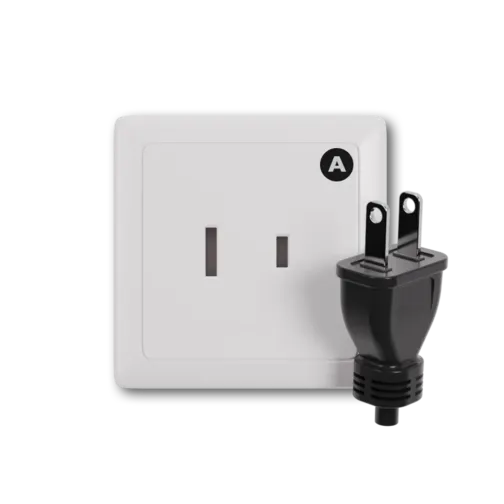
Type A
|
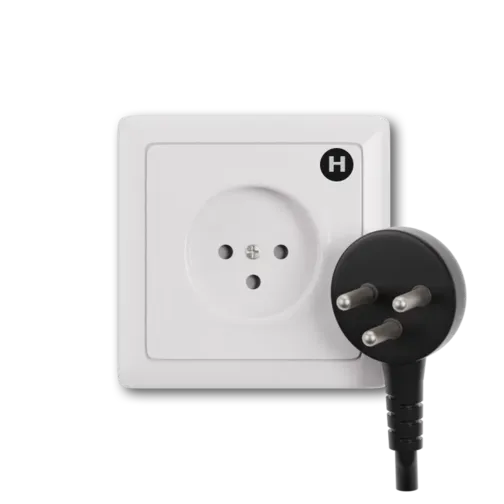
Type H
|
|
|---|---|---|
| Standard | NEMA 1-15 | SI 32 |
| Pin Configuration | Two flat parallel pins (15.9mm apart, 15.9mm long, 6.3mm wide) | Three pins in V-shape arrangement (round 4.5mm or flat pins, 19mm length) |
| Grounding | Ungrounded | Grounded |
| Pin Count | 2 | 3 |
| Amperage | 15A | 16A |
| Voltage Range | 100-127V | 220-240V |
Packing a laptop from New York for a week in Tel Aviv? The type A vs type H plug question comes down to one fact: the two flat blades of an American plug have no matching holes in an Israeli wall socket, so you always need an adapter, and sometimes a voltage converter too.
Below you'll see how the pins, earthing, ratings and safety of each design differ, and which plugs each socket accepts.
Type A vs Type H Plug at a Glance
Both designs belong to the family of power plugs and sockets that the IEC labels with letters from A to O, but they come from opposite ends of the world of electricity. The American design uses two flat blades about 12.7 mm apart with no earth contact; the Israeli design arranges three round pins in a triangle, with the earth pin 9.5 mm below the line joining the live and neutral pins, which sit 19 mm apart.
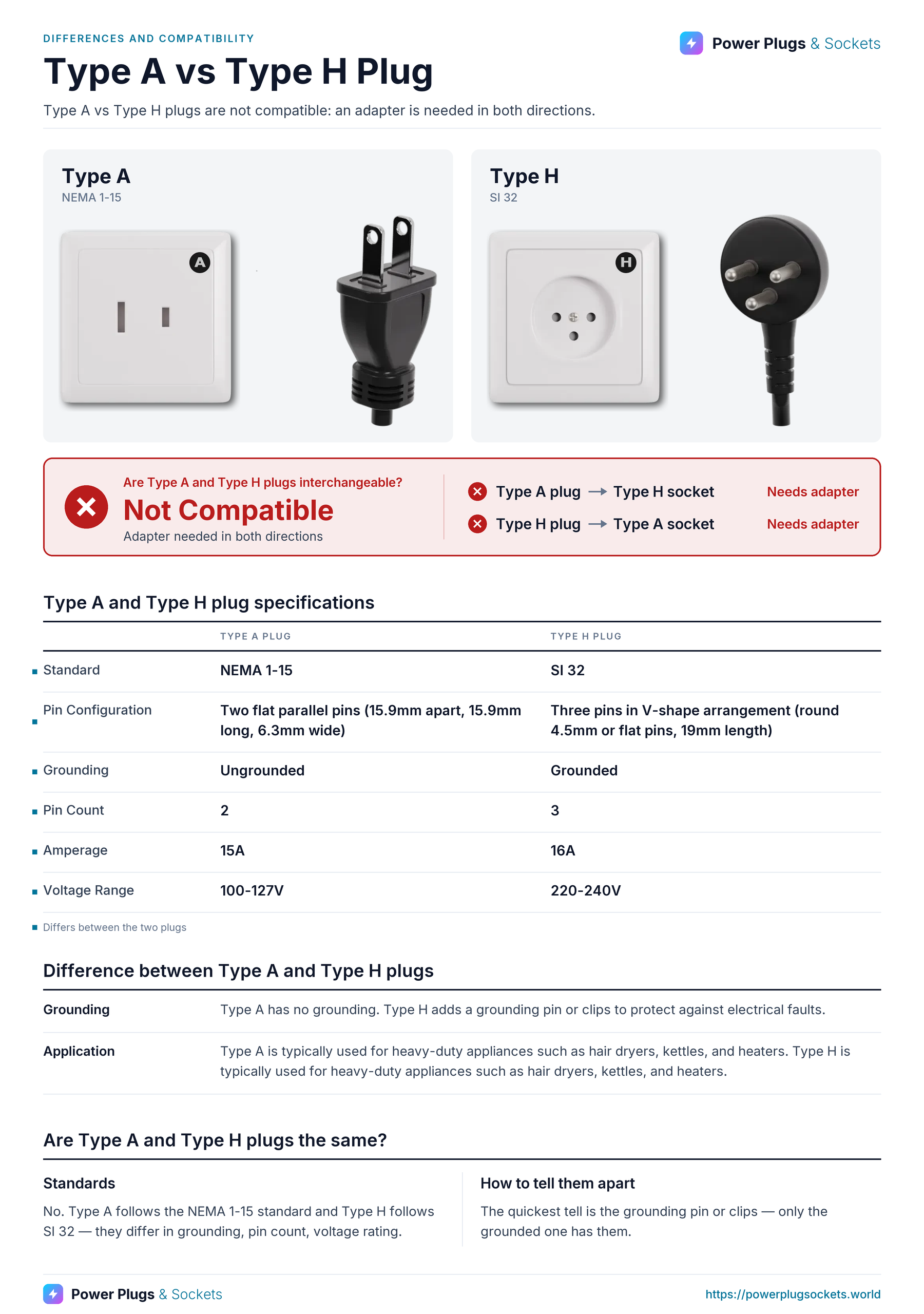
That pin spacing is shared by nothing on the other side. The two share no geometry, so neither fits the other's socket.
The American plug is also ungrounded, suiting double-insulated Class II devices, while the Israeli plug is earthed, sending fault current to ground.
| Feature | Type A (NEMA 1-15) | Type H (SI 32) |
|---|---|---|
| Pins | 2 flat parallel blades | 3 round pins (flat on pre-1989 plugs) |
| Earth pin | None | Yes, below the live and neutral pins |
| Polarized | Usually (wider neutral blade in the US) | Socket polarity is defined, plug is not keyed |
| Current rating | 15 A | 16 amp |
| Mains voltage | 120 V (US), 100 V (Japan) | 230 V |
| Frequency | 60 Hz (50 Hz in eastern Japan) | 50 Hz |
| Accepts the Europlug (type C) | No | Yes |
| Main countries | United States, Canada, Mexico, Japan | Israel, West Bank, Gaza Strip |
A US appliance designed for 110V supply can't plug in physically, and even with an adapter it may not survive the higher voltage.
How the US Plug Is Built: NEMA 1-15 Blades
The US plug is formally the NEMA 1-15, named after the National Electrical Manufacturers Association. It is rated at 15 A and 125 volts, and it fits both the old two-slot receptacle and the modern three-slot grounded receptacle.
Two Flat Parallel Prongs and the Polarized Neutral Blade
Every type A plug has two flat parallel prongs. On most US plugs the neutral blade is wider, which makes the plug polarized: it goes in one way only, so a lamp switch interrupts the live wire.
A Japanese plug has equal-width prongs.
Type A and B: The Ungrounded and Grounded Pair
Type B is the NEMA 5-15, the same two blades plus a round grounding pin, and its socket accepts type A plugs too. Ungrounded two-slot outlets are barred in new construction but linger in older buildings.
Neither the two-blade nor the three-prong American plug fits an Israeli wall socket, so both need the same adapter.
Where It Is Used: North America, Central America and Japan
Power outlet type A is standard across North America and Central America, and in Japan, at 120V in the US and Canada and 100 V in Japan. China also uses the type A socket, but on a 220 V grid, a reminder that a matching socket says nothing about the voltage behind it.
How the Israeli Plug Is Built: SI 32 Standard
The Israeli plug is defined by the Standards Institution of Israel in SI 32 (also written SI32). Each round pin is 4.5 mm in diameter, the plug is rated for a current of 16 A at 230 V, and no other country has adopted it. You might also want will a type J plug work in a type M socket without an adapter.
Type H plugs is also listed on IEC charts as plug H.
From Flat Pins to Round Prongs
Before 1989 the plug had three flat prongs in a Y-shape, the power blades in a V shape above the earth blade. Since 1989 it has three round prongs in the same positions, and sockets take both; the old flat-bladed plugs are obsolete.
Type H Outlets and the Europlug
A power outlet type H takes the two-pin Europlug (type C), because the line and neutral holes sit 19 mm apart, the same spacing as its pins. Any device with a type C plug works there without an adapter, as long as the voltage suits it, though a Europlug has no earth pin and only suits Class II devices.
Where It Is Used: Israel, the West Bank and Gaza Strip
The plug is used in Israel, the West Bank and the Gaza Strip, covering Israel and Palestine, all on 230 V at 50 Hz. Hotels follow the same standard, so expect SI 32 outlets in your room.
Plugs and Outlets Compatibility: What Fits Where
Compatibility between these two designs is simple: there isn't any. Neither plug fits the other's socket.
A US two-prong plug cannot fit an Israeli socket, because its blades are too wide for the round holes and sit 12.7 mm apart instead of 19 mm. Use a plug adapter, or a US-to-Europe adapter with two round pins for Class II devices; for a three-prong NEMA 5-15 plug, choose one that carries the earth through.
Some hotels fit a hybrid socket, or multi-standard sockets, that accept several plug types, but they rarely change the voltage, so check your device label first.
- Type A plug into a NEMA 5-15 socket: fits
- Type B plug into a type A socket: doesn't fit (no earth hole)
- Type A plug into type H sockets: doesn't fit
- Type C Europlug into a type H socket: fits
- Type E or F plug into an Israeli socket: forced fit, unsafe
- Type H plug into US outlets: doesn't fit
Why Type E and Type F Plugs Are Forced, Not Fitted
The French type E and German Schuko (type F) plugs have 4.8 mm pins, while Israeli socket holes are sized for 4.5 mm. A Schuko plug can sometimes be forced in, but its earth clips connect to nothing and the appliance runs unearthed.
Use a Schuko-to-SI 32 adapter and never file down the pins.
Voltage and Safety: US Appliances on an Israeli Socket
Getting the plug in is half the job. The bigger risk is voltage: the grid delivers about twice the 120 V US appliances were built for, so a device that can't handle it overheats and can fail within seconds. You might also want comparing type A and type B plugs for international travel.
The pins are not insulated and sockets are rarely recessed, so a plug pulled halfway out leaves live metal exposed and raises the risk of electrocution for children. Look for outlets with shutters, tamper-resistant receptacles in the US, and plug covers for child protection.
Dual Voltage Chargers vs a Voltage Converter
If a charger's label says 100-240V, 50/60 Hz, it is dual voltage and needs only a plug adapter; most phone, laptop and camera chargers are built this way. A label showing 110V–120V only, such as on a hairdryer or shaver, means you need a voltage converter or step-down transformer too, and buying a local hairdryer is often simpler.
Choosing a Travel Adapter for Israel
For most travelers from North America, the right travel adapter for Israel is simple:
- Check whether your devices use a two-blade or three-prong plug.
- Choose an adapter with SI 32 pins, or a Europlug adapter for two-blade Class II devices only.
- Prefer one with an earth connection if you bring anything with a metal case.
- A model with USB ports charges a phone and earbuds from one socket.
- Confirm every other device is dual voltage, or pack a converter.
Universal adapters rarely carry the earth to an SI 32 socket, so they suit chargers rather than appliances. The type A vs type H plug mismatch is purely mechanical; the voltage check is what keeps your devices alive.