Type A vs Type M Plugs: Differences & Compatibility
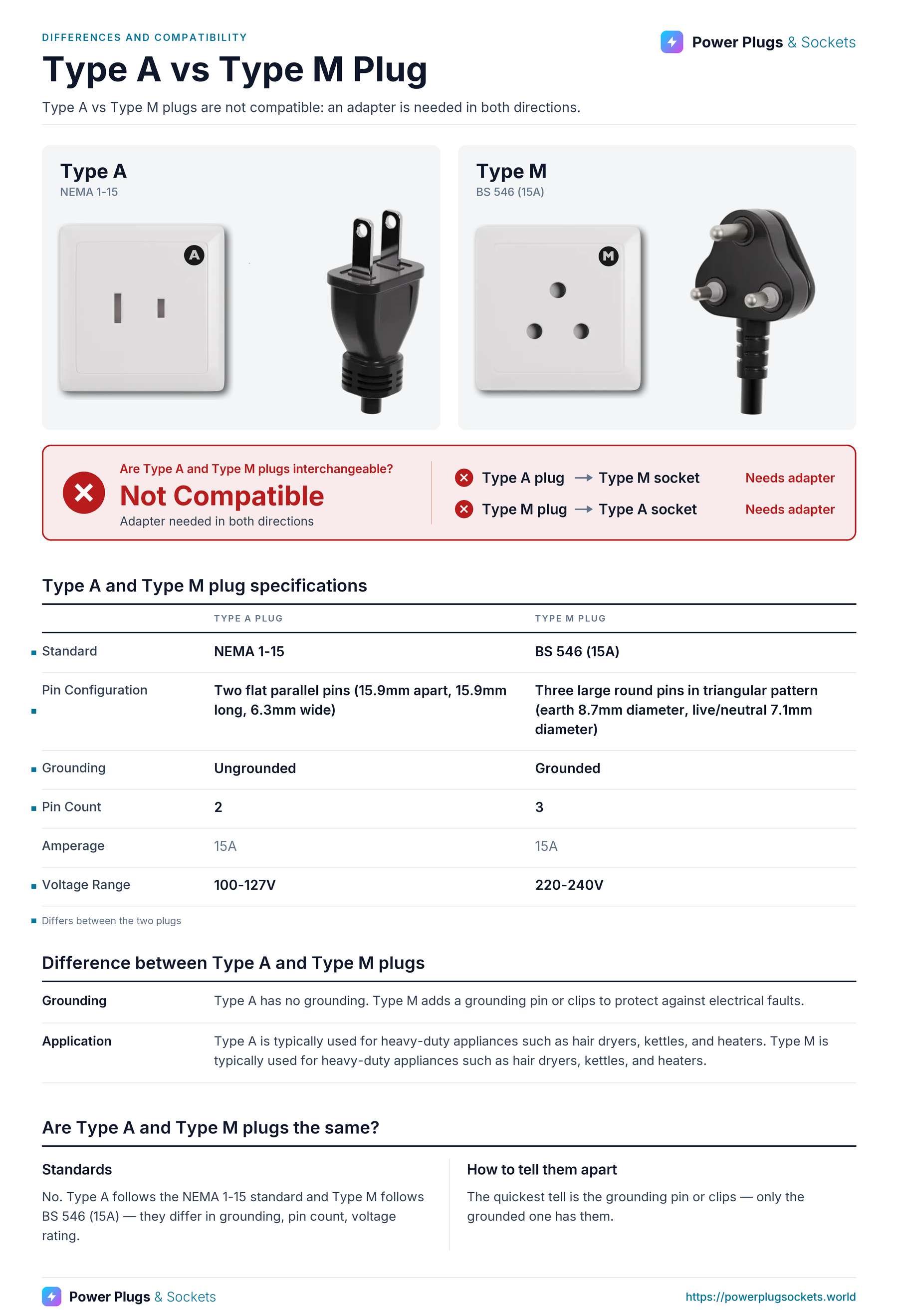
Type A vs Type M plugs are not compatible: an adapter is needed in both directions. Type A is a 2-pin, ungrounded plug rated 15A at 100-127V, while Type M is a 3-pin, grounded plug rated 15A at 220-240V. The two differ mainly in grounding, voltage and pin design, which is what decides compatibility — whether a Type A plug fits a Type M socket, and vice versa. For a related pairing, see type B versus type O plug shape and socket design compared.
Swipe to compare
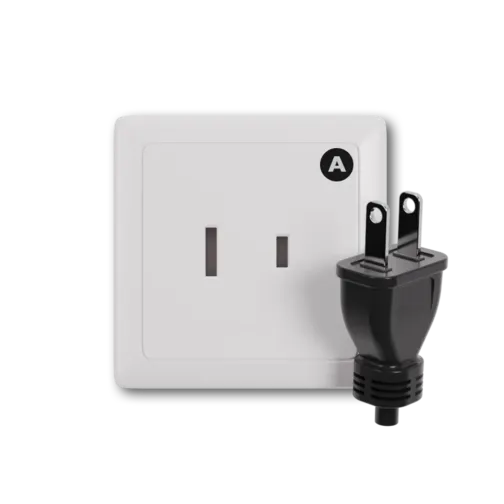
Type A
|
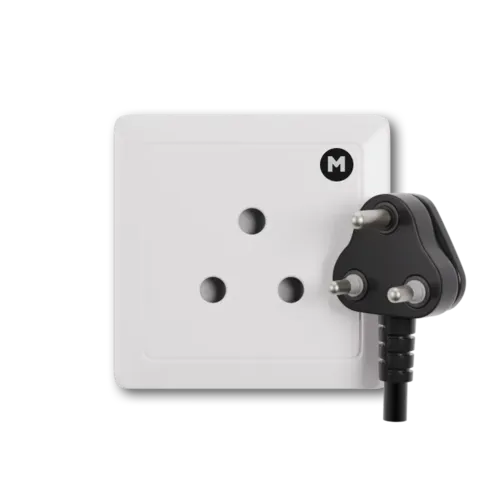
Type M
|
|
|---|---|---|
| Standard | NEMA 1-15 | BS 546 (15A) |
| Pin Configuration | Two flat parallel pins (15.9mm apart, 15.9mm long, 6.3mm wide) | Three large round pins in triangular pattern (earth 8.7mm diameter, live/neutral 7.1mm diameter) |
| Grounding | Ungrounded | Grounded |
| Pin Count | 2 | 3 |
| Amperage | 15A | 15A |
| Voltage Range | 100-127V | 220-240V |
Packing for Johannesburg with American chargers? The type A vs type M plug answer: a slim two-blade American plug will never go into a large three-pin South African wall outlet without an adapter, and that does nothing about the difference in electricity supply.
Below are the dimensions, ratings, countries and safety features of both plug types for travellers.
Type A vs Type M Plug at a Glance
The IEC (International Electrotechnical Commission) records the national standard behind each letter in IEC TR 60083. One is a slim, unearthed plug for low-voltage countries; the other a heavy earthed connector for 220 – 240 V mains. Also see what is the difference between type C and type L electrical sockets.
| Feature | Flat-blade plug (A) | Round-pin plug (M) |
|---|---|---|
| National standard | NEMA 1-15; JIS C 8303 Class II in Japan | BS 546; SANS 164-1; IS 1293 |
| Pins | 2 flat parallel blades | 3 round pins in a triangle |
| Earth contact | None (ungrounded) | Large top earth pin (grounded) |
| Rated current | 15 A | 15 A in the UK, 16 A in South Africa and India |
| Plug voltage rating | 125 V | 250 V |
| Typical mains supply | 100 – 127 V, 60 Hz | 220 – 240 V, 50 Hz |
| Polarized | Optional (wider neutral blade) | Yes |
| Fused | No | No |
| Insulated pins | No | Optional sleeves |
| Spacing of the power contacts | 12.7 mm between blade centres | 25.4 mm between pin centres |
| Accepted by the other's sockets | No | No |
| Main countries | USA, Canada, Mexico, Japan | South African region: Lesotho, Eswatini |
Nothing overlaps, so there is zero physical compatibility in either direction: the live pin and neutral pin sit twice as far apart as the blades, and the pins are much larger than the smaller type D. The real electrical gap is the supply, not the amperage (15 amps against 16 A), so you need both a physical adapter and a voltage check.
NEMA 1-15: How the Flat-Blade American Plug Is Built
The plug type A on most American phone chargers and lamps is defined by NEMA 1-15: two flat prongs, no earth. Harvey Hubbell patented the parallel-blade design in 1913. Compare this with which countries use type K plugs versus type O plugs.
The blades are about 6.3 mm wide, 12.7 mm apart, with a hot blade and a wider neutral, rated 15 A at 125 V; on a polarized plug the wider neutral blade means one way round only, while older unpolarized plugs have equal blades. The power outlet type A is standard in North America, Central America and Japan: the United States, Canada and Mexico, though older buildings may still have ungrounded two-slot sockets and new construction no longer allows them.
Japan uses JIS C 8303 Class II at 100 volts, and mainland China fits these sockets for unearthed appliances.
How Type A and B Plugs Relate
The type B plug (NEMA 5-15) adds a round grounding pin to the same blades. Grounded sockets accept both type A and B, but neither fits round-pin sockets.
BS 546 and the Large Round-Pin Plug Family
The plug type M grew out of a British standard introduced in 1934 with 2 A, 5 A, 15 A and 30 A round-pin sizes for 250 V. India added a 16 A version under IS 1293, and South Africa followed.
Type M Pin Measurements and Insulated Sleeves
Three pins form a triangular layout. The earth pin is 28.6 mm long with an 8.7 mm pin diameter; the line and neutral pins are 7.1 mm thick and 18.6 mm long.
South African plugs often have insulated sleeves, and protection from excess current comes from the circuit breaker, not the plug.
Where You Find It in South Africa, Lesotho and Eswatini
The power outlet type M is the everyday residential socket in these three countries (Eswatini was formerly Swaziland), all at 230 volts and 50 hertz. It also appears in Namibia and Sri Lanka.
Heavy Appliances in India, Nepal and Israel
In India and Nepal the 16 A type M socket serves larger appliances such as geysers, room heaters and air conditioners, and sometimes washing machines. Israel and the United Arab Emirates use it for air-conditioning units; in the UK it lingers as a theatre lighting connector.
Why Type N Is Replacing the Round-Pin Socket
South Africa adopted IEC 60906-1 as SANS 164-2 and made this type N plug the preferred standard in 2013. Since 2018, new homes need at least one type N socket per wall outlet.
Two Flat Parallel Prongs vs Three Round Prongs on Safety
For electrical safety, the American plug relies on the appliance for protection; the round-pin plug carries a protective earth to the wall, and its current rating is higher. A two-blade plug is never grounded and has no earth ground path through the cord, so earthing, via grounding pin and earth pin differences, is the main reason the M plug is big; its longer earth pin touches first, breaks last and opens the shutters over the live and neutral holes.
For protection from accidental contact, American blades are bare, so a plug pulled halfway out stays live, a risk of electrocution and electric shock for children, and the same holds for a partially inserted round-pin plug. Round-pin sleeves and shutters help, but neither system is fully recessed.
Class II Appliances Without an Earth
The flat-blade plug is safe without an earth only because Class II appliances use double insulation. Metal-cased appliances use the grounded three-prong plug.
Voltage and Frequency Behind the 16 Amp Plug
The 16 amp plug is rated 250 V and runs on 230-volt mains, while the American plug sits on roughly half that. The voltage rating of plugs and cords matters too: a NEMA 1-15 plug and cord are marked for 125 volts, a round-pin plug 250 V, so check the marking on the cord, not just the device label.
120 V Versus 230 V Mains
A 1,250 W travel kettle built for 120 V would try to dissipate about 4,590 W at 230 volts, 3.7 times its rating, and burn out. Clocks and motors built for 60 hertz run slow on 50 hertz.
Dual Voltage Devices and AC Adapters
If the power brick says Input: 100-240V, 50/60Hz, the device is dual voltage and needs only the plug change. Most laptop chargers qualify, while a hairdryer, hair straighteners, travel kettles and rice cookers need conversion as well.
Travel Adapter Choices for SANS 164-1 Sockets
Choosing a travel adapter for round-pin sockets is less obvious than for Europe or the UK. An adapter only changes pin shape, not 120 volts into 230 volts, so a plug adapter or voltage converter question follows: single-voltage devices need a step-down voltage converter rated above their wattage, or a local replacement.
A multi-standard universal socket, like a power strip with American sockets and one adapter, sits outside any standard and may grip loosely, so use it for chargers only; never chain an extension cord into a loose plug in a wall socket.
Why Worldwide Travel Adapters Often Skip It
Most worldwide travel adapters omit the large round-pin plug. Buy a dedicated plug adapter with a round-pin front, or a Europlug front, since newer South African outlets accept the Europlug; models with USB ports charge several devices at once.