Type B vs Type E Plugs: Differences & Compatibility
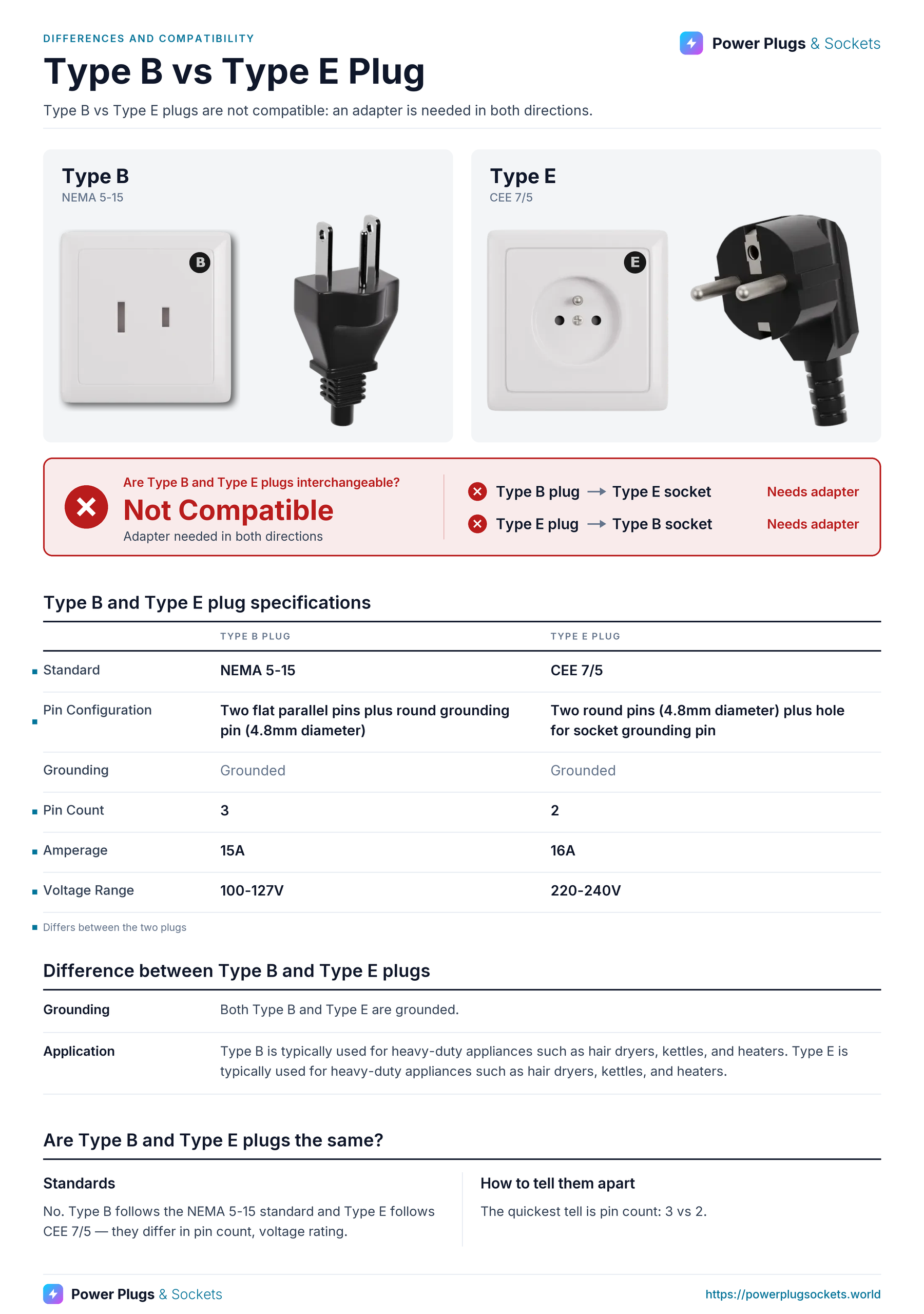
Type B vs Type E plugs are not compatible: an adapter is needed in both directions. Type B is a 3-pin, grounded plug rated 15A at 100-127V, while Type E is a 2-pin, grounded plug rated 16A at 220-240V. The two differ mainly in voltage, amperage and pin design, which is what decides compatibility — whether a Type B plug fits a Type E socket, and vice versa. For a related pairing, see what adapter converts a type G plug to a type K socket.
Swipe to compare
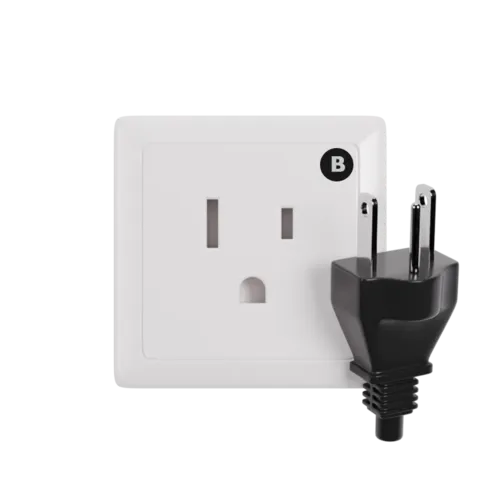
Type B
|
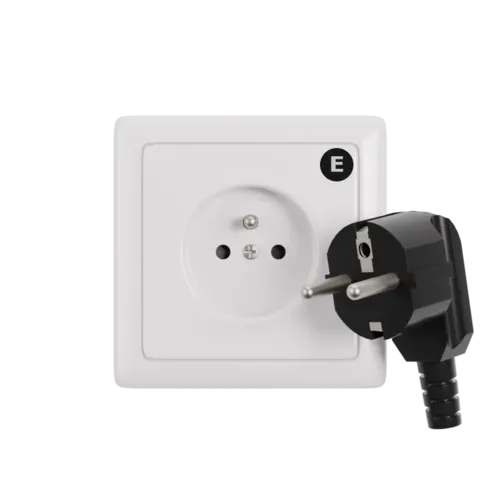
Type E
|
|
|---|---|---|
| Standard | NEMA 5-15 | CEE 7/5 |
| Pin Configuration | Two flat parallel pins plus round grounding pin (4.8mm diameter) | Two round pins (4.8mm diameter) plus hole for socket grounding pin |
| Grounding | Grounded | Grounded |
| Pin Count | 3 | 2 |
| Amperage | 15A | 16A |
| Voltage Range | 100-127V | 220-240V |
Pack a laptop charger in Chicago, unpack it in Lyon, and the type B vs type E plug question stops being trivia. Type B has two flat parallel pins plus a ground prong on the plug, while Type E uses two round pins and takes its earth from a pin fixed in the wall.
That design choice decides whether your appliance fits, stays earthed, and survives the mains electricity abroad.
Type B vs Type E Plug at a Glance
Type B is the North American NEMA 5-15 design for a 15 A circuit; Type E is the Belgian and French design in the European CEE 7 standard sheets, built for 16 A, 250 V. Both appear in IEC TR 60083, yet share almost nothing but a protective earth.
| Feature | Type B | Type E |
|---|---|---|
| Standard | NEMA 5-15 (US), JIS C 8303 Class I (Japan) | CEE 7/5 socket with CEE 7/6 plug |
| Power contacts | Two flat blades, 12.7 mm apart | Two solid pins, 4.8 mm across, 19 mm apart |
| Earth contact | Round or U-shaped pin on the plug | Round pin fixed in the socket |
| Rating | 15 A, 125 V | 16 A, 250 V |
| Typical supply | 100-127 V at 60 Hz | 220-240 V at 50 Hz |
| Earthed | Yes | Yes |
| Polarized | Yes, fixed by the third pin | Partially |
| Insulated pins | No | No |
| Recessed socket | No, flush receptacle | Yes, circular well |
| Socket accepts | Type A and Type B plugs | Type C, Type E and hybrid E/F plugs |
| Main countries | USA, Canada, Mexico, Japan, Taiwan | France, Belgium, Poland, Czech Republic, Slovakia |
Which Socket Accepts Which Plug
Neither socket outlet takes the other's plug: a Type B outlet takes blades and a Type E outlet takes cylindrical pins. Each accepts relatives, such as Type A in Type B and Type C in Type E, so the two systems are incompatible without an adapter.
Type B Plug Design: The NEMA 5-15 Standard
NEMA is the National Electrical Manufacturers Association. In NEMA 5-15, the 5 marks the grounded 125 V family and 15 the rating, meaning 15 amps; NEMA 5-20 adds a T-shaped neutral slot yet still accepts a 5-15 plug. For a related pairing, see will a type F plug work in a type L socket without an adapter.
Flat Parallel Pins and a Longer Grounding Pin
The blades are 1.5 mm thick, often with a small hole near the tip, and on two-pin plugs the neutral blade is wider than the hot blade. A round grounding pin about 3.2 mm longer than the blades sits below, so earthing is made before power reaches the device.
The grounding prong fixes the orientation.
Type A and the Japanese Class I Version
Type A is the same plug without the third pin, the ungrounded NEMA 1-15, and a Type B outlet accepts it. Japan uses the same shapes under JIS C 8303, often with equal-width slots on 100 V.
Where Type B Is Used in North America and Beyond
Type B is standard in the United States, Canada, Mexico, most of Central America, the Caribbean and Taiwan, mostly at 110-127 V. The Philippines and Peru have flat-blade outlets on 220 V, so check the supply too.
Type E Design: The CEE 7/6 Plug and CEE 7/5 Socket
Type E most likely started in Belgian factories in the 1930s and was written into the European CEE 7 sheets in 1951: CEE 7/5 describes the socket and CEE 7/6 the plug, rated 16 A at 250 V.
Round Pins and the Socket's Round Earth Pin
The plug carries two solid pins, 4.8 mm in diameter, and a matching pinhole that slides over the earth pin projecting from the socket's circular recess, with an earth pin offset of 10 mm above the power holes. The earth connection is made first and breaks last.
Countries That Use Type E in Europe
Type E is the primary socket in France, Belgium, Poland, Czechia and Slovakia, and in many former French territories. The supply is 230 V at 50 Hz, nearly twice the North American voltage.
Can Type B Plugs Fit a Type E Socket? Compatibility Explained
No. Blades need rectangular slots, and a Type E outlet has only round holes plus an earth pin that blocks other shapes. A Type E outlet is compatible with Type C, Type E and hybrid plugs, but a Schuko (Type F) plug won't fit because the socket's pin blocks its earth clips.
The CEE 7/7 hybrid has side strips and a pinhole, rated 16 A at 250 V, so it is earthed in both socket types. The Europlug (Type C) is an unearthed 2.5 A plug for small double-insulated chargers.
Universal Sockets and Multi-Standard Outlets
Hotel universal sockets accepting both pin shapes meet no official standard. Contacts grip poorly, the earth may not connect, and the socket still delivers local mains.
Voltage and Frequency Gaps Between Type B Sockets and Type E Outlets
Type B sockets deliver 120 V at 60 Hz and Type E outlets 230 V at 50 Hz. A 120 V-only hair dryer on 230 V mains draws about 3.7 times its rated power and can fail within seconds or start a fire.
A plug adapter only changes shape; a voltage converter changes the voltage. If the label says INPUT: 100-240 V, 50/60 Hz, the adapter is enough, and laptop and phone chargers are usually such dual voltage devices.
A 15 A outlet at 120 V supplies 1,800 W against 3,680 W for a 16 A Type E outlet, and many cheap adapters carry only a 10 A current rating. If a device's voltage rating shows only 120 V, you need a converter rated above its wattage, or a European replacement.
Grounded Plug Safety: Earthing and Polarization
On Type B the grounding contact is a pin on the plug; on Type E it is a pin on the socket, giving fault current a safe path so a damaged appliance trips the circuit breaker instead of causing an electric shock. A Type B outlet is polarized; Type E is only partly polarized, or polarised in British spelling, while Schuko is unpolarized.
Type E pins are not sleeved, and neither plug carries a fuse, so overcurrent safety depends on the building's circuit breakers.
Shutters, Recessed Sockets and Pulled-Out Plugs
A partially pulled-out plug in a flush Type B wall socket can leave live metal exposed, while the recessed Type E socket hides the pins inside the round well. French rules call for child-resistant shutters on new sockets.
The US electrical code has required tamper-resistant receptacles in new homes since 2008.
Picking a Travel Adapter for an Earthed Plug
For a laptop or any earthed plug, choose a travel adapter that keeps the earth connected rather than a two-pin model. Check that it accepts a three-pin Type B plug, has a current rating covering your heaviest appliance (16 A is better than 10 A), and never stack adapters. Compare this with type I vs type M plug.
Class II equipment relies on double insulation and needs only a simple shape adapter.
Extension Cords, Power Strips and Multisocket Adaptors
For international travellers, most North American power strip models are built for 125 V and can overheat on European mains whatever the amperage or power supply rating of the devices, so a locally bought extension cord or multisocket adaptor is safer.