Type G vs Type K Plugs: Differences & Compatibility
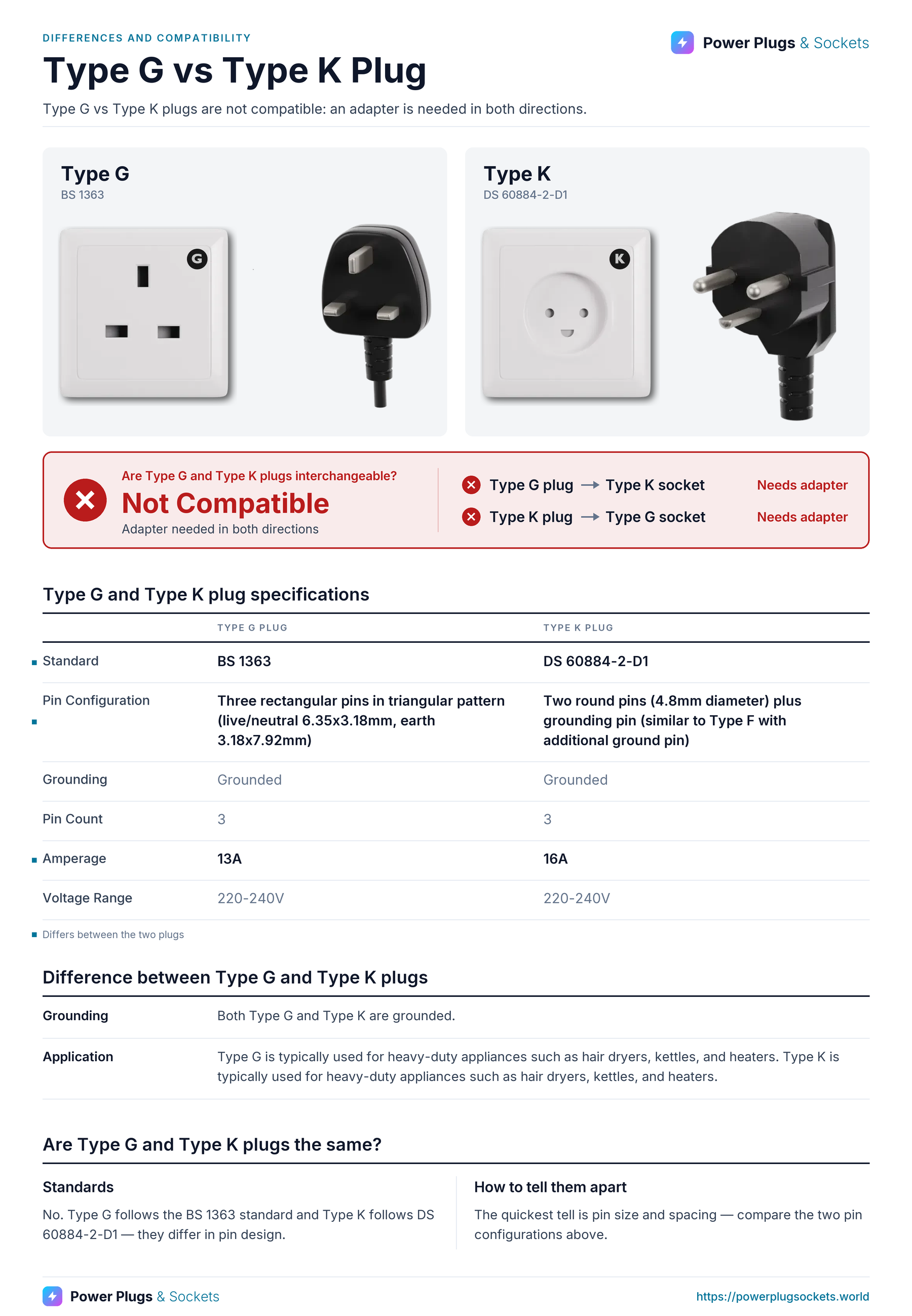
Type G vs Type K plugs are not compatible: an adapter is needed in both directions. Type G is a 3-pin, grounded plug rated 13A at 220-240V, while Type K is a 3-pin, grounded plug rated 16A at 220-240V. The two differ mainly in amperage and pin design, which is what decides compatibility — whether a Type G plug fits a Type K socket, and vice versa. You might also want type E plugs run on 220-240V while type L plugs run on 220-240V.
Swipe to compare
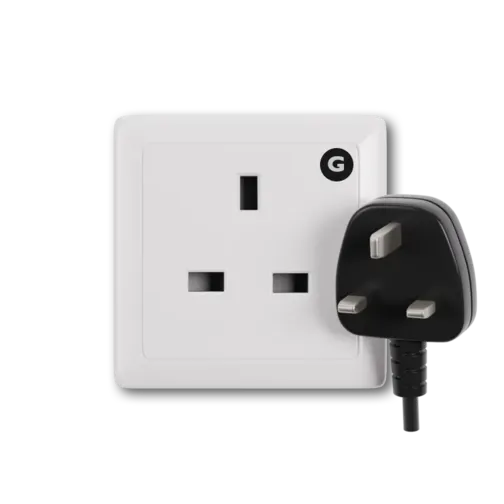
Type G
|
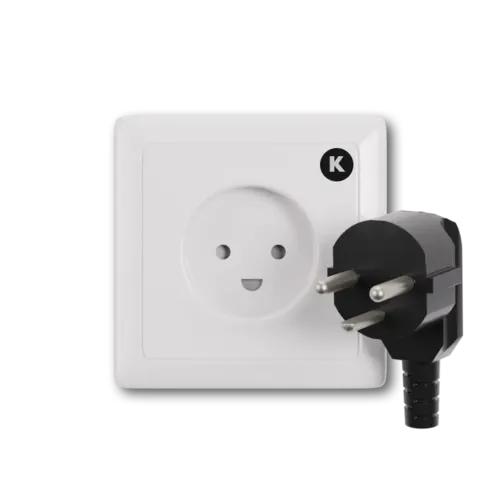
Type K
|
|
|---|---|---|
| Standard | BS 1363 | DS 60884-2-D1 |
| Pin Configuration | Three rectangular pins in triangular pattern (live/neutral 6.35x3.18mm, earth 3.18x7.92mm) | Two round pins (4.8mm diameter) plus grounding pin (similar to Type F with additional ground pin) |
| Grounding | Grounded | Grounded |
| Pin Count | 3 | 3 |
| Amperage | 13A | 16A |
| Voltage Range | 220-240V | 220-240V |
Pack a British charger for Copenhagen and you hit the type G vs type K plug question at the wall. The type G plug uses three rectangular pins in a triangular pattern with a fuse in the plug body; the Danish design uses two round pins and a half-round earth pin.
The two never fit each other's outlet, so you need a travel adapter for your electrical devices, although both run on 230 V household mains electricity.
Type G vs Type K Plug at a Glance
Both are earthed, three-pin plug types for 220 – 240 V networks. Plug type G is the British BS 1363 system, finalised in 1947; plug type K is the Danish standard.
British Empire history spread G widely. The letters come from the IEC world plugs guide and are labels for travellers, not standards.
| Feature | Type G (British, BS 1363) | Type K (Danish, 107-2-D1) |
|---|---|---|
| IEC type letter | Type G | Type K |
| Current rating | 13 A | 16 A |
| Earthed (grounded) | Yes | Yes |
| Voltage and frequency | 230 V, 50 Hz (rated 250 V) | 230 V, 50 Hz (rated 250 V) |
| Live and neutral pins | Flat, rectangular, about 4 × 6 mm | Round, 4.8 mm diameter |
| Earth pin | Rectangular, top centre, longest pin | Half-round (D-shaped), below the power pins |
| Fuse in the plug | Yes, always (3 A or 13 A typical) | No |
| Insulated pins | Yes, sleeved live and neutral | No, the pins are bare |
| Polarized | Yes | Yes |
| Socket shutters | Yes, opened by the earth pin | Child-resistant shutters provided for |
| Recessed socket | No | Optional (required if unswitched) |
| Socket accepts Europlug | No | Yes |
| Socket accepts CEE 7/17 contour plug | No | Yes |
| Socket accepts Schuko (CEE 7/4) | No | Physically, but without earth |
| Main countries | United Kingdom, Ireland, Malta, Cyprus, Malaysia, Singapore, Hong Kong | Denmark, Greenland, Faroe Islands |
Both plugs carry an earth because both serve IEC Class I appliances; two-pin Class II equipment relies on double insulation instead.
Pin Spacing and Pin Length Compared
On a Type G plug the live and neutral pins sit about 22 mm apart; on the Danish plug they are 19 mm apart, round, 4.8 mm across. The British earth pin is the longest, so it enters first and leaves last.
Current Rating and the Maximum Load Each Plug Carries
At 230 V a 13 A British plug tops out at about 2,990 W, a 16 A Danish plug at about 3,680 W. That is why British kettles and heaters are usually capped at 3 kW.
How the British Plug Is Built
You will hear it called the UK plug, the Commonwealth plug or simply BS 1363, after the standard that defines the whole plug and socket system, including the 13 A socket. The three rectangular pins and a longer earthing pin form an isosceles triangle, with the earth, called the circuit protective conductor or CPC, at the top. For a related pairing, see type F versus type L plug shape and socket design compared.
The fixed layout makes the plug polarized, and the earthing pin is wider and longer. Ring circuits are protected at 30 or 32 A, so every BS 1363 plug carries an integrated fuse.
The fuse protects its flexible cord from overload. A 3A fuse suits a lamp or laptop charger; a 13A fuse suits heaters and kettles.
Every BS 1363 socket has shutters that open only when the earth pin enters first. The live pin and neutral pin are also sheathed on the half nearest the plug body.
How the Danish Plug Is Built
The Danish plug is defined by 107-2-D1, now DS 60884-2-D1. A type K plug looks like a Schuko or Europlug until you notice the curved third pin below the two round ones.
Round Pins and the Half-Round Protective Contact
The protective contact is D-shaped, about 14 mm long and offset 13 mm below the power pins. Unlike French and German designs, the earth is part of the plug, and prevents polarity reversal.
Child-Resistant Shutters, Switches and Earth-Fault Protection
The standard provides for child-resistant shutters, and sockets traditionally had a built-in switch; unswitched ones must be recessed. Since 2008 every socket sits behind an earth-fault interrupter, or RCD, which reduces the risk of electric shock.
The Danish Computer Socket Variant
Danish offices use DK 2-5a for surge-protected computer socket circuits, with tilted, flattened pins; a normal plug will not fit it.
UK Plug and Danish Socket Compatibility
A UK plug fits only a UK socket. A Danish socket is socket compatible with several continental plugs, some safely and some not, but neither plug and socket pair accepts the other.
Both are polarized and earthed, though each handles earthing and polarity differently. The British earth receptacle is the top slot and the Danish one is the half-round hole below, and an unearthed adaptor can quietly undo the protection.
Which Plug Types Fit a Type K Socket
A wall socket of type K takes the Danish plug (full fit), the Europlug CEE 7/16 (Type C) and the CEE 7/17 contour plug safely. The Schuko CEE 7/4 (Type F) and French–Schuko hybrid CEE 7/7 fit physically with partial and unsafe compatibility: no earth connection is made, and newer installations may include Schuko-style sockets.
Why the Type G Socket Accepts Only One Plug
Its rectangular holes, 22 mm spacing and shutters admit no Europlug, Schuko or Danish plug. The separate shaver socket-outlet, BS 4573, suits electric shavers, not a hair dryer or charger.
Where the Commonwealth Plug and DS 60884-2-D1 Plug Are Used
According to the International Electrotechnical Commission (IEC), the British system is used in more than 50 countries, the Danish in only a handful.
Countries Built Around the UK Electrical Socket
The UK electrical socket is the main socket in the United Kingdom and Ireland, and is common in Malta, Cyprus, Malaysia, Singapore, Hong Kong, Saudi Arabia, the United Arab Emirates, Kenya and Nigeria.
Denmark, Greenland and Other Socket Types in Use
The Danish plug is standard in Denmark, Greenland and the Faroe Islands. Elsewhere, such as Bangladesh, the Maldives, Senegal, Guinea and Madagascar, it is one of several socket types in use.
Choosing a Travel Adaptor for 107-2-D1 Sockets and UK Outlets
Going from the UK to Denmark you need a Danish (Type K) face with the half-round earth pin; a Type C face suits only unearthed Class II chargers. Going the other way you need a fused three-pin British face. You might also want does a type B plug fit into a type E socket.
Check that the adapter passes grounding through for safety. A universal adaptor has a pitfall between these two standards: a multi-standard plug adapter often offers a "Europe" face that is not grounded, so it makes no earth connection in a Danish socket.
For an earthed appliance, use a dedicated Danish adaptor with a real half-round earth pin.
Voltage and Frequency: Why No Converter Is Needed
Both countries supply 230 V and 50 Hz, so you need no voltage converter; a mobile phone charger labelled 100–240 V or a dual voltage dryer copes either way, and only the pin shape has to change.