Type I vs Type M Plugs: Differences & Compatibility
Type I vs Type M plugs are not compatible: an adapter is needed in both directions. Type I is a 3-pin, grounded plug rated 10A at 220-240V, while Type M is a 3-pin, grounded plug rated 15A at 220-240V. The two differ mainly in amperage and pin design, which is what decides compatibility — whether a Type I plug fits a Type M socket, and vice versa. For a related pairing, see how the BS 546 (15A) standard for type M compares to TIS 166-2549 for type O.
Swipe to compare
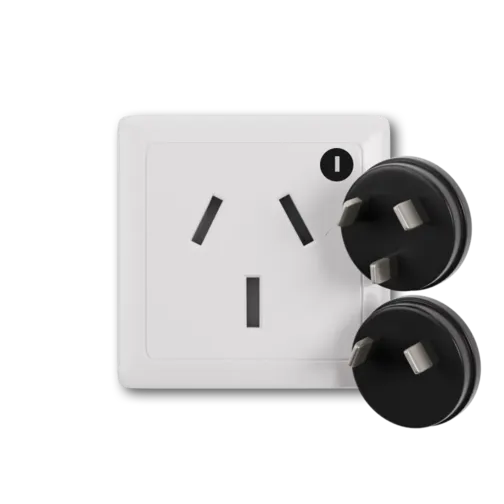
Type I
|
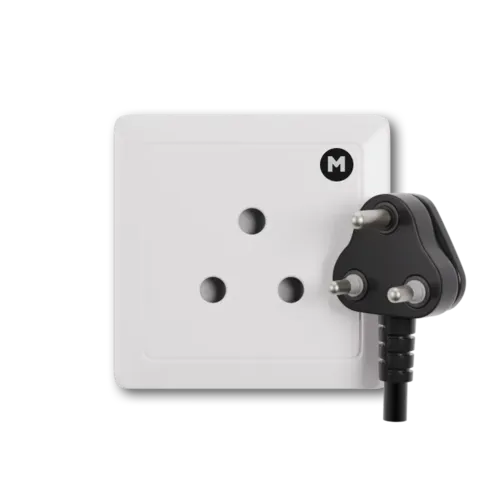
Type M
|
|
|---|---|---|
| Standard | AS/NZS 3112 | BS 546 (15A) |
| Pin Configuration | Two angled flat pins (8mm long, 6.5mm wide, 30 degree angle) plus vertical grounding pin | Three large round pins in triangular pattern (earth 8.7mm diameter, live/neutral 7.1mm diameter) |
| Grounding | Grounded | Grounded |
| Pin Count | 3 | 3 |
| Amperage | 10A | 15A |
| Voltage Range | 220-240V | 220-240V |
Pack a charger from Sydney or Shanghai for Johannesburg and it has nowhere to go. The type I vs type M plug question comes down to two families of plugs and sockets that share almost nothing: one uses slim flat blades set in a V, the other three thick round pins in a triangle, and neither power plug fits the other's power sockets.
Both run on the same 230 V class of electricity, so most appliances need only an adapter.
Type I vs Type M Plug: The Core Differences
The letters come from a scheme first published by the US Department of Commerce and now maintained by the IEC, the International Electrotechnical Commission. They sort plug types and socket types roughly, as a guide for travellers.
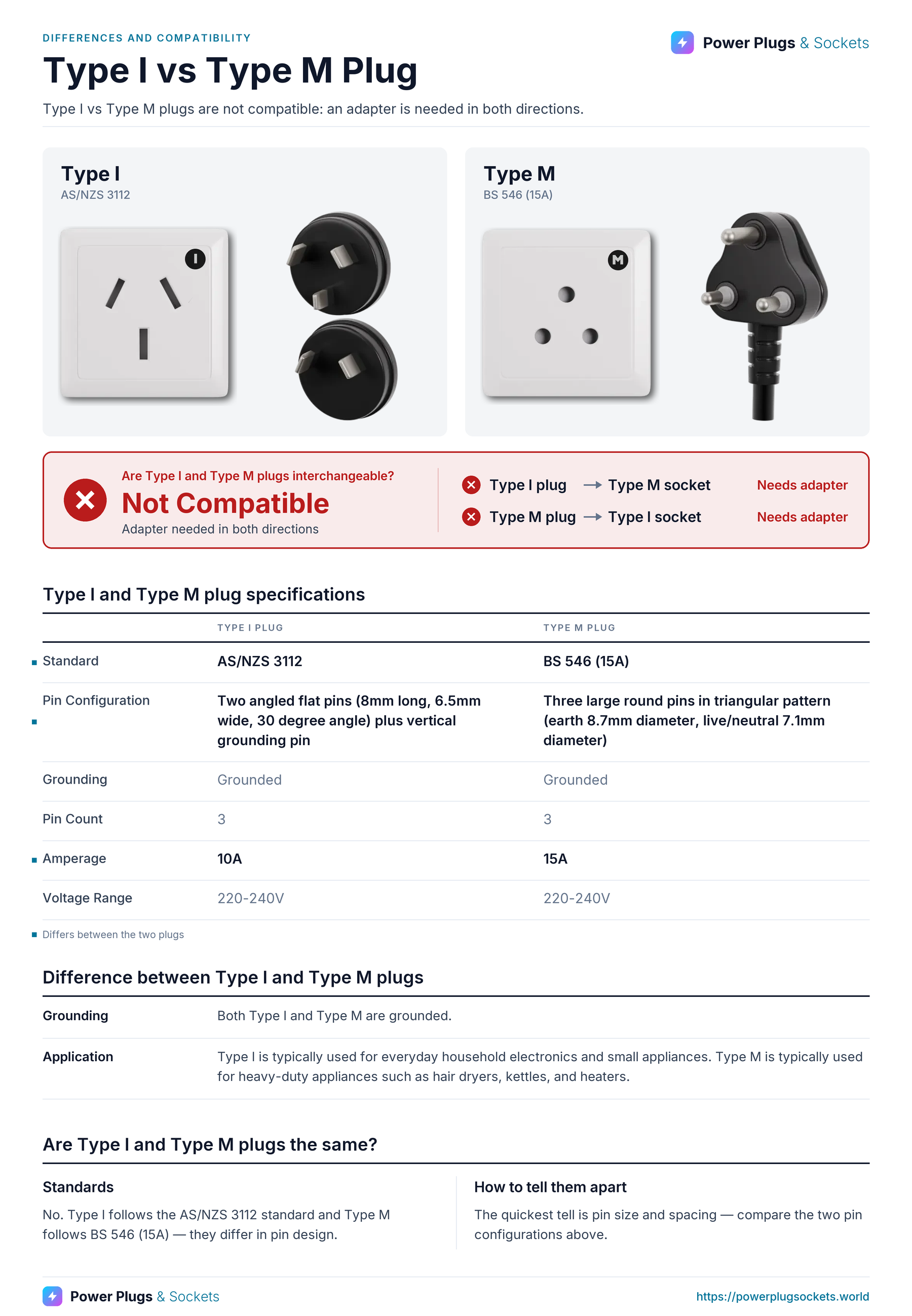
Both designs are grounded and polarized, neither has a recessed socket, and neither accepts a two-pin Europlug.
| Feature | Type I | Type M |
|---|---|---|
| Main standards | AS/NZS 3112, GB 1002 / GB 2099.1, IRAM 2073 | BS 546 (15 A), SANS 164-1, IS 1293 |
| Pin shape | Two flat blades in a V plus a flat vertical earth blade | Three round prongs in a triangle |
| Typical rating | 10 A at 250 V (heavier versions up to 32 A) | 15 A (British) or 16 A at 250 V |
| Earthed / polarized | Yes / yes | Yes / yes |
| Fuse in plug | No | Optional, most are unfused |
| Insulated pins | Required in Australia and New Zealand, optional in China and Argentina | Optional |
| Socket also accepts | Only its own family | Only its own family |
| Main regions | Australia, New Zealand, China, Argentina, Pacific islands | South Africa, Lesotho, Eswatini, heavy appliances in India |
Pin Dimensions Side by Side
The national standards set the pin dimensions. Each Australasian flat blade is 6.35 × 1.63 mm, with the two power pins angled 30° from vertical and the earth blade offset 10.31 mm below centre.
The round-pin plug's line and neutral pins have a 7.1 mm diameter and stand 25.4 mm apart on centres, while the earth pin is 8.7 mm across and 28.6 mm long. That pin spacing is three times wider.
The earth pin also has the longer pin length on these larger pins, so earth connects first, ahead of the live and neutral pins.
10 A, 15 A and 16 A Current Ratings
The blade plug is rated 10 A at 250 V, about 2,300 W at 230 V; the British round-pin version is rated 15 A and the South African and Indian ones 16 A, about 3,680 W, a higher current rating. The 16 amp socket suits heavy appliances such as geysers and stoves, while the blade plug serves most appliances.
Mains electricity in both regions is 220 – 240 V at 50 Hz, so voltage and frequency match and electrical compatibility holds. AC adapters marked 100–240 V, 50 or 60 Hz work anywhere.
AS/NZS 3112: Two Flat Pins in an Inverted V-Shape
Countries in Oceania, plus China and Argentina, use two flat pins in an inverted V-shape with a flat vertical grounding pin below on earthed versions. That consistency is why type I outlets and type I power cords sell as one family. Next, check type B versus type E plug shape and socket design compared.
The Argentine plug is wired the other way round, with live on the right at the earth receptacle, so its polarity is mirrored. Its 20 A version, used for air conditioners, has a longer earthing pin and is mutually incompatible with the 10 A size.
Older installations in Brazil use a near-identical 20 A plug. China's GB plugs suit Class I appliances, while unearthed versions serve Class II appliances and carry the CCC Mark.
Australia has required insulated pins since 2005.
Type I Plugs in Australia and New Zealand
AS/NZS 3112 is the reference version, also used in Fiji, Papua New Guinea, Tonga, the Solomon Islands, Samoa, Vanuatu, Kiribati, Nauru, Tuvalu and Uruguay. Australian sockets come with a switch to cut the supply at the wall.
20 A Sockets and One-Way Compatible Ratings
The system covers 10, 15, 20 A, 25 and 32 A and is one-way compatible: a socket accepts plugs of equal or lower rating, because higher ratings use a wider earth blade, keeping ratings non-interchangeable in the unsafe direction.
BS 546: Three Round Pins in a Triangle
The round-pin family started in the United Kingdom with BS 546 in 1934, a British standard of 2 A, 5 A, 15 A and 30 A sizes. The 15 A size became type M and the 5 A size Type D. Each uses three round prongs in a triangle with the thicker earth pin on top.
In Britain it survives in theatre installations, and a type M socket is far likelier in southern Africa or South Asia.
Type M in South Africa, Lesotho and Eswatini
The plug is tied to South Africa, specified as SANS 164-1 and rated 16 A at 250 V, and is the main plug in Lesotho and Eswatini, and common in Namibia, Botswana and Mozambique.
IS 1293 and the 16 Amp Socket Outlet in India
In India and Nepal a 6 A round-pin plug handles everyday loads, while the 16 A version under IS 1293 serves larger appliances through a dedicated socket outlet. It also appears in Israel and the United Arab Emirates for air conditioners and washing machines.
Type N as the Preferred Standard
South Africa named SANS 164-2, a type N match for IEC 60906-1, its preferred standard in 2013. Since 2018 every wall outlet position in new homes needs a Type N socket with mandatory shutters, though the older round-pin socket is still allowed beside it.
Plug and Socket Compatibility and the Type D Mix-Up
There is no physical compatibility between the families in either direction. More common is confusion with type D, which shares the triangular layout but is rated 6 A or 5 A; a 6 A plug can be pushed loosely into a 16 A socket, which is unsafe. Next, check what is the difference between type F and type L electrical sockets.
Two-pin blade plugs are not grounded. Both designs depend on earthing, also called grounding, for electrical safety.
The longer earth pin connects first, so never bridge them with a two-pin adapter. Plastic insulating sleeves guard against accidental contact with a partially inserted plug and an electric shock, and many South African plugs have insulated sleeves.
Why a Dual Socket Doesn't Bridge the Gap
China's older dual socket pairs a blade socket with a two-pin opening for US and Europlug connectors. It has been banned in new installations since 2021 and is a trap for 120 V appliances.
India's combined socket takes 6 A and 16 A round-pin plugs, not blades, so none removes the need for an adapter.
Choosing a Travel Adapter or Voltage Converter for SANS 164-1 Sockets
Because the supply voltage matches, travellers need only a travel adapter, not a voltage converter; read the rating plate on your devices. A South African visitor to Australia needs type I adapters or a travel adaptor feeding a power board.
Use extension cords or multisocket adaptors only below the adapter's own rating, often 10 A.
Universal Adapters and the Missing M Plug
Almost no universal adapter includes the large round M plug, so buy a dedicated round-pin adapter before you leave. One adapter feeding a strip beats carrying several power strips.
Picking a Plug Adapter With Larger Pins
A good plug adapter for South Africa has full-size pins, a real earth contact and a 16 A rating; for power cords on a kettle, check its rating covers the draw. A short Australian board on one adapter gives you familiar power sockets.