Type D vs Type F Plugs: Differences & Compatibility
Type D vs Type F plugs are not compatible: an adapter is needed in both directions. Type D is a 3-pin, grounded plug rated 5A at 220-240V, while Type F is a 2-pin, grounded plug rated 16A at 220-240V. The two differ mainly in amperage and pin design, which is what decides compatibility — whether a Type D plug fits a Type F socket, and vice versa. Also see type G vs type M socket.
Swipe to compare
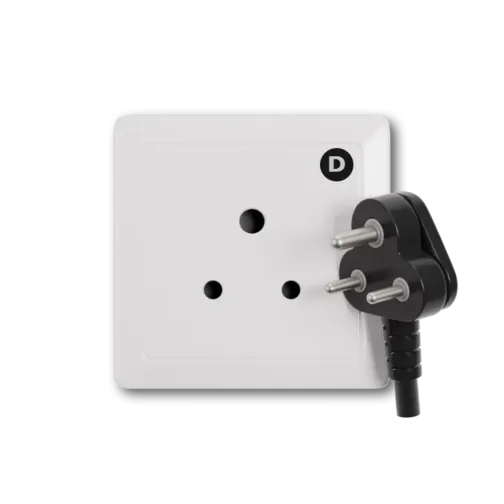
Type D
|
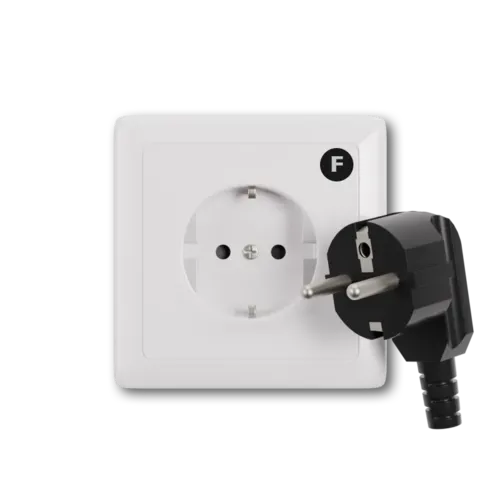
Type F
|
|
|---|---|---|
| Standard | BS 546 | CEE 7/4 (Schuko) |
| Pin Configuration | Three large round pins in triangular pattern (ground pin 7.1mm, live/neutral 5.1mm diameter) | Two round pins (4.8mm diameter, 19mm long) with grounding clips on sides |
| Grounding | Grounded | Grounded |
| Pin Count | 3 | 2 |
| Amperage | 5A | 16A |
| Voltage Range | 220-240V | 220-240V |
Packing for a trip between India and Germany, or buying electrical plugs for a mixed household, you quickly hit the type D vs type F plug question: one is a three-pin triangle, the other a two-pin plug with side earthing clips. Both power plugs run on the same voltage and frequency, so for most travel the real difference is shape, earthing and rating, and whether a plug adapter is enough for your devices.
Type D vs Type F Plug at a Glance
The letters come from the US Department of Commerce's International Trade Administration, which labelled the domestic plug types A to O. They are only labels, not a standard; the real specification is a national or IEC standard, written decades apart in Britain and Germany for these plugs and sockets.
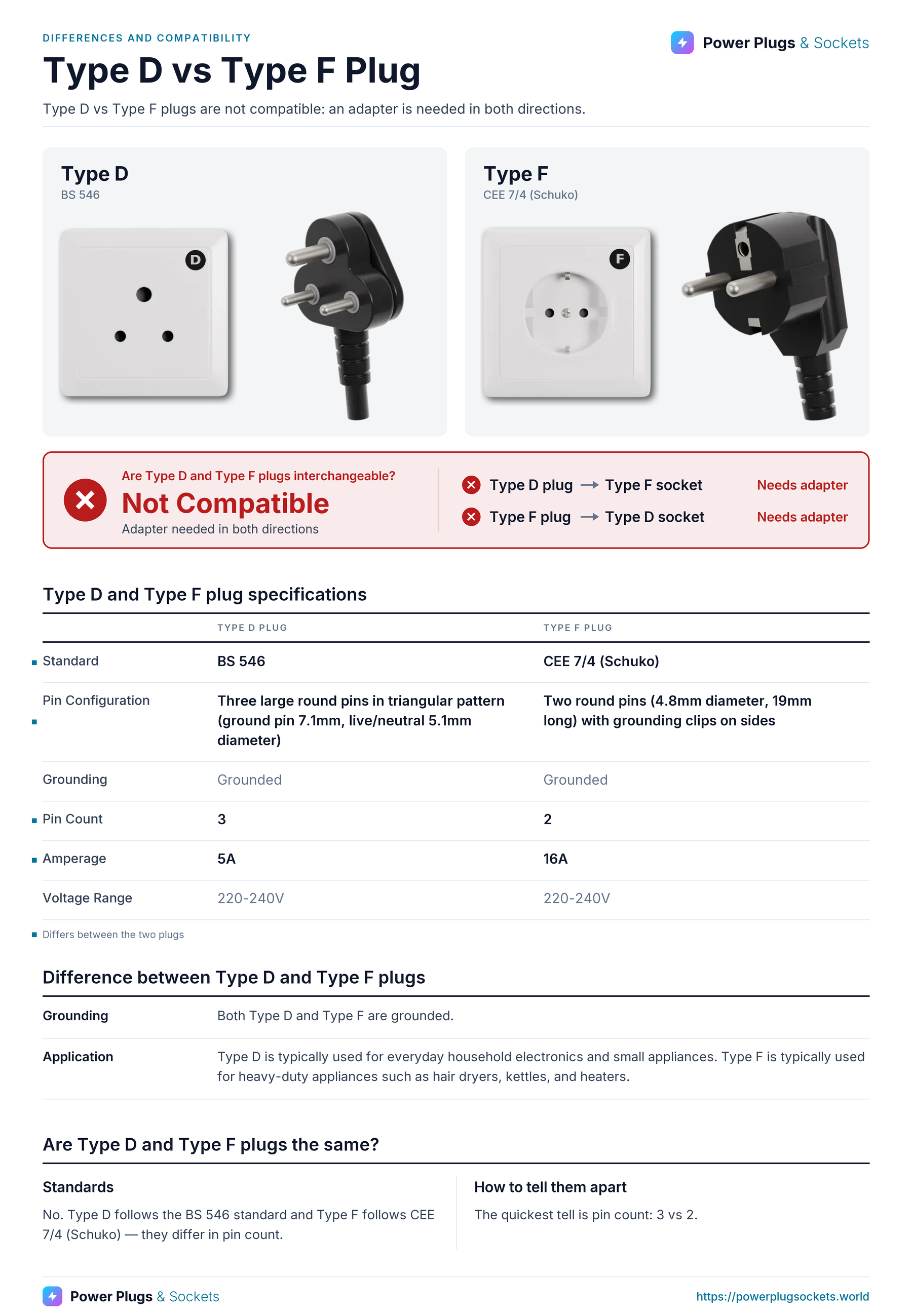
| Feature | Type D | Type F |
|---|---|---|
| Pins | Three round pins in a triangle | Two round pins plus side earthing clips |
| Main standard | BS 546 (5 A), IS 1293 (6 A) | CEE 7/4 plug, CEE 7/3 socket |
| Current rating | 5 A or 6 A at 250 V | 16 A at 250 V |
| Voltage | 220 – 240 V, 50 Hz | 220 – 240 V, 50 Hz |
| Earthing | Large earth pin on the plug | Metal clips in the socket recess |
| Polarity | Polarized | Unpolarized, reversible |
| Main regions | India, Nepal, Sri Lanka, Bangladesh, Pakistan, parts of Africa | Germany and most of Europe, Russia, South Korea |
Type D has 3 pins grounded and is socket compatible with plug type D only, with partial and unsafe fit for C, E and F plugs; Type F has 2 pins grounded through the clips and takes Type C, Type E (via the CEE 7/7 hybrid) and Type F plugs. Both carry mains electricity at 250 V, so a dual voltage charger works on either.
The neighbouring Type M is the large 16 A Indian and South Africa socket, Type G is the fused 13 A plug beside Type D in Sri Lanka, and every plug and socket has live and neutral pins plus an earth path.
Type D: Three Round Pins in a Triangle
A type D plug has three round pins arranged in a triangle: live and neutral below and a larger top pin as the protective earth, so it fits one way and is polarized. It is normally unfused.
Some type D plugs carry an optional fuse. The live and neutral pins are about 5 mm thick, 19.1 mm apart, and a type D outlet mirrors the layout, often with shutters.
A hotel spec listing plug type D means this exact triangle.
Type F: Earthing Clips Instead of an Earth Pin
A type F plug, the Schuko plug, has two round pins of 4.8 by 19 mm, 19 mm apart, and no earth pin; the socket's circular recess has two metal earthing clips instead, a real earth contact with no grounding knob. The name is short for Schutzkontakt, "protective contact".
Type F plugs go in either way round. A socket type F is rated at 16 A, and a type F outlet is recessed so fingers cannot reach a live pin.
BS 546 and IS 1293: Where the Triangle Design Comes From
Type D began in Britain: the BS 546 standard of 1934 made the 5 A size Type D. India adopted it as IS 1293, which rates the small plug at 6 A. So "5 A" on one site and "6 A" on another are both correct. Type D plugs & outlets are used in around 40 countries, so check the country, not just the letter. For a related pairing, see will a type B plug work in a type G socket without an adapter.
Type M and the 5 A vs 15 A Split
The big brother of Type D is Type M, the same layout rated 15 A under BS 546 and 16 A under IS 1293, used for geysers and air conditioners. The two sizes are not interchangeable; among outlet types, BS 1363 Type G replaced it in the United Kingdom and Ireland.
South Africa uses Type M under SANS 164.
Countries and Outlet Styles Around India
Type D is found in India, Nepal, Sri Lanka, Bangladesh and Pakistan, plus African countries such as Namibia and Botswana. A room may hold more than one socket shape, so know both the letter and the rating.
Schuko and CEE 7/4: The European Earthing Standard
Schuko was patented by Siemens-Schuckertwerke in 1929 and absorbed into the CEE 7 standard, plug CEE 7/4 and socket CEE 7/3. Type F plugs & outlets are the default in Germany, Austria, the Netherlands, Sweden, Norway, Finland, Spain, Portugal, Turkey and Russia, and in South Korea and Indonesia, and many type F outlets sit in newer buildings.
A CEE 7/3 socket has a round recess about 17.5 mm deep with two spring clips, and many countries require child-resistant shutters in it.
Type E and the CEE 7/7 Hybrid
Type E, used in France, Belgium and Poland, puts a male earth pin in the socket, so a pure Schuko plug will not go in. The CEE 7/7 hybrid plug has both side strips and a hole for that pin, and fits Type E and Type F sockets alike.
Europlug and Type C in Both Sockets
The Europlug (Type C, CEE 7/16) is a flat two-pin plug, not grounded and rated 2.5 A, for Class II devices with double insulation, marked with a double square. It fits a Type F socket and most Indian Type D outlets, making it the closest thing to a shared plug.
Plug D and Plug F Compatibility and Safety
On paper, compatibility is zero: a Schuko plug has no earth pin for a Type D socket's top hole. Loose Indian sockets may take a Type F plug in the two lower holes, but this partial compatibility is unsafe: the earth is not connected, a danger and a risk of electric shock, and the earthed protection is lost. Next, check packing an adapter for a trip that has both type A and type E sockets.
A universal socket in a hotel often earths nothing properly, and these power sockets meet no standard.
Load Limits on a 6 A Socket
The rating gap matters more than shape. A 1,850 W hair dryer draws 8.04 A at 230 V: half of a 16 A Schuko socket, but over a 6 A Indian Type D socket's rating.
At 230 V, a 6 A socket carries about 1,380 W and a 16 A one about 3,680 W. Most travel adapters are rated 10 A, so use the large Type M socket for anything that heats. Class I appliances such as a kettle depend on the earth ground, and Type D is polarized while Type F is not.
Picking a Travel Adapter for a Schuko Plug
A travel adapter for India must accept CEE 7/4 or CEE 7/7 pins and present a Type D or Type M triangle; going back, a Type D to Type F adapter suits most electronics. Choose one built to IEC safety standards with a real earth connection, not a two-pin travel adaptor.
Adapter Plug vs Voltage Converter
An adapter plug only changes the shape, while a voltage converter changes the voltage. India and Europe both run at 230 V and 50 Hz, so you rarely need one.
A dual voltage label such as "100–240 V" works anywhere, though a cord whose voltage rating (rated voltage) is 125 V is not built for 230 V mains.Multisocket adaptors and extension cords add a second limit: a 16 A Schuko power strip (plug strip) with surge protection plugged into a 6 A Type D outlet is limited to 6 A. Read the total rating on any chained socket outlets, and never plug one multi-way adapter into another.