Type B vs Type N Plugs: Differences & Compatibility
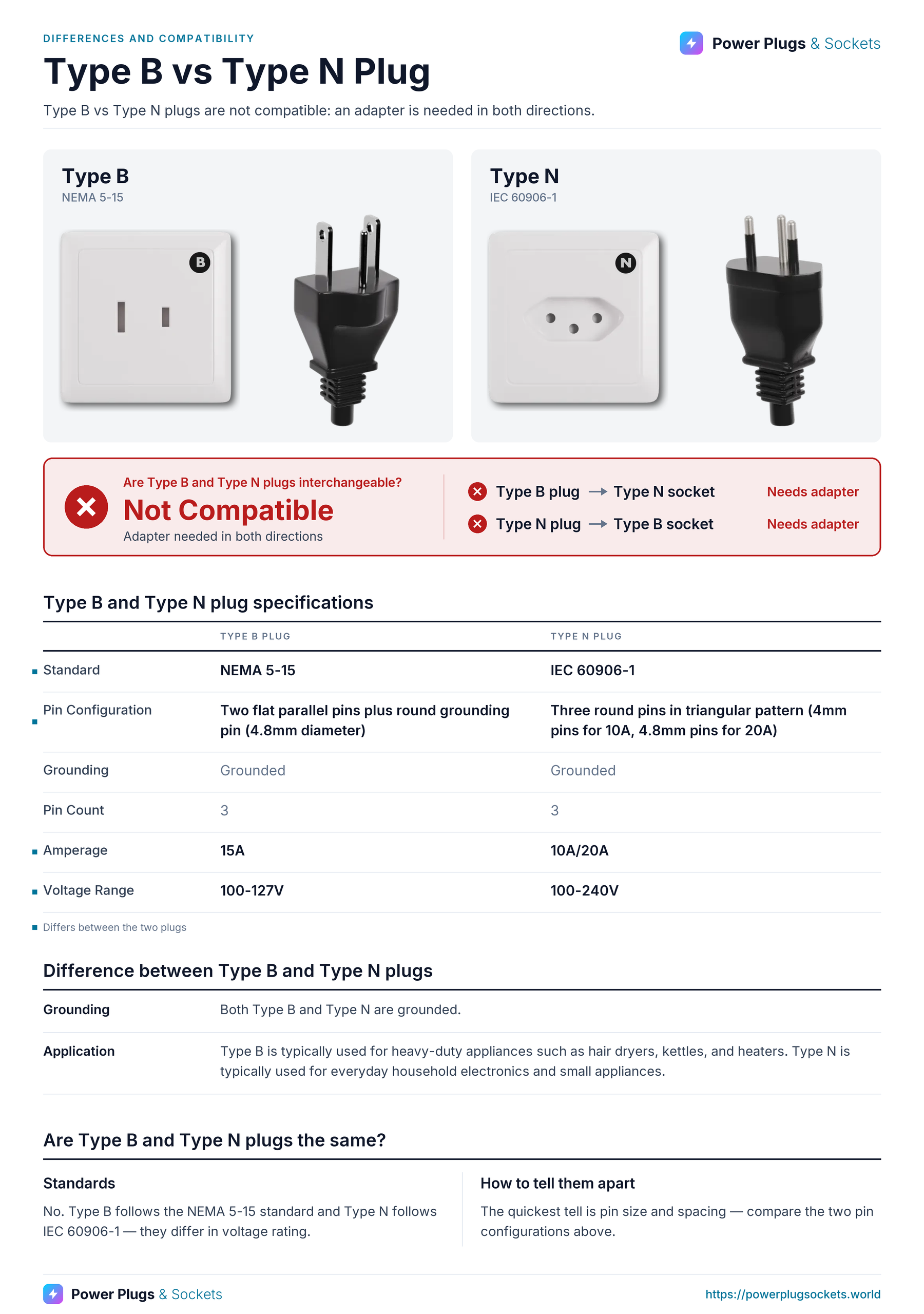
Type B vs Type N plugs are not compatible: an adapter is needed in both directions. Type B is a 3-pin, grounded plug rated 15A at 100-127V, while Type N is a 3-pin, grounded plug rated 10A/20A at 100-240V. The two differ mainly in voltage, amperage and pin design, which is what decides compatibility — whether a Type B plug fits a Type N socket, and vice versa. For a related pairing, see how does the amperage rating of a type C plug compare to a type D plug.
Swipe to compare
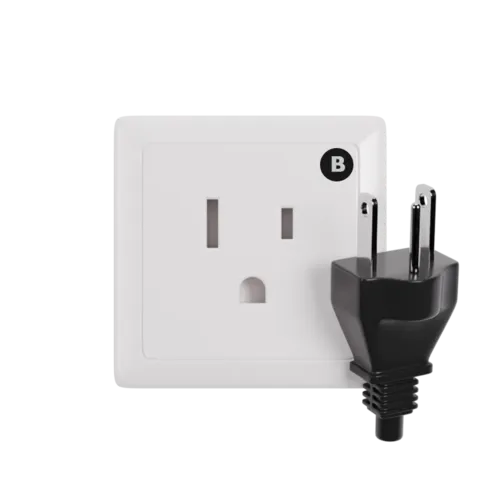
Type B
|
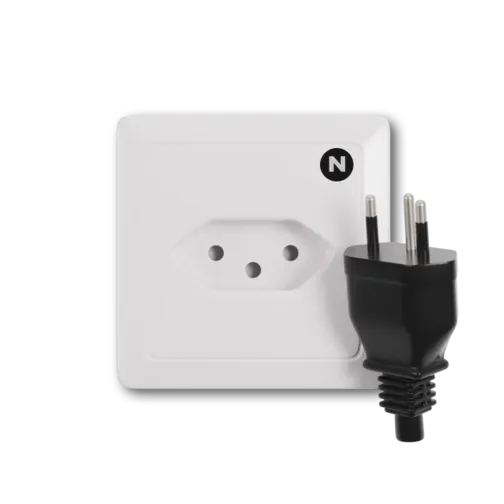
Type N
|
|
|---|---|---|
| Standard | NEMA 5-15 | IEC 60906-1 |
| Pin Configuration | Two flat parallel pins plus round grounding pin (4.8mm diameter) | Three round pins in triangular pattern (4mm pins for 10A, 4.8mm pins for 20A) |
| Grounding | Grounded | Grounded |
| Pin Count | 3 | 3 |
| Amperage | 15A | 10A/20A |
| Voltage Range | 100-127V | 100-240V |
If you are packing an appliance for Brazil or South Africa, or bringing one home to North America, the type B vs type N plug question decides whether it can draw electricity from the wall at all. Both are three-pin, grounded designs with an earth pin.
The American NEMA plug uses flat parallel pins while its counterpart uses round ones, so neither fits the other's electrical outlet. The voltage behind each differs too.
Type B vs Type N Plug at a Glance
The type B plug is the 15 A grounded connector set by the American national standard. Type N plugs follow the International Electrotechnical Commission's IEC 60906-1 standard and its Brazilian and South African national versions. You might also want type D vs type O socket.
| Feature | Type B (NEMA 5-15) | Type N (IEC 60906-1 family) |
|---|---|---|
| Governing standard | NEMA 5-15 (US), CSA C22.2 No. 42 (Canada), JIS C 8303 earthed version (Japan) | IEC 60906-1, SANS 164-2 (South Africa), NBR 14136 (Brazil) |
| Rated current | 15 A | 16 A (IEC and SANS standard), 10 A or 20 A (Brazilian standard) |
| Rated voltage | 125 V; supply almost always 100 – 127 V | 250 V; supply 100 – 240 V depending on country |
| Live and neutral pins | Two flat blades | Two round pins, 19 mm apart |
| Earth contact | Round or U-shaped pin, longer than the blades | Round pin offset from the line between the other two |
| Insulated pins | No | Yes |
| Recessed power socket | No | Yes |
| Power socket accepts | Type A and type B | Type C (Europlug) and type N |
A North American 15 A outlet tops out around 1,800 W, a South African 16 A power socket carries roughly twice that, and Brazil reserves 20 A for showers and ovens and fits 10 A elsewhere. Both plug types also come in two-pin Class II versions.
NEMA 5-15: How the American Three-Pin Design Is Built
The National Electrical Manufacturers Association names devices NEMA n-mmX, with P for plug or R for receptacle. The three-pronged Type B replaced the two-pronged type A for new US wiring.
A NEMA 5-15P plug mates with a NEMA 5-15R receptacle at 15 A on circuits delivering about 120 volts. The hot blade carries current in and the neutral blade returns it.
The ground pin fits a D-shaped or U-shaped hole and is longer than the blades, so the earth connects first. On the outlet the neutral slot is wider, which suits polarized plugs.
This polarization keeps the live pin on the switch and the neutral pin on the exposed parts.
Where You Find the Type B Electrical Socket
The type B electrical socket is standard across North America (the United States, Canada and Mexico), most of Central America, Colombia, Ecuador, Venezuela, Taiwan and the Philippines. Japan uses it as JIS C 8303 at 100 V, on 50 Hz in the east and 60 Hz in the west.
The same power socket also accepts the older two-pin type A plug.
IEC 60906-1 and Its Two National Versions
The International Electrotechnical Commission published IEC 60906-1 in 1986: two round 4.5 mm power pins 19 mm apart, with an earth pin offset to form a shallow triangle, rated 16 A at 250 V. The European rollout stalled, and the design survives as two national standards whose pin dimensions differ; Paraguay's take-up is voluntary. South Africa adopted it as SANS 164-2 on 230 V mains and made it the preferred standard in 2013.
It still fits combination plates with the old Type M outlet.
NBR 14136: Why Pin Diameter Sets the Rating in Brazil
Brazil's NBR 14136, compulsory since 1 January 2010, keeps the 19 mm spacing but splits the rating by pin diameter: 10 A plugs have 4.0 mm pins and 20 A plugs 4.8 mm pins, so a 20 A plug cannot enter a 10 A socket. Brazilian sockets run on both 127 V and 220 V supplies.
A 16 A South African plug forced into a 10 A socket risks overload.
Shutters and the Recessed Socket
IEC 60906-1 requires shutters over the live and neutral holes and a recessed socket face, so fingers cannot reach a live pin; Brazil keeps the recess without the shutters. A flat NEMA outlet leaves a partly inserted Type B plug's blades exposed, a source of minor electric shock.
Grounded Plug Compatibility Between the Two Systems
Physical compatibility between the two socket types is zero in both directions: a grounded plug from one system will not enter the other's outlet, because blades cannot enter round holes. A Type N socket accepts only the unearthed type C Europlug, and a Type B socket the unearthed type A.
Why Neither Socket Accepts the Other Plug
A Type N socket takes round 4.0 – 4.8 mm pins inside a recess, while a NEMA socket expects flat blades about 12.7 mm apart. Forcing type B plugs into a Brazilian outlet is awkward, and a converting adapter must be grounded on both sides or it removes the safety the third pin gives.
Earth Pin Position and Class II Devices
Class I equipment with a metal case relies on the earth pin. Devices with the square-in-a-square symbol use double insulation instead, which is why many chargers have two pins.
If an adapter loses the earth contact, a grounded kettle keeps working but loses protection against an internal fault.
Where the Europlug Fits In
The Europlug's thin round pins fit Brazilian and South African outlets, so a Europlug charger works without an adapter; it will not fit a NEMA outlet, but most travellers never need that.
Voltage Behind a NEMA 5-15R Outlet Versus a South African or Brazilian Socket
The voltage behind an American receptacle is 120 V in the US and Canada and 100 V in Japan, while South African outlets deliver roughly double that at 50 cycles per second; Brazil's mains voltage varies by state. Check the supply frequency and voltage rating on your device label before plugging into mains electricity abroad.
A dual voltage device marked 100 – 240 V handles all of them. Travel adaptors connect the pins and nothing more, but most phone, laptop and camera chargers are AC adapters built for 100 to 240 volts.
When You Need a Voltage Converter
A hair dryer or kettle built for 120 V will draw roughly four times its rated power from a South African power socket through a simple adaptor and burn out. These need a step-down voltage converter or transformer sized above the wattage, or a local model.
Plug Adapter Safety Checklist
- Use a three-pin plug adapter for any grounded device; a two-pin adaptor drops the earth.
- Check the adapter's rated current: a 10 A adaptor on a 16 A or 20 A load will overheat.
- Never chain adaptors; each extra joint adds heat and weakens electrical safety.
Safety Design: NBR 14136 and SANS 164-2 Against the American Plug
The Type N family is the more protective standard, building electrical safety into the plug and the electrical outlet face, while the American design relies on the long ground pin and, since 2008, on shutters in new homes. Next, check how the NEMA 1-15 standard for type A compares to CEI 23-50 for type L.
Insulated Pins and Tamper-Resistant Shutters
Type N pins are sleeved near the base. NEMA blades are bare, so tamper-resistant receptacles became mandatory in new American homes; they protect children but not an adult from a plug pulled halfway out.
Grounding Pin Wiring in Older Brazilian Homes
A Type N outlet with a grounding pin hole does not guarantee a grounded circuit. Older Brazilian houses often lacked an earth wire, and equipment came with a flying earth tail many owners never connected.
US homes have the mirror problem: three-hole receptacles on two-wire circuits.