Type C vs Type D Plugs: Differences & Compatibility
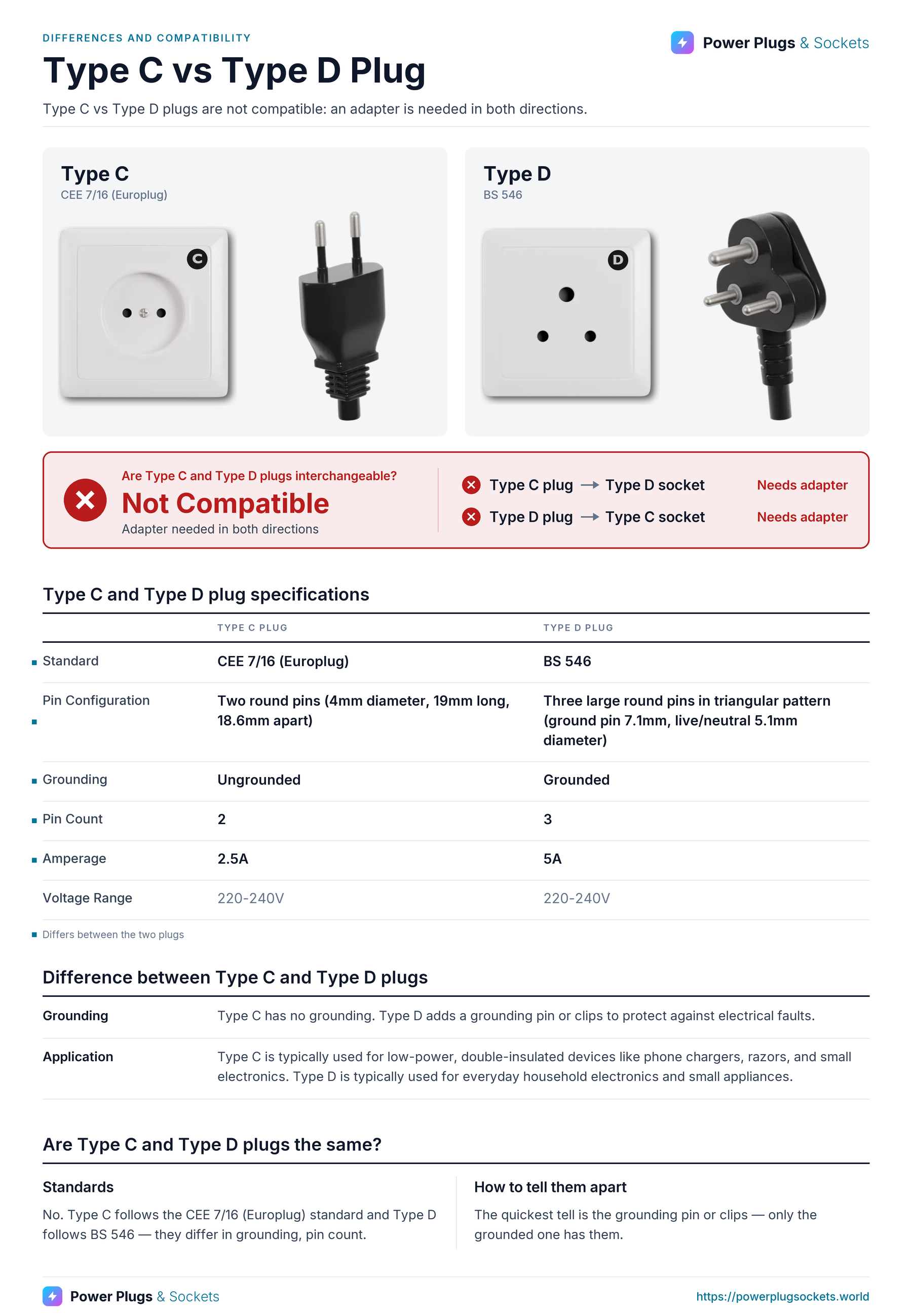
Type C vs Type D plugs are not compatible: an adapter is needed in both directions. Type C is a 2-pin, ungrounded plug rated 2.5A at 220-240V, while Type D is a 3-pin, grounded plug rated 5A at 220-240V. The two differ mainly in grounding, amperage and pin design, which is what decides compatibility — whether a Type C plug fits a Type D socket, and vice versa. For a related pairing, see will a type C plug work in a type E socket without an adapter.
Swipe to compare
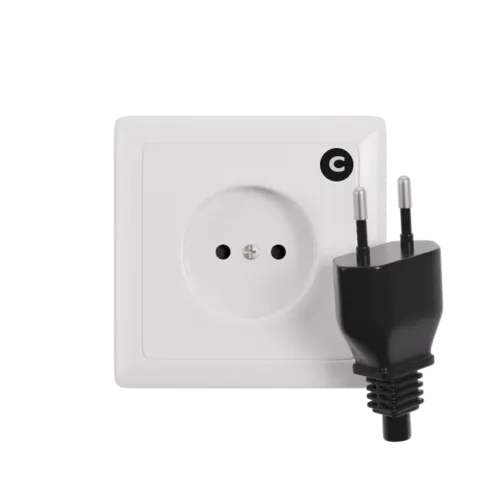
Type C
|
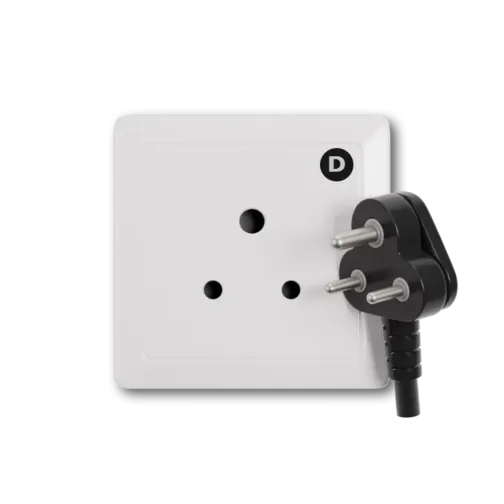
Type D
|
|
|---|---|---|
| Standard | CEE 7/16 (Europlug) | BS 546 |
| Pin Configuration | Two round pins (4mm diameter, 19mm long, 18.6mm apart) | Three large round pins in triangular pattern (ground pin 7.1mm, live/neutral 5.1mm diameter) |
| Grounding | Ungrounded | Grounded |
| Pin Count | 2 | 3 |
| Amperage | 2.5A | 5A |
| Voltage Range | 220-240V | 220-240V |
Planning a trip that crosses type C vs type D plug territory, say a week in Europe followed by two in India, means working out whether the slim Europlug you already own will hold in a three-pin wall socket, and what to pack if it won't. The short answer: a plug with two round pins often slides into a type D socket but never seats properly, while a type D plug won't enter a type C outlet at all.
Below are the dimensions, the safety catch, the countries and the voltage checks for travel where two electricity standards meet.
Type C vs Type D Plug at a Glance
Both plug types use round pins in a 220-240 V world, and that's where the overlap ends. One is a light plug for small electronics; the other is an older earthed standard with heavier pins.
The table compares published dimensions, with pins spaced as measured between their centres.
| Feature | Type C (Europlug) | Type D |
|---|---|---|
| Pins | 2 round pins, no earth | 3 round pins in a triangle |
| Pin diameter | 4 to 4.8 mm | 5.1 mm line and neutral, 7.1 mm earth |
| Pin length | 19 mm | 14.9 mm line and neutral, 20.6 mm earth |
| Pin spacing | 17.5-18.6 mm (pins angle inward) | 19.1 mm, earth offset 22.2 mm |
| Current rating | 2.5 A | 6 A in India, 5 A on the old British version |
| Origin | European standard | BS 546, Britain before 1947 |
| Main regions | Europe, plus most of the world as a secondary plug | India, Nepal, Sri Lanka, parts of Africa |
Type C Plug: Two Round Pins, Ungrounded, 2.5 A
The type C plug carries two round prongs with insulated pin shanks: the half of each pin nearest the body is sleeved in plastic, so a plug that's half pulled out exposes no live metal. With no earth contact it is ungrounded by design, meant for low-power, double-insulated gear such as shavers and small lamps.
Because it is so slim, type C plugs fit nearly every socket in Europe: type E in France, type F (Schuko) in Germany, type J in Switzerland, type K in Denmark, type L in Italy and type N in Brazil all accept them. The matching type C socket is another story.
Bare type C sockets are now rare and are illegal for new installations in much of Europe, since an outlet with no earth can't protect an earthed appliance.
Type D Plug: Three Round Prongs, an Earth Pin and a 6 Amp Rating
The type D plug comes from BS 546, the standard in Great Britain before 1947. Its three large round pins sit in a triangular pattern: line and neutral at the bottom, and a thicker, longer earth pin at the top that serves as the grounding pin.
Being longer, the earth connects first and disconnects last, which is the point of grounding. India standardized on a 6 amp version, while the older British form was rated at 5 amps.
Today you'll meet it almost only in India, Nepal and Sri Lanka, with pockets in Namibia and other African countries.
Does a Type C Plug Fit a Type D Outlet?
Physically, often yes. Electrically, only just. Next, check how does the amperage rating of a type A plug compare to a type C plug.
A Europlug can be pushed into most type D sockets, but its prongs rarely reach full depth, and that gap is where the trouble starts.
Why Flexible Prongs Let the Pins Squeeze In
Europlug pins sit 17.5-18.6 mm apart, a little closer than the 19.1 mm centres of a D receptacle. The elasticity of those thin, flexible prongs lets them spread slightly and find the holes.
What they can't do is go in all the way. Near the plug body the pins are rigid and sleeved, and at 19 mm they are longer than the pins of type D plugs, so the plug can't be fully inserted and stops a few millimetres short of the face of the receptacle.
The contacts then grip only the tips, so you lose proper contact: the joint heats up, may spark when the cable is nudged, and in a worn socket can lead to a short-circuit.
Why Insulated Pins Matter for Safety
Type D is counted among the most dangerous plug designs in use. Its pins carry no insulation, so a plug pulled halfway out still has live metal exposed between the plug and the wall, and type D outlets aren't recessed to shield your fingers.
A Europlug in the same socket is safer than it looks, because its sleeves cover the part that stays exposed. The real safety hazard is forcing a French or German plug into a D socket.
Those plugs have rigid pins and are meant to be grounded, so in a type D outlet they lose their earth, cause sparking and a tripping circuit breaker, and leave about 4 mm of bare pin showing. Touching that risks an electric shock and, for a child, electrocution.
Going the Other Way: Three Pins into European Sockets
A type D plug won't enter a type C socket, a Schuko outlet or any other European socket. Its 5.1 mm pins are thicker than the 4.8 mm holes allow, and the earth pin has nowhere to go.
If you're bringing Indian appliances to Europe, you need a plug adapter whose back accepts a D plug. Adapters with D outlets on the back are less common, so check before you buy.
Countries That Use Type D Sockets Alongside Type C
Most countries that list type D also list type C, which is why a Europlug travels so well. The table shows where both appear, with the mains voltage of each; every country here runs at a frequency of 50 Hz. Also see how do i tell a type E plug apart from a type F plug.
Botswana and Namibia use D alongside type M and type G instead, without C. Expect a mix: a room in Pakistan may have a universal power socket by the desk and an old D outlet by the bed.
| Country | Voltage | Socket types |
|---|---|---|
| Bangladesh | 220V | Type C, Type D, Type G, Type K |
| Bhutan | 230V | Type C, Type D, Type F, Type G, Type M |
| Chad | 220V | Type C, Type D, Type E, Type F |
| French Guiana | 220V | Type C, Type D, Type E |
| India | 230V | Type C, Type D, Type M |
| Iraq | 230V | Type C, Type D, Type G |
| Madagascar | 220V | Type C, Type D, Type E, Type J, Type K |
| Monaco | 230V | Type C, Type D, Type E, Type F |
| Myanmar | 230V | Type C, Type D, Type F, Type G |
| Nepal | 230V | Type C, Type D, Type M |
| Pakistan | 230V | Type C, Type D, Type G, Type M |
| South Africa | 230 V | Type C, Type D, Type M, Type N |
| United Arab Emirates | 220V | Type C, Type D, Type G |
Round-Pin Outlet Sockets in UK Hotels
Type D isn't quite gone from the UK, where the everyday socket is type G. Older hotels still have the odd BS 546 round-pin outlet, often by a bed. Leave it alone: these sockets usually sit on a special-purpose circuit, feeding lamps run from a light switch or dimmer, and a few were wired for direct current.
Type M Sockets Rated at 16 Amps Beside Type D
Type M looks like a scaled-up type D, with thicker pins rated at 16 amps for larger appliances such as air conditioners, water heaters and washing machines. In India, Nepal and South Africa you'll often find a combined socket that takes both.
The catch for travelers is that type M is the one shape most worldwide adapters leave out, so if the only free outlet is a big M socket, a standard adapter set won't help.
Travel Adapters and Voltage for Both Plug Types
Three checks cover almost every trip between type C and type D countries: Next, check does a type K plug fit into a type N socket.
- Confirm the plug type at your destination: D sockets, or only C and universal ones.
- Check whether your plug is a flexible Europlug or a rigid, earthed French or German plug.
- Read each device's input label, and pack adapter plugs only for the shapes each destination uses.
Picking a Travel Adapter or Universal Adapter
A Europlug charger needs no adapter in most D sockets, but because it seats loosely there, a travel adapter or adapter plug with a D face on the front gives a firm grip in India and Nepal. Indian appliances heading to Europe need the reverse: a D socket on the back and a type C face on the front.
A universal adapter suits trips that mix both, but many lack a D face, so check before you buy. USB ports, a power strip or a surge protector behind one D adapter cut the count.
The IEC (International Electrotechnical Commission) World Plugs List confirms each country's power outlet shapes, and hotels with universal outlets may spare you the adapter.
Dual-Voltage Devices vs a Voltage Converter
Type C and type D regions share the same 220-240 V, 50 Hz supply, so moving between C and D countries needs only a plug adapter, never a converter. Converters matter only for 110-120 V gear.
Most devices, from laptops to cellphone chargers, are dual-voltage: look for Input: 110-240V on the brick. A single-voltage 120 V device needs a voltage converter, and for electronics that means a transformer-type unit.
High-Wattage Appliances and Socket Limits
Wattage is where both plug types reach their limit. Watts equal volts times amps, so a 2.5 A Europlug can carry at most about 575 W at 230 V, and a 6 A type D socket about 1,380 W. A 1,800 W hair dryer draws about 7.8 A, more than either is rated for.
Leave high-wattage appliances at home or use the hotel's dryer.