Type D vs Type O Plugs: Differences & Compatibility
Type D vs Type O plugs are not compatible: an adapter is needed in both directions. Type D is a 3-pin, grounded plug rated 5A at 220-240V, while Type O is a 3-pin, grounded plug rated 16A at 220-240V. The two differ mainly in amperage and pin design, which is what decides compatibility — whether a Type D plug fits a Type O socket, and vice versa. Compare this with type B versus type N plug shape and socket design compared.
Swipe to compare
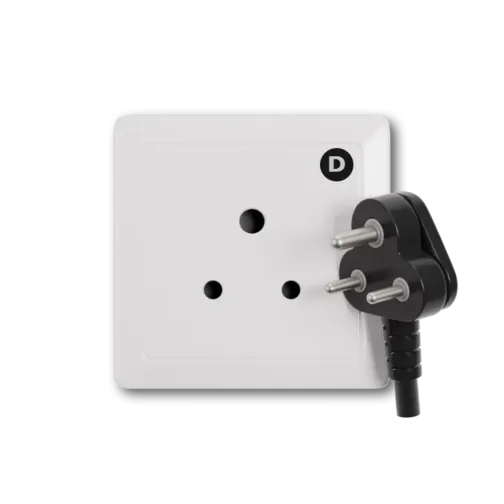
Type D
|
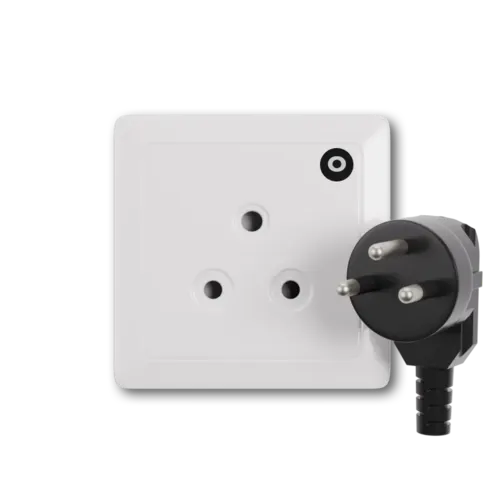
Type O
|
|
|---|---|---|
| Standard | BS 546 | TIS 166-2549 |
| Pin Configuration | Three large round pins in triangular pattern (ground pin 7.1mm, live/neutral 5.1mm diameter) | Three round pins in triangular pattern (4.8mm diameter power pins, 4mm grounding pin) |
| Grounding | Grounded | Grounded |
| Pin Count | 3 | 3 |
| Amperage | 5A | 16A |
| Voltage Range | 220-240V | 220-240V |
Pack a charger from India for a week in Thailand and the Type D vs Type O plug answer is short: they do not fit, though both have three round prongs and run on 50 Hz electricity. This page compares each power plug, the power sockets they fit and the adapter you need.
Type D vs Type O Plug Comparison Chart
The IEC letters mandate nothing; the national standard behind each plug matters. Type D is the old British three-pin design South Asia kept; Type O is Thai, from 2006.
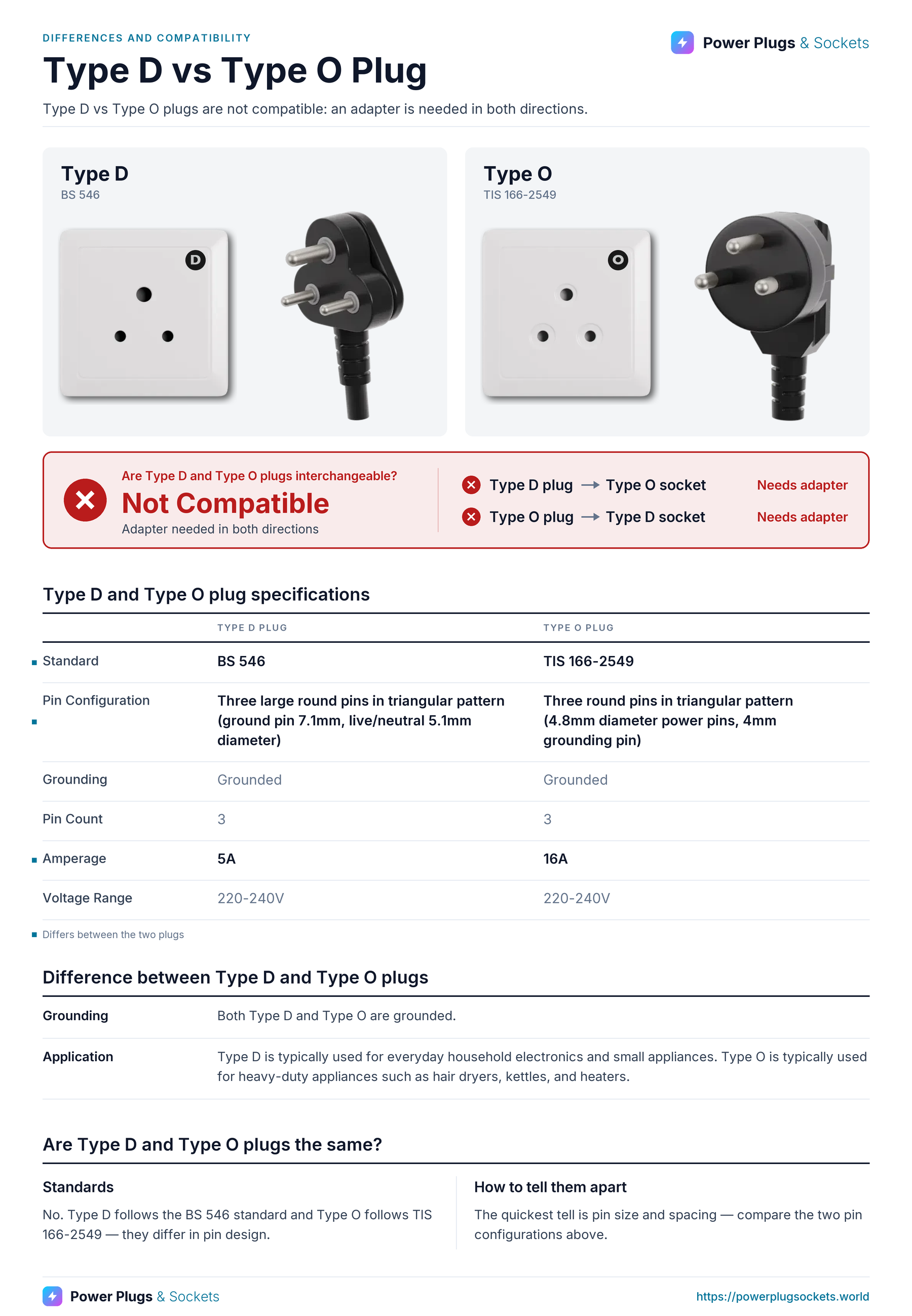
| Feature | Type D | Type O |
|---|---|---|
| Defining standard | BS 546 (British, 1934) and IS 1293 (Indian) | TIS 166-2549 (Thai, 2006) |
| Rated current | 5 A (British), 6 A (Indian) | 16 A |
| Rated voltage | 250 V | 250 V |
| Pin layout | Triangle, thick earth prong on top | Two line prongs, slim ground prong below (or flat unearthed) |
| Earthed | Yes | Yes (three-prong); no (two-prong) |
| Polarized | Yes | Yes (three-prong) |
| Fused | Optional | No |
| Insulated pin sleeves | Optional | Yes |
| Recessed socket | No | No |
| Socket accepts Europlug | No | Yes |
| Where you find it | South Asia, parts of Africa and the Middle East | One country only |
A Type O plug is rated for almost three times the current of a Type D, with thinner prongs.
Reading the Chart: Grounded, Polarized and Insulated Pins
Earthed means a third prong gives fault current a safe path; polarized means the plug fits one way; insulated sleeves hide live metal. The amperage row is the maximum continuous current.
Plug Type D: The Old British Plug With Three Round Pins
The Type D electrical plug is the Old British plug, the United Kingdom's general-purpose plug until Type G replaced it in the late 1940s: three pins in a triangular layout, the thickest on top. Indian IS 1293 adopts the geometry of British BS 546, rated 6 amps.
The live and neutral prongs are about 5 mm thick; the longer earth pin sits above them, a deliberate safety detail that opens shutters on many Indian socket-outlets.
Type M, the Larger 15 A Sibling
Type M is the same triangle scaled up, rated 15 A (British) or 16 A (Indian), for high-power appliances such as geysers. Its thicker prongs will not enter a Type O outlet.
Where the Type D Plug Still Works in Britain
Type D is phased out of British homes, but hotels and theatres still use 5 amp round-prong wall plug sockets for lighting circuits. A Type O plug cannot enter them.
The Thai Plug and the TIS 166-2549 Standard
Thai wiring mixed American and European plugs, so the Thai Industrial Standards Institute wrote one standard, and the IEC named it O. The Thai plug has Europlug-spaced pins plus a ground prong, rated 16 A and 250 V. The hybrid socket takes Type O, a flat-blade NEMA 1-15 (Type A), a grounded NEMA 5-15 (Type B) and a Europlug, with its ground hole at NEMA 5-15 pin spacing. A dual socket with two openings is the most common Thai wall fitting. Also see should you choose type F or type M for an international travel adapter.
Grounded Three-Pin and Unearthed Two-Pin Versions
The grounded version adds a ground prong below the line prongs. The ungrounded version is a slim flat plug with the full 16 A rating, against 2.5 A for a real Europlug.
Pin Size and Layout: Type D Socket vs Thai Socket
The power pins are almost the same size and spacing. The third prong stops the fit: a Type D socket expects a thick earth pin above the line holes, a Type O outlet a thin one below.
Newer socket-outlets add shutters that open only for the ground prong, and Type O plugs also have insulated pins; with an older Type D cord, keep fingers off a partly inserted plug, a real electric shock risk.
Earth Pin Size and Placement
On a Type D the earth pin is the largest prong and points up; on a Type O it is thin and sits below. Rotating the plug cannot line them up.
Is a Type D Receptacle Compatible With a Type O Plug?
No. A Type D receptacle will not accept a Type O plug, or the reverse: prong diameters and ground positions differ. You need an adapter either way.
Europlug and Type C Plugs: Socket Compatible With Both?
A Europlug is fully socket compatible with a Type O outlet. In a Type D outlet its thinner 4 mm prongs grip loosely and can arc or heat up, so use a universal socket or adapter.
Type E and Type F Schuko Plugs: Unsafe Compatibility
Type F Schuko and Type E plugs physically enter a Type O outlet, but it has no ground clips or ground prong for them, so they run unearthed. Use a proper earthed adapter.
Grounding and Safety at a Type D Electrical Outlet and a Type O Outlet
Both standards are earthed, polarized designs, but an electrical outlet is only as good as its electrical wiring; older buildings may lack an earth wire. Use an adapter that carries the ground and is rated 6 amps at a Type D outlet.
The amperage gap matters too: Type O is rated 16 A, about 3,600 watts of load capacity, while Type D carries about 1,400 at 6 amps. A 16 A appliance on a 6 amp outlet runs hot, and overheating starts most plug fires, so check the wattage label.
Earthed vs Unearthed Appliances
Irons, kettles and computers are earthed and need the ground to survive the trip. Phone chargers and shavers are double insulated, so only the line prongs need adapting.
Voltage and Frequency Behind a Type D Electric Plug and a Type O Outlet
Indian mains runs at 230 V and Thai mains at a nominal 220 volts, both at 50 Hz, and a Type D electric plug and Type O plug are both rated 250 V. Only 120 volts, 60 Hz devices need more than an adapter.
Dual-Voltage Electronics vs Fixed-Voltage Appliances on Both Plugs
Most phone, laptop and camera chargers read "100-240 volts, 50/60 hertz" and need only an adapter; only a fixed "120 volts" label rules a device out.
Countries That Use the Indian Outlet and the Type O Plug
The Indian outlet family spans dozens of countries, including India, Nepal, Sri Lanka, Bangladesh and Pakistan. Type O is limited to Thailand, usually in the hybrid outlet. Next, check packing an adapter for a trip that has both type C and type D sockets.
Type D follows the map of former British colonies, whose plug types later diverged: Sri Lanka kept it, while Hong Kong and Malaysia moved to Type G and South Africa went from Type M to its own design.
Choosing a Type D Adapter or Travel Adapter for Thailand
Voltage and frequency match, so you only need an adapter. Going to Bangkok, use a Type D to Type O converter plug; coming back, a Type D adapter or Type D plug adaptor.
Two-prong chargers usually need nothing in Thailand. An adapter plug changes only the prong shape, not voltage or current rating.
A good travel plug adapter passes the ground through and has shuttered inputs. Avoid stacking a plug converter or universal adapters; each joint adds overheating risk.
When You Need a Voltage Converter
A voltage converter, or step-down electrical transformer, is not needed between Type D and Type O, since 230 volt and 220 volt supplies at 50 hertz are close enough. You need one only for 120 volts equipment from North America or Japan.