Type F vs Type M Plugs: Differences & Compatibility
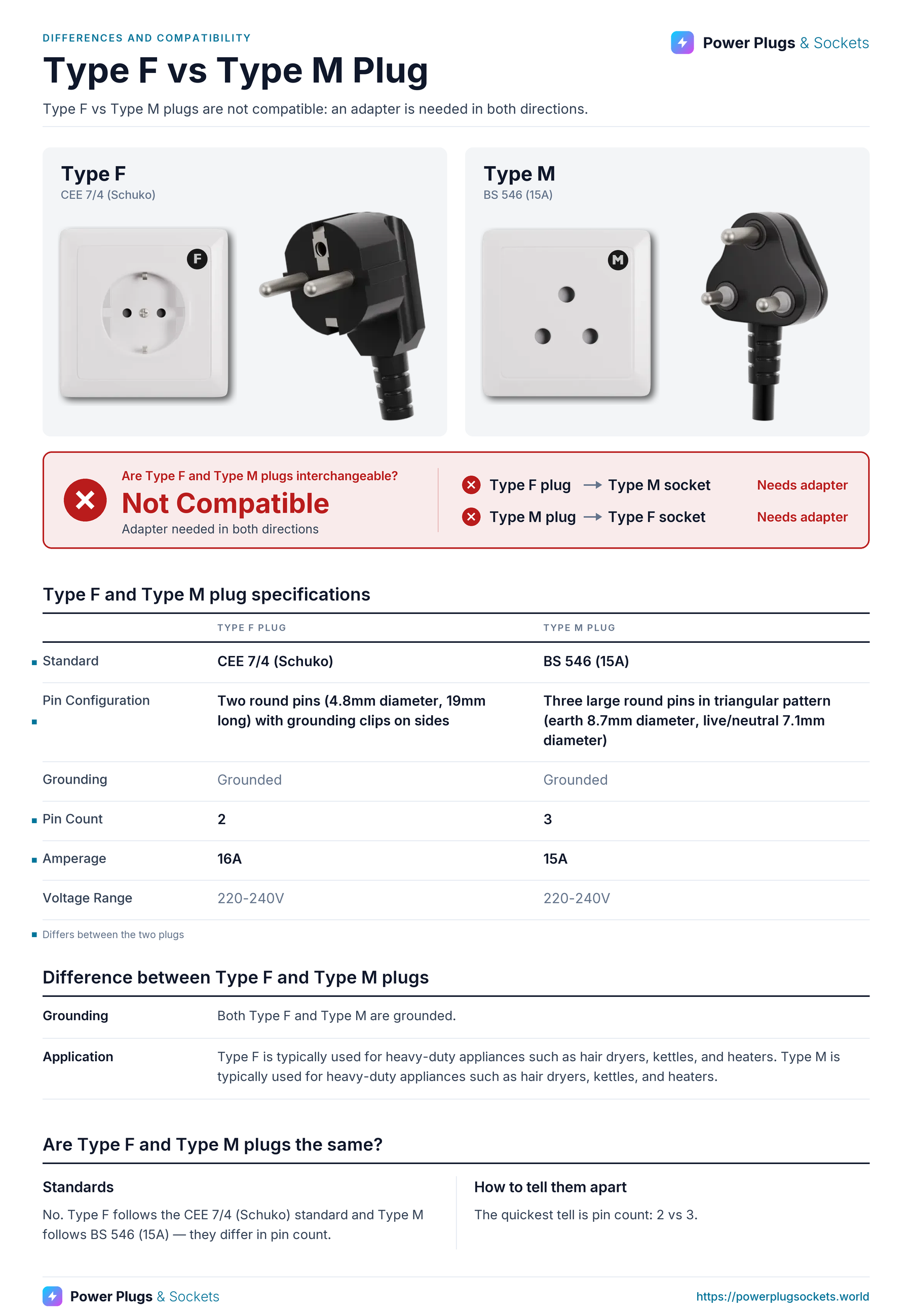
Type F vs Type M plugs are not compatible: an adapter is needed in both directions. Type F is a 2-pin, grounded plug rated 16A at 220-240V, while Type M is a 3-pin, grounded plug rated 15A at 220-240V. The two differ mainly in amperage and pin design, which is what decides compatibility — whether a Type F plug fits a Type M socket, and vice versa. You might also want is a type D plug compatible with a type O socket.
Swipe to compare
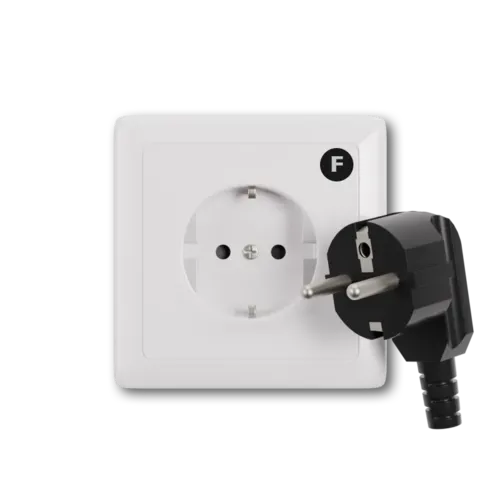
Type F
|
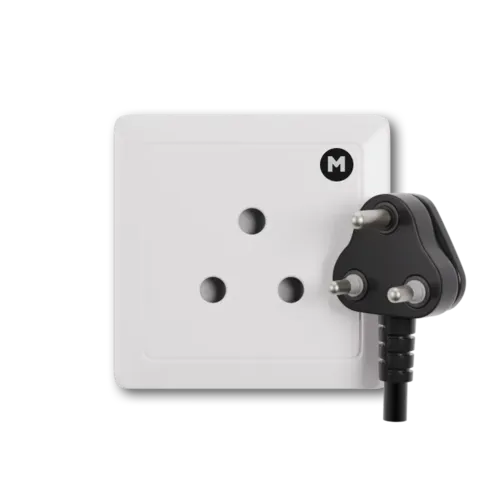
Type M
|
|
|---|---|---|
| Standard | CEE 7/4 (Schuko) | BS 546 (15A) |
| Pin Configuration | Two round pins (4.8mm diameter, 19mm long) with grounding clips on sides | Three large round pins in triangular pattern (earth 8.7mm diameter, live/neutral 7.1mm diameter) |
| Grounding | Grounded | Grounded |
| Pin Count | 2 | 3 |
| Amperage | 16A | 15A |
| Voltage Range | 220-240V | 220-240V |
Flying from Frankfurt to Cape Town with a German kettle in your bag? The type F vs type M plug question decides whether it reaches the wall: the round two-pin Schuko and the chunky three-pin South African plug share the same 230 V domestic electricity, but not a single matching hole, so you need a plug adapter before you travel abroad.
Type F vs Type M Plug at a Glance
Both of these power plugs and power sockets run on 220 – 240 V and 50 Hz, both are grounded, and both are rated around 16 A. The type F plug is a German design with two round pins and earth contacts on its sides. The type M plug is a British design from the 1930s with three round pins in a triangle, the top one a thick earth pin. For a related pairing, see which countries use type H plugs versus type M plugs.
Each is built to a separate national standard, and the socket outlet on each side is shaped around its own plug.
| Feature | Type F (Schuko) | Outlet type M (BS 546 / SANS 164-1) |
|---|---|---|
| Pins | Two round pins, 4.8 mm thick | Three round pins in a triangle |
| Pin spacing | 19 mm between live and neutral | 25.4 mm between live and neutral |
| Earth connection | Two earthing clips in the socket | Large earth pin on the plug |
| Rated current | 16 A | 15 A (16 A in South Africa) |
| Voltage and frequency | 220 – 240 V, 50 Hz | 220 – 240 V, 50 Hz |
| Polarity | Not polarized | Polarized |
| Socket also accepts | Type C and type E plugs | Only type M plugs |
| Main region | Continental Europe and Russia | South Africa and nearby countries |
Countries That Use Schuko Sockets
You will find type F outlets, or hybrids that also take type E plugs, in Germany, Austria, the Netherlands, Sweden, Norway, Finland, Spain, Portugal, Turkey, Greece, Eastern Europe, Russia and South Korea; one adapter covers the whole country. France, Belgium and Poland use the related type E socket, while the UK uses type G.
Countries That Use the Large Three-Pin Plug
The IEC counts about 15 countries that use type M plugs: South Africa, where plug type M is still the most common wall socket, Lesotho, Swaziland (now Eswatini), Namibia, Mozambique, Botswana, and India, Pakistan and Sri Lanka for heavy appliances such as geysers.
Schuko (CEE 7/4) and How Its Two-Pin Earthing Works
Schuko is short for Schutzkontakt, German for "protective contact". Patented by Siemens-Schuckertwerke in 1929, the plug is CEE 7/4 and the socket CEE 7/3, with 4.8 mm pins on 19 mm centres. Also see how do i tell a type C plug apart from a type D plug.
The Schuko system carries 16 A at up to 250 V, and the earthing is done by the Schuko socket, not by a third pin. The plug is symmetrical and so unpolarized, and France and Belgium's type E socket needs the CEE 7/7 hybrid plug, which works in both socket types.
Grounding Clips and the Circular Recess
Every CEE 7/3 socket has a circular recess about 17 mm deep, so fingers cannot touch live pins. Two spring-metal grounding clips press against strips on the plug body, and notches guide it in, so the appliance is earthed first and disconnected last.
Many newer sockets add shutters as child protection.
BS 546 and the Large Three-Pin Triangle
BS 546 is a British standard from 1934 for round-pin plugs rated 2 A, 5 A, 15 A and 30 A; the 15 A size is the type M plug, with live and neutral 25.4 mm apart and a thicker earth pin on top. The much larger pins mean pin diameter alone makes cross-fitting impossible.
The design is polarized and has no fuse in the plug, so protection comes from the breaker in the distribution board.
Type D, the Smaller Sibling
The 5 A member of the family is type D, the standard socket in India, with thinner pins, so a type M plug will not enter it.
SANS 164-1 in South Africa and Its Neighbours
South Africa's national standard for the 15 A plug is SANS 164-1, rated at 16 A.
SANS 164-2 and the Move to Type N
Since 2013 the preferred standard has been SANS 164-2, the IEC 60906-1 design known as type N, with shutters on the live contacts. New buildings fit combination plates with one large three-pin socket and smaller sockets that take the Europlug, so the old triangle will be around for years.
Round Pins Compared: Schuko Plug Against the 15 A Plug
Both plugs use round pins, but they are physically incompatible: a 4.8 mm pin could slide into a 7 mm hole, but a 19 mm gap cannot line up with holes 25.4 mm apart. The current rating differs by one amp: at 230 V, 16 A works out to 3,680 W and 15 A to 3,450 W. Both plugs are grounded, the Schuko through socket clips and BS 546 through a dedicated earth pin, so a fault sends current to ground and the risk of electric shock stays low.
Problems only start when an adapter is rated lower than the plug it carries, which can overload it.
Compatibility Between Schuko and SANS 164-1 Sockets
There is no direct compatibility in either direction. A Schuko socket accepts type C, type E and type F plugs, but not the South African triangle, and a large three-pin outlet accepts only its own plug.
Forcing a plug leaves the appliance ungrounded and is a real safety risk.
Plugging a Type F Appliance into a Johannesburg Wall
A German appliance needs an adapter with a Schuko face, with earth clips, on one side and three large prongs on the other. Check that the clips are wired to the earth pin, since some budget models leave them unconnected.
In a room with a newer SANS 164-2 plate, a two-pin Europlug charger may fit directly.
Using a Type M Plug in Europe
A South African type M plug will not enter a German socket. Use an adapter with a three-pin South African socket on top and a CEE 7/7 plug underneath, which works in German and French outlets alike and keeps the appliance grounded.
Where the Europlug Fits In
The flat two-pin Europlug (type C) fits every Schuko socket and the new SANS 164-2 outlets, but not old large three-pin outlets on their own. It is rated only 2.5 A and not grounded, so it suits small electronics, not kettles or heaters.
Choosing a Travel Adapter for Schutzkontakt and Three-Pin Outlets
A single-purpose travel adapter made for the exact pair, a Schuko or CEE 7/7 socket to a South African three-pin plug, is usually the better buy. A bulky universal adapter often lacks a proper earth contact for European plugs and is rated as low as 6 A. Any travel adaptor needs a clear rating label and a tested standard, since adaptors between national plugs and sockets have no IEC standard of their own.
Multisocket adaptors and extension cords add up the load: two 2,000 W appliances on one 16 A outlet ask for about 17.4 A, so plug the adapter straight into the wall.
Do You Need a Voltage Converter?
No. Both systems supply mains electricity at 230 volts and 50 Hz, so a voltage converter is needed only for 120 V equipment from North America or Japan that is not dual voltage; "100-240 V" on a charger means it handles any of these grids.
Class I and Class II Appliances
Class I devices have metal parts and rely on the earth, so a German kettle needs an adapter that joins the Schuko clips to the thick top prong of the South African plug. Class II devices use double insulation, marked with a double-square symbol, and come with two-pin plugs, so they can go into a SANS 164-2 socket directly.