Type E vs Type I Plugs: Differences & Compatibility
Type E vs Type I plugs are not compatible: an adapter is needed in both directions. Type E is a 2-pin, grounded plug rated 16A at 220-240V, while Type I is a 3-pin, grounded plug rated 10A at 220-240V. The two differ mainly in amperage and pin design, which is what decides compatibility — whether a Type E plug fits a Type I socket, and vice versa. You might also want type I versus type J plug shape and socket design compared.
Swipe to compare
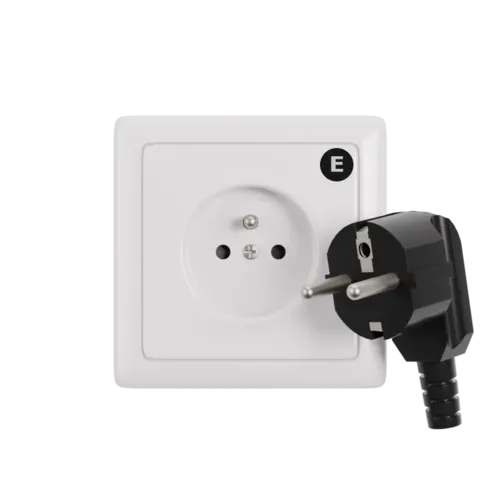
Type E
|
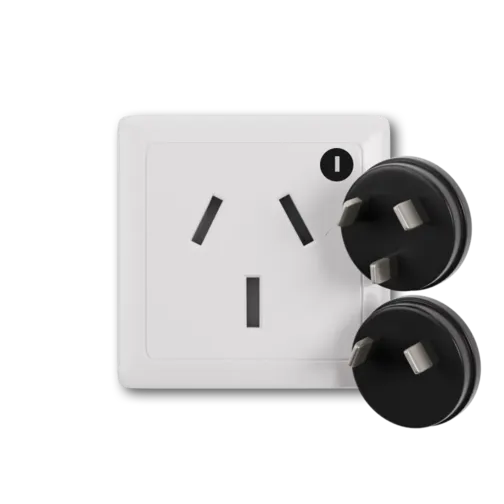
Type I
|
|
|---|---|---|
| Standard | CEE 7/5 | AS/NZS 3112 |
| Pin Configuration | Two round pins (4.8mm diameter) plus hole for socket grounding pin | Two angled flat pins (8mm long, 6.5mm wide, 30 degree angle) plus vertical grounding pin |
| Grounding | Grounded | Grounded |
| Pin Count | 2 | 3 |
| Amperage | 16A | 10A |
| Voltage Range | 220-240V | 220-240V |
Heading from Lyon to Melbourne, or shipping one appliance to both markets, comes down to one question: will your plug go in? This type E vs type I plug comparison sets the round two-pin socket of France, Belgium, Poland, Slovakia and the Czech Republic beside the angled flat-pin system used from Sydney to Shanghai and Buenos Aires: the two power plugs never fit each other and you always need a plug adapter.
Both run on 220-240 V electricity at 50 Hz, so the adapter is usually the only extra.
Type E vs Type I Plug at a Glance
Both designs carry mains power with a protective earth, in opposite ways: the French and Belgian system puts the earth pin on the socket, while the Oceania system puts all three pins on the plug. The International Electrotechnical Commission (IEC) gives each family of plugs and sockets a letter, but it is not a single national standard.
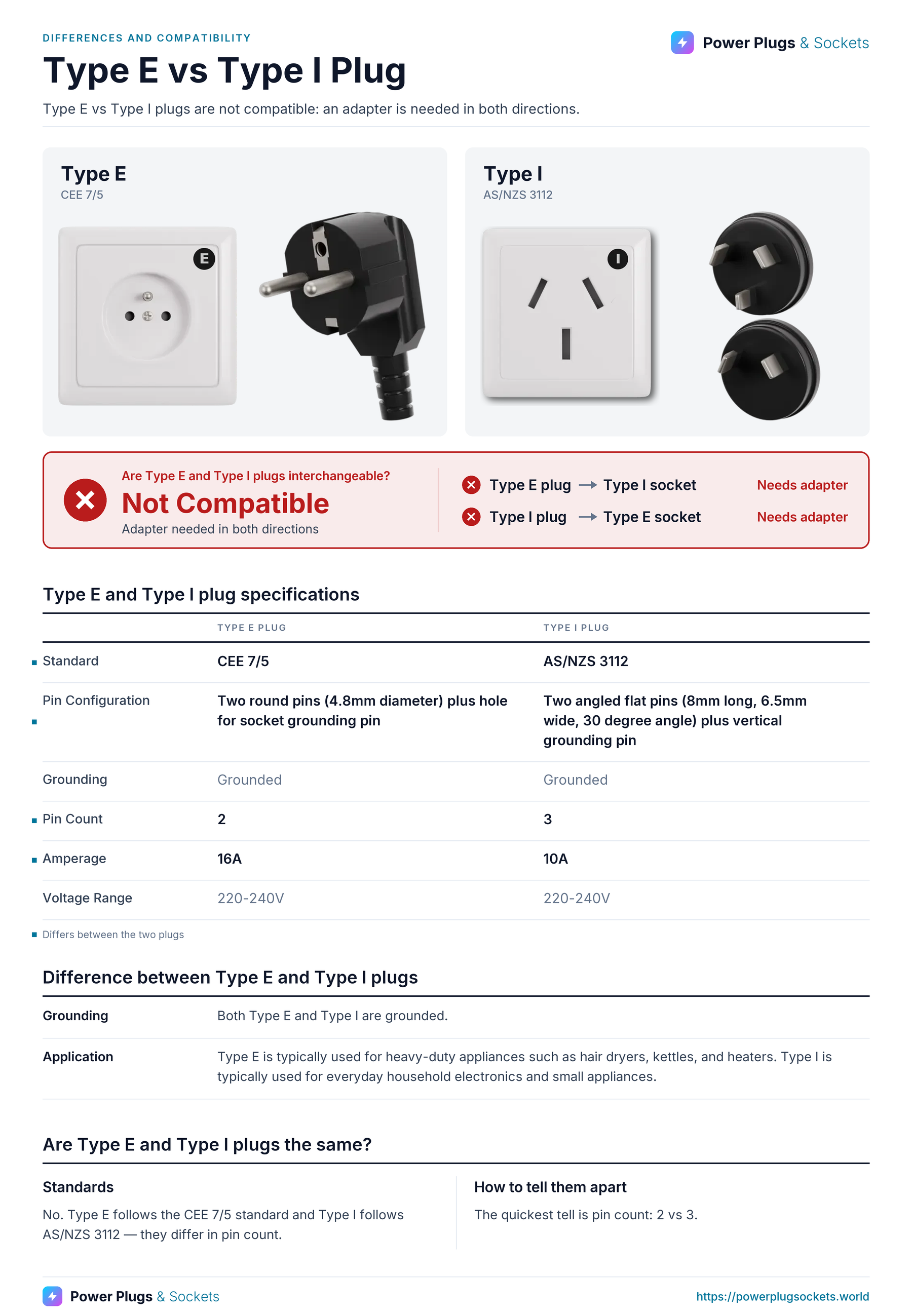
| Feature | Letter E (CEE 7/5 socket, CEE 7/6 plug) | Letter I (flat-pin family) |
|---|---|---|
| Plug pins | Two round pins, 4.8 by 19 mm | Two flat power pins at an angle plus a flat earth blade |
| Earth connection | Pin fixed in the socket, hole in the plug | Blade on the plug, slot in the socket |
| Rated current | 16 A | 10 A standard, with 15, 20, 25 and 32 A versions |
| Supply voltage | 230 V, 50 Hz | 230 V in Sydney and Auckland, 220 V in Beijing and Buenos Aires, 50 Hz |
| Grounded | Yes | Yes, plus an unearthed two-blade version |
| Polarized | Partially | Yes |
| Recessed socket | Yes, 15 mm deep | No, flush face |
| Accepts the Europlug | Yes | No |
| Electrical standard | NF C 61-314, NBN C 61-112, ČSN 35 4516 | AS/NZS 3112, GB 1002 and GB 2099.1, IRAM 2071 |
Nothing about the two shapes overlaps: a round pin cannot enter a flat slot, so there is no "it sort of fits" case.
Pin Shape: Round Pins Against Flat Pins
The French plug uses two round pins 19 mm apart, while the other system uses blade-style flat pins angled toward each other with the earth blade beneath.
Countries That Use Each Standard
The power outlet type E countries in Europe include France, Belgium, Poland, Tunisia and Morocco. The power outlet type I countries are Australia, New Zealand, Fiji, Tonga, Solomon Islands, Papua New Guinea (South Pacific), China and Argentina; Brazil has an Argentine-style 20 A socket.
Voltage and frequency match, but the current rating differs: 16 amps against 10 A, roughly 3,680 W against 2,300 W, so a 2,400 W fan heater is over the limit of a standard 10 A outlet.
How the CEE 7/5 Socket Works
The French and Belgian connector is the CEE 7/5 socket with the CEE 7/6 plug. Each type E socket, or type E outlet, has a round recess, two round holes and a round earth pin sticking out of the socket itself. Next, check what adapter converts a type G plug to a type H socket.
The earth pin is 14 mm long and offset 10 mm from the line between the power holes. It engages before any live contact, so the earth contact is made first and broken last, which is the point of an earthing pin.
Female Contact and Grounding Hole on the Plug
The plug needs a female contact to receive it: the grounding hole sits between and slightly above the power pins. Turn the plug upside down and the hole no longer lines up, so it goes in one way only.
The socket is recessed by 15 mm, so a partially inserted plug is no shock hazard. The 4.8 mm pins and other pin dimensions are fixed, a plain type E plug fits one way, and the polarised fit does not guarantee which hole is live.
The socket likely came from Belgium's Vynckier and was never patented. Schuko belonged to Siemens and required royalties.
The Hybrid E/F Plug and Schuko Compatibility
The hybrid E/F plug, CEE 7/7, carries both earthing systems, so modern type E plugs and plugs from Germany are compatible. It is rated 16 A and fits type E sockets and German sockets, but not a single flat-pin outlet.
Industrial IEC 60309 power sockets take heavier loads.
Earthing Clips, Plastic Notches and the Type F Socket
The German type F socket has no earth pin, only two metal earthing clips. The hybrid plug carries matching grounding clips plus a hole for the French pin, and plastic notches let it pass the guide ribs in a German socket.
Where the Europlug and Type C Fit
The two-pin Europlug, the flat unearthed type C plug on phone chargers and shavers, fits the French socket because its thin pins match the 19 mm spacing. Flat-pin outlets accept no Europlug, so travellers with a type C charger need an adapter in Sydney.
Only loosely. The earth pin forces one orientation in a French socket, but in a German socket the plug fits either way, so no appliance can rely on polarity.
The flat-pin plug is fully polarized, with the live blade on the left when the earth points down.
Inside the Australasian Standard
The flat-pin family is shared by Australia, New Zealand and Pacific neighbours under one joint standard, with related standards in China and Argentina, so type I plugs from these markets generally fit each other's outlets. Each socket outlet takes two power pins and one earth blade, and most Australian outlets have a wall switch.
Grounding Pin and Inverted V-Shape Geometry
The two live blades form an inverted V-shape, each set at 30° to the vertical. The flat grounding pin below is longer (19.94 mm against 17.06 mm) so the earth connects first, giving earth ground protection.
Why Higher-Rated Sockets Are One-Way Compatible
The ladder runs 10 A, 15 A, 20 A, 25 A and 32 A, and the sockets are one-way compatible: a 10 A plug fits every outlet, but a 15 A plug will not enter a 10 A socket. Because the socket face is flat, these plugs need insulated pins with insulating sleeves.
New Zealand also allows tap-on piggy-back plugs.
China's Version and Ungrounded Two-Pin Plugs
The Chinese GB plug has slightly longer pins and sleeves are optional. Argentina's Argentine plug under IRAM 2073 swaps live and neutral.
Every market also uses an ungrounded two-blade plug for Class II appliances, which rely on double insulation; Class I appliances need the earth.
Travel Adapter Advice for AS/NZS 3112 and CEE 7/7 Outlets
Any trip between the regions needs a travel adapter. Pick one with a grounded earth path for earthed appliances, because an unearthed adapter removes the protection your plug and socket were designed to give. Also see comparing type A and type C plugs for international travel.
A dual voltage label of 100-240 V means a wall socket needs nothing else.
Plug Adapter vs Voltage Converter
An adapter changes only the shape of the plug; a voltage converter is needed only for 110-120 V devices. Between these regions the supply already matches, so most chargers work with the right travel adapters.
For safety, a hotel universal socket is not covered by any national standard and can leave live pins exposed or run an appliance unearthed. A dual socket and multisocket adaptors with shutters carry one total rating, so never stack adaptors, to avoid an electric shock or a melted plug.
For electronics, use one adapter feeding a power strip, and power cord rated for the current you draw. A 10 A strip from Sydney on a 16 A French circuit is the case to watch, since the breaker trips only well past what the extension cords can carry.