Type G vs Type H Plugs: Differences & Compatibility
Type G vs Type H plugs are not compatible: an adapter is needed in both directions. Type G is a 3-pin, grounded plug rated 13A at 220-240V, while Type H is a 3-pin, grounded plug rated 16A at 220-240V. The two differ mainly in amperage and pin design, which is what decides compatibility — whether a Type G plug fits a Type H socket, and vice versa. You might also want which countries use type A plugs versus type C plugs.
Swipe to compare
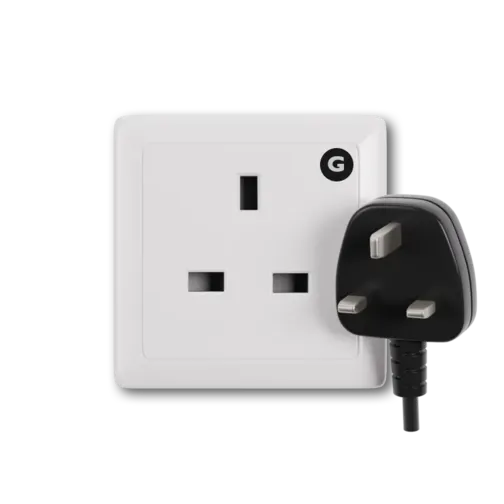
Type G
|
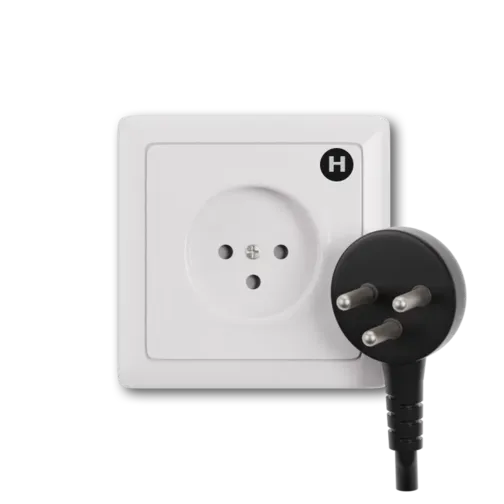
Type H
|
|
|---|---|---|
| Standard | BS 1363 | SI 32 |
| Pin Configuration | Three rectangular pins in triangular pattern (live/neutral 6.35x3.18mm, earth 3.18x7.92mm) | Three pins in V-shape arrangement (round 4.5mm or flat pins, 19mm length) |
| Grounding | Grounded | Grounded |
| Pin Count | 3 | 3 |
| Amperage | 13A | 16A |
| Voltage Range | 220-240V | 220-240V |
Packing for a trip between London and Tel Aviv raises the type G vs type H plug question. Of the 15 different kinds of domestic plug the world uses, these two look nothing alike, yet they share the same mains electricity.
This page gives a side-by-side breakdown of pins, ratings, safety features and which plugs fit which power sockets.
Type G vs Type H Plug: Comparing Two Plug Types Side by Side
They are labels, not electrical standards. The letters come from the US International Trade Administration and are used by the IEC (International Electrotechnical Commission) on its World Plugs reference.
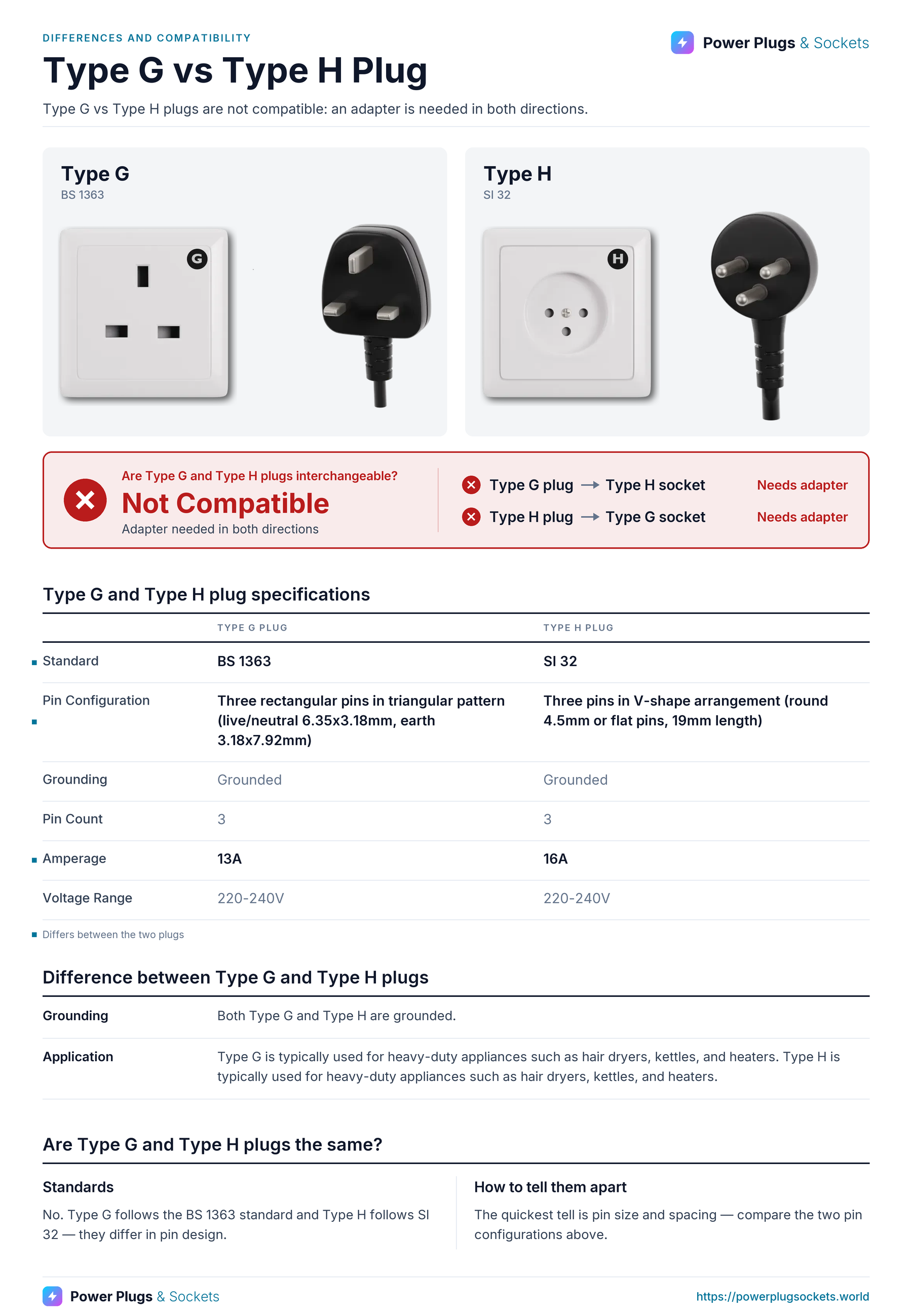
Each points to a national standard: BS 1363 for the British three-pin design, SI 32 (SI32) for the Israeli one.
| Feature | Type G (British) | Type H (Israeli) |
|---|---|---|
| Governing standard | BS 1363 | SI 32 |
| Pin shape | Rectangular blades | Round 4.5 mm pins (flat on pre-1989 plugs) |
| Plug current rating | 13 A maximum | 16 A |
| Fuse in the plug | Yes, always | No |
| Socket shutters | Required | Not a defining feature |
| Supply voltage | 230 V nominal (220-240 V) | 230 V nominal (220-240 V) |
| Plugs the socket accepts | Type G only | Type H and Type C (Europlug) |
| Main regions | UK, Ireland, Malta, Cyprus, Singapore, Hong Kong, Arabian Peninsula | Israel, Gaza Strip, West Bank |
The electricity is the same but the hardware is not, and neither is the electrical standards behind each: a type G electrical plug will not enter an Israeli receptacle, and an Israeli plug will not enter a British one.
What Is a Type G Plug? The BS 1363 Standard
The type G plug is of British origin, defined by BS 1363 and first published in 1947. It is widely known as the 13-amp plug, and BS 7671 wiring regulations treat it as the standard socket-outlet; British sockets are shuttered.
Three Rectangular Pins and a Longer Earth Pin
The plug has three rectangular pins in an isosceles triangle; the socket has three rectangular holes. The top earth pin, formally the circuit protective conductor, is larger and longer, so it makes contact first.
The bottom pair carries live on the right and neutral on the left. Since 1984 the live and neutral pins have carried insulating sleeves.
The integrated fuse, typically 3 A, 5 A or 13 A, protects the flexible cord, and shutters in the socket open only when the earth pin enters, giving child protection.
What Is the Israeli Plug? The SI 32 Standard
The Israeli plug is defined by SI 32, published by the Standards Institution of Israel. Type H is unique to Israel and Palestine, and modern Israeli sockets accept both generations of plug.
Flat Pins, Round Pins and the 1989 Revision
The original design used three flat pins in a Y, with live and neutral 19 mm apart. The 1989 revision switched to three round pins of 4.5 mm in the same positions.
Sockets made after the change accept old and new plugs and the Europlug, while pre-1989 sockets that accept only flat pins turn up in older buildings.
The Y-Shape and V-Shaped Pin Layout
Seen from the front, live and neutral form a V-shaped pair at the top, with the ground pin below at the point of the Y. The plug is rated at 16 A and each receptacle is polarized.
Voltage and Frequency: Type G Electrical Outlet vs Israeli Sockets
Here the two systems agree: a type G electrical outlet in Manchester and an Israeli receptacle in Haifa both deliver 230 V nominal at 50 Hz, so the difference is purely mechanical.
13 A vs 16 A: What the Current Rating Means for You
The current rating is the one electrical difference: a British plug is limited to 13 A, about 3,000 W at 230 V, an Israeli plug is rated 16 A, about 3,680 W. A 16 A Israeli appliance in a 13 A British outlet through an adapter can draw more than the socket expects, so a fused adapter helps. A Europlug in an Israeli socket is still limited to 2.5 A.
Both Run at 220-240 V and 50 Hz
Both grids alternate at the same rate, in hertz (cycles per second), so a UK appliance runs unchanged in Israel and vice versa. Devices from 60 Hz regions run slower; an adapter changes only the plug shape.
Which Plugs Are Compatible With a Type G Socket and an Israeli Outlet?
A type G socket accepts only type G plugs; its shutters reject everything else. A Type H socket takes type H plugs and the Europlug (plug type C), and gives only partial, unsafe compatibility with 16 A Schuko plugs (Type E and Type F). Also see type H versus type M plug shape and socket design compared.
Why a Europlug Fits the Israeli Socket but Not the British One
The Europlug, CEE 7/16 and Type C, has two round pins that are not grounded 19 mm apart with insulating sleeves. The Israeli socket uses the same spacing, so type C plugs slide in, within the Europlug's 2.5 A. A British socket has no round holes and its shutters stay closed without an earth pin.
Schuko and Type E: Unsafe Compatibility With Israeli Sockets
The German Schuko plug (Type F) and the French Type E have thicker 4.8 mm pins on the same spacing and can sometimes be forced in, but this is unsafe compatibility: Schuko's side-clip earth (Schutzkontakt, protection contact) has nothing to meet in a type H socket, so the appliance runs unearthed.
Never Force the Shutters With a Screwdriver
Opening shutters with a pointy object to insert a two-pin plug exposes live contacts.
Countries Using the Type G Electric Plug and Israeli Plugs
For appliances in Europe or beyond, the British type G electric plug spread with the British Empire; the Israeli design stayed home.
Where the British Three-Pin Design Is Standard
Type G plugs are used in the United Kingdom, Ireland, Malta, Cyprus, Malaysia, Singapore, Hong Kong, Macau, Brunei, Sri Lanka, the Arabian Peninsula (Saudi Arabia, the United Arab Emirates, Qatar, Bahrain, Kuwait, Oman), Kenya, Uganda, Tanzania, Ghana, Nigeria, Grenada and St. Lucia.
Where Type H Is Used: Israel, the Gaza Strip and the West Bank
Type H appears only in Israel, the Gaza Strip and the West Bank, with Type C among its socket types; a type H electrical outlet exists nowhere else.
Choosing a Travel Adapter or Voltage Converter for Type G Outlets
For any electrical socket, both systems run at 230 V and 50 Hz, so a travel adapter is all you need; a voltage converter isn't. A type G outlet, type G receptacle or type G electric outlet only takes a British plug.
One Adapter Plug for Trips Between London and Tel Aviv
Coming to the UK, you need a type G adapter plug with three rectangular pins, preferably with a built-in fuse, since Israeli plugs have none. Going the other way, a type G plug adaptor to the Israeli layout keeps the earth connection; a cheaper travel adaptor to a Europlug leaves the appliance ungrounded.
When You Need a Converter, Not Just a Plug Adapter
Between British and Israeli sockets you never need a converter. A step-down transformer matters only for a US or Japanese device rated 100-127 V; most chargers are rated 100-240 V.
Earthed, Fused and Polarized: British Plug and SI32 Safety
Both designs are earthed and polarized. Earthing gives fault current a path to ground; the IEC classes an appliance relying on it as Class I, and a double-insulated one with an unearthed plug as Class II. Also see what are the differences between a type E and a type I plug.
The British design adds a plug fuse and shutters, while the Israeli design relies on circuit breakers and residual-current devices.