Type H vs Type M Plugs: Differences & Compatibility
Type H vs Type M plugs are not compatible: an adapter is needed in both directions. Type H is a 3-pin, grounded plug rated 16A at 220-240V, while Type M is a 3-pin, grounded plug rated 15A at 220-240V. The two differ mainly in amperage and pin design, which is what decides compatibility — whether a Type H plug fits a Type M socket, and vice versa. Next, check how do i tell a type G plug apart from a type H plug.
Swipe to compare
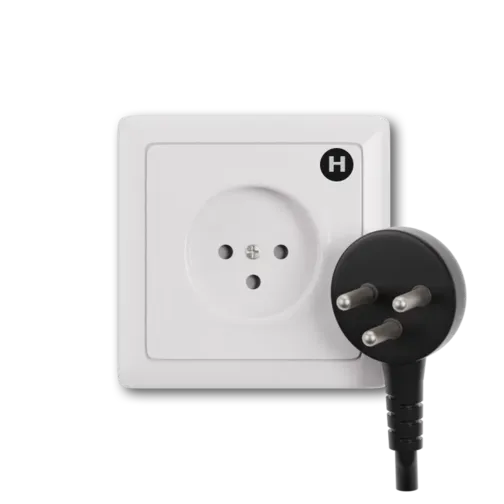
Type H
|
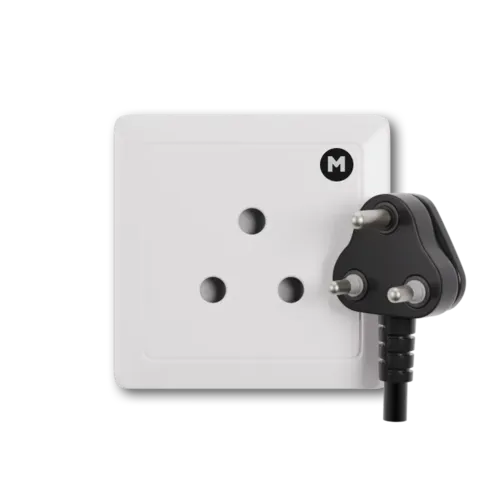
Type M
|
|
|---|---|---|
| Standard | SI 32 | BS 546 (15A) |
| Pin Configuration | Three pins in V-shape arrangement (round 4.5mm or flat pins, 19mm length) | Three large round pins in triangular pattern (earth 8.7mm diameter, live/neutral 7.1mm diameter) |
| Grounding | Grounded | Grounded |
| Pin Count | 3 | 3 |
| Amperage | 16A | 15A |
| Voltage Range | 220-240V | 220-240V |
Packing for a trip that takes in both Tel Aviv and Johannesburg? The type H vs type M plug question matters because each country's wall outlet has three holes, yet neither plug fits the other's socket, so you need a separate plug adapter for each leg of your travel.
Israel uses type H, South Africa uses type M, and the two share only a voltage, not a shape.
Type H vs Type M Plug at a Glance
Both plug types are grounded designs with 3 pins in a rough triangle, and both run on 220 – 240 V at 50 Hz. That is where the likeness ends. Also see do you need a type C to type D plug adapter.
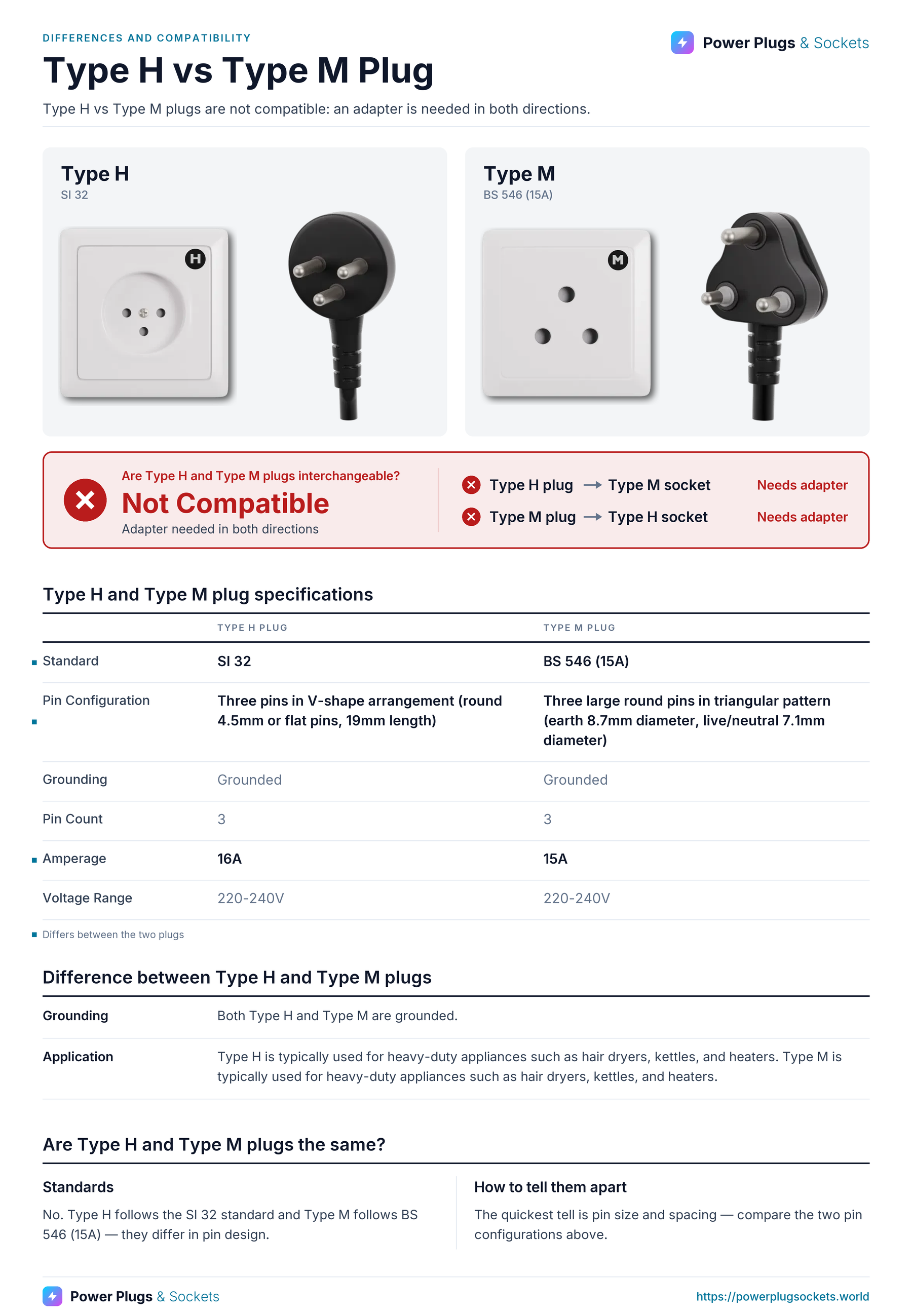
The table sets each outlet style side by side so you can see the differences in pin shape, rating and socket fit before you travel.
| Feature | Type H outlet style | Type M outlet style |
|---|---|---|
| Pins | 3 pins, thin, in a Y-shaped configuration | 3 pins, thick round prongs in a triangle |
| Earthing | Grounded | Grounded |
| Rating | 16 A | 16 A (15 A in the original British design) |
| Voltage | 220 – 240 V | 220 – 240 V |
| Main countries | Israel, Palestine | South Africa, Lesotho, Eswatini, Botswana, Namibia |
| Socket compatible with | Type H and type C plugs | Outlet type M plugs only |
| National standard | SI 32 | SANS 164-1 (from BS 546) |
Read the last two rows first if you are packing chargers: a European two-pin plug is compatible with an Israeli socket and goes straight in, but it will not fit a type M socket, so you need an adapter in South Africa.
The Israeli Outlet Style and Its V Shape
The type H plug is used almost nowhere outside Israel and the Palestinian territories. A power outlet type H has its live and neutral holes angled into a V shape, with the earth hole set below them.
From Flat Prongs to Round Pins
The original design carried two flat prongs for live and neutral plus a flat earth blade, all three flat prongs angled rather than parallel. In 1989 Israel changed the standard to round pins about 4 mm thick, and widened the socket holes so they accept both versions.
You will still find older appliances with the flat blades in Israeli homes, and a current socket takes them without trouble.
Where Type H Sockets Are Used
A type H socket is the normal wall fitting in Israel, the West Bank and the Gaza Strip. No other country in the Middle East uses it as a national standard; Jordan and Lebanon next door use different sockets, so a type H adapter is no help once you cross the border.
Europlug and Type C Fit; Type E and Type F Only Partly
Because the round-pin holes sit 19 mm apart, a type C plug with two round pins, whether a 2.5 A Europlug or a 10 A lamp plug, slots in directly, and most hotel rooms rely on this. The type C plug is the one you will most often see plugged into Israeli walls.
Plugs of type E and type F (the German Schuko, with earth clips on the sides, or the French plug that takes a grounding knob from the socket) have the same two pins but a thicker body, so they only fit an Israeli socket with partial and unsafe compatibility: they may go in, but the earth is not connected. Type H shares this half-fit with Thailand's type O socket, but none of it applies to type M, which rejects E and F plugs outright.
If your laptop charger is a Schuko design, use a proper adapter rather than forcing it.
The South African Plug Style and Its Three Round Prongs
The South African plug style is one of the largest domestic plugs still in everyday use: three round prongs, thick enough that a type M plug looks oversized next to most chargers. A power outlet type M is common in older buildings and still standard on many new ones.
Earth Pin on Top of a Triangle
The earth pin sits at the top of the triangle, and it is both thicker (about 8.7 mm) and longer than the live and neutral pins below it. Being longer, it enters first and, in shuttered sockets, opens the live and neutral holes.
That is the reverse of the Israeli plug, where the earth sits below the other two pins.
Type M vs Type D: Same Triangular Pattern, Bigger Pins
Both come from the old British BS 546 family, the system the UK used before it moved to the flat-pin type G. Type D is rated at 5 amps and type M at 15 amps, so they share a triangular pattern but differ in size: the live and neutral pins of a type M plug are roughly 7 mm thick, against about 5 mm on type D, and are spaced about 25 mm apart instead of 19 mm. Neither fits the other's socket.
Namibia uses both, and some sockets there accept either.
Used for Larger Appliances in India and Nearby Countries
In India, Nepal and Sri Lanka, type D handles everyday 6 A loads while plug type M is reserved for larger appliances such as air conditioners, water heaters and refrigerators. Heavy appliances draw more current, so the thicker pins handle up to 16 A instead of type D's 6 A.
Type N Is Replacing It in New South African Homes
Since 2018, new South African installations must include the slimmer type N socket (SANS 164-2), which also accepts the Europlug. Older homes and many hotels still have type M, so you may meet both in one building.
Lesotho and Swaziland (now Eswatini) still use type M as their main standard, and Mozambique uses it alongside type C and type F. Across southern Africa, carry an adapter for type M even if your hotel says it has "modern" sockets.
Plug Shapes Compared: Pin Size, Grounding and Safety
Put the two plug types next to each other and the gap in size is obvious: these plug shapes are not compatible with each other's sockets. These are the physical differences that decide whether pins line up. Also see should you choose type F or type M for an international travel adapter.
Pin Size and Spacing
- Type H plugs (SI 32): round pins about 4 mm thick, live and neutral 19 mm apart.
- Type M plugs (SANS 164-1): live and neutral about 7 mm thick and 25 mm apart; earth about 8.7 mm.
- Both use three prongs, but a type M pin is wider than a type H socket hole, so it cannot enter.
- A type H plug is socket compatible with nothing in South Africa except through an adapter.
Where the Grounding Pin Sits
On type H the grounding pin sits below the live and neutral; on type M it sits above them and is longer. The wall plug in each country is built around that position, so even the earth alone makes the two impossible to swap.
Both rely on grounding for appliances with metal cases, so never cut off or bend an earth pin to make a fit.
Insulated Sleeves and Electrocution Risk
Older type H plugs, and many older type M plugs, have bare metal pins with no insulation. If the plug is half pulled out, live metal is exposed, so there is a small risk of electrocution if your fingers touch the pins.
Newer plugs of both types usually have insulated sleeves on the live and neutral pins. For safety, push either plug fully home so no bare pin is left carrying electricity.
Which Travel Adapter Fits These Outlet Types?
The two outlet types need different adapters. A type H travel adapter is small and cheap, and a Europlug adapter often does the same job.
Type M is harder: you will need adapters made for South Africa specifically.
Why Universal Adapters Skip the South African Socket
Most worldwide travel adapters leave out type M because its pins are too thick and too far apart to fold into a compact box. A universal adapter that lists "150 countries" will usually cover Israel but not South Africa.
If you are traveling to both, pack a single type M adapter plug for the South African leg and use the universal one, or a plain Europlug, in Israel. Devices such as a mobile phone, tablet or laptop charger with a Europlug will work in either country once the adapter is in place, since these electronics accept 100 – 240 V.
Do You Need a Voltage Converter at 220 – 240 V?
Both countries supply 230 V at a frequency of 50 Hz, so the voltage is the same. If you come from Europe, you need no voltage converter at all.
If you come from North America, check the label on each device: most travel chargers read 100 – 240 V and only need an adapter, but a single-voltage 120 V hair dryer or straightener needs a converter, or it may burn out on the first use.
Why Plug Types Differ Between Israel and South Africa
Each country chose its plug long before people started to travel with chargers. South Africa inherited the British round-pin system in the early 20th century and kept the 15 A size after Britain moved on.
Israel wrote its own standard, then changed it in 1989 so that the round-pin plug types from Europe would fit. The result is two grounded, three-pin systems on the same 230 V supply that cannot accept each other's plugs.
One adapter for each country solves the problem.